The problem? There are too many options and not enough clarity. Hydrogen, biodiesel, propane, ammonia, e-fuels: which ones actually work today, and which are still a decade away?
Data centers alone consumed 176 TWh, or 4.4% of U.S. electricity, in 2023, with projections reaching 325-580 TWh by 2028, according to a DOE report on data center electricity demand. That surge is reshaping which fuels matter most.
This guide breaks down what alternative fuels are, the seven most common types in use today, and where natural gas fits into the broader energy transition.
Key Takeaways
- Alternative fuels replace gasoline, diesel, and heavy fuel oil across multiple energy sources
- Biofuels, natural gas, propane, hydrogen, electricity, ammonia, and e-fuels lead today's alternative fuel market
- U.S. law (EPA) defines alternative fuels to include hydrogen, natural gas, propane, alcohols, biodiesel, and electricity
- Natural gas and NGLs offer the most scalable, infrastructure-ready option today
- Each fuel type balances cost, energy density, infrastructure, and emissions differently
What Are Alternative Fuels?
Under U.S. law (42 USC 13211, from the Energy Policy Act of 1992), alternative fuels include:
- Methanol and other alcohols
- Natural gas and its liquid derivatives
- Propane
- Hydrogen
- Coal-derived liquids
- Biologically derived fuels
- Electricity
The EU and Canada define the category similarly, focusing on fuels that substitute for petroleum and support decarbonization.
The motivation behind all of this comes down to three things:
- Reducing greenhouse gas emissions from the transportation sector
- Improving energy security by diversifying away from imported oil
- Cutting local air pollution tied to conventional combustion
Meeting these goals requires different levels of vehicle compatibility. Some alternative fuels are drop-in replacements, meaning they blend directly into existing fuel systems with no engine modifications. Others, like hydrogen or dedicated propane systems, require converted or purpose-built vehicles.
Here's the urgency in numbers: petroleum supplied about 89% of U.S. transportation-sector energy in 2025, according to the EIA's energy use data. That's a massive dependency to unwind.
Not every alternative fuel is zero-emission. CNG and propane are fossil-derived, but they qualify because they burn cleaner than gasoline or diesel at the tailpipe.
The Seven Most Common Alternative Fuels
Biofuels (Ethanol & Biodiesel)
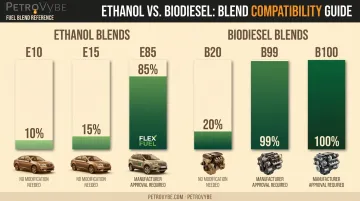
Biofuels come from crops, waste oils, or animal fats. Ethanol blends into gasoline at several ratios:
- E10: 10% ethanol, approved for any gasoline vehicle
- E15: 10.5%-15% ethanol, approved for 2001-model-year and newer vehicles
- E85: 51%-83% ethanol, flex-fuel vehicles only
Biodiesel follows a similar pattern. B20 (6%-20% biodiesel) runs in most current diesel engines without modification, while B99 and B100 are near-pure or pure biodiesel, typically requiring manufacturer approval.
Natural Gas (CNG & LNG)
Compressed natural gas (CNG) and liquefied natural gas (LNG) power a growing share of fleets and long-haul trucking. The DOE's Alternative Fuels Data Center describes heavy-duty natural gas vehicles as delivering small-to-moderate lifecycle GHG reductions versus diesel, with results varying by duty cycle and methane leakage rates. Renewable natural gas pathways can push those reductions substantially lower, depending on feedstock.
Propane (LPG/Autogas)
Propane is the world's third most common transportation fuel behind gasoline and diesel, with more than 28 million propane-autogas vehicles worldwide, per PERC's fleet data. It benefits from decades-old infrastructure and low-pressure storage. Autogas can produce up to 22% fewer GHG emissions than gasoline and up to 36% fewer NOx emissions than diesel.
Hydrogen
Fuel-cell vehicles emit only water vapor. Light-duty models refuel in about 5 minutes and travel more than 300 miles on a tank. The catch: DOE describes hydrogen infrastructure as still in an early implementation stage, with cost, high-pressure storage, and station availability as the main hurdles. DOE's own R&D target is $7/kg by 2030 for early markets.
Electricity
Battery-electric vehicles eliminate tailpipe emissions entirely. U.S. light-duty EV sales topped 1 million for the first time in 2023.
But scaling has a downside: DOE estimates that electrifying the entire 2022 U.S. vehicle fleet would have required electricity equal to roughly 34% of that year's available supply. Factor in rising data center and AI-related electricity demand, and grid capacity — not battery technology — could become the tighter constraint in the years ahead.
Ammonia
Ammonia is carbon-free at the point of use and easy to store as a liquid, which is why maritime shipping is betting on it. DNV counted 39 ammonia-capable ships on order as of August 2025. The tradeoffs are real, though: ammonia is toxic and corrosive, and combustion can produce NOx and N2O, requiring engine controls most vessels don't yet have.
Synthetic/E-Fuels
E-methanol, e-diesel, and e-kerosene come from green hydrogen and captured CO2. They're drop-in compatible with existing aviation and shipping engines, which is their biggest selling point. Their biggest weakness is scale. The IEA's main-case projection puts e-fuels at just 0.17 EJ by 2030, far below what's needed for aggressive net-zero targets.
Alternative Fuels in the US: Market and Policy Landscape
The EPA's Renewable Fuel Standard (RFS) program sets annual volume requirements for biofuel blending. Refiners comply by acquiring Renewable Identification Numbers (RINs), tradable across four nested categories:
- Biomass-based diesel
- Cellulosic biofuel
- Advanced biofuel
- Total renewable fuel The 2025 total renewable-fuel volume requirement was set at 22.33 billion gallons.
Federal policy hasn't been steady, though. Support for EV mandates and alternative fuel incentives has shifted between administrations, creating real uncertainty for anyone planning a multi-year investment around a specific fuel type.
Adoption on the ground is uneven by fuel:
| Fuel Type | U.S. Station/Location Count |
|---|---|
| Electric | 81,488 |
| E85 | 4,985 |
| Propane | 2,607 |
| Biodiesel | 1,998 |
| CNG | 710 |
| LNG | 24 |
| Hydrogen | 50 (46 retail) |
Source: DOE Alternative Fuels Data Center
Electric charging infrastructure dominates by sheer count, but propane and biodiesel remain far more accessible than hydrogen or LNG in most regions.
Benefits of Switching to Alternative Fuels
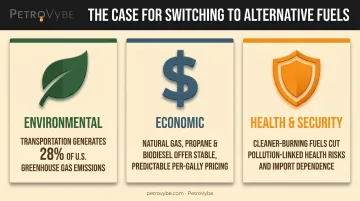
Environmental case: Transportation generated 28% of total U.S. GHG emissions in 2022, the largest single sector in EPA's inventory, according to the EPA's fast facts on transportation emissions. Lower lifecycle CO2 and reduced NOx/SOx from alternative fuels chip directly into that number.
Economic case: Cost predictability matters too. Natural gas, propane, and biodiesel typically offer more stable per-gallon-equivalent pricing than volatile gasoline and diesel markets. Fleet operators especially benefit from that predictability when budgeting fuel costs years out.
Health and security case: Public health and national security follow close behind.
- CDC research found sufficient evidence linking traffic-related pollution to asthma exacerbation, plus suggestive links to cardiovascular mortality
- Reduced tailpipe emissions near roadways correlate with better respiratory outcomes
- Diversified fuel sources reduce dependence on imported oil, a national security consideration as much as an economic one
Challenges and Limitations to Consider
Cost and infrastructure remain the two biggest barriers. Most alternative fuels still cost more to produce at scale than gasoline or diesel, and outside of propane and ethanol blends, refueling networks are thin.
Energy density is another real constraint. Ethanol (E100) carries about 0.67 gasoline-gallon equivalents per gallon, meaning lower range on the same tank size. Hydrogen packs roughly 120 MJ/kg versus gasoline's 44 MJ/kg by mass, but its low volumetric density creates storage and tank-size headaches.
Biofuels carry their own baggage. USDA reports ethanol production uses about 40% of the U.S. corn crop, including corn tied to marketable co-products like distillers grains. This raises legitimate land-use and food-price questions depending on the feedstock and region.
EV batteries have a parallel issue on the mineral side. Lithium demand jumped nearly 30% in 2024 alone, per the IEA's critical minerals outlook, with refining capacity concentrated in just a few countries. That's a supply chain risk, not just a cost issue.
Natural Gas: The Practical Bridge Fuel Powering Today's Energy Transition
Of every fuel on this list, natural gas and natural gas liquids (NGLs) are the most infrastructure-ready today. They're already displacing coal in power generation and diesel in heavy transport, without waiting on breakthrough technology or a national buildout of new stations.
NGLs specifically command premium pricing at lower production cost compared to dry gas, delivering higher margins for producers while still burning cleaner than oil or diesel. That combination, better economics and better emissions, is rare in the energy sector.
Why AI Changes the Equation
Natural gas already supplies nearly half of U.S. electricity generation. As data centers and AI infrastructure push grid demand higher, natural gas is increasingly viewed as the fuel source capable of meeting that surge at scale. It moves faster than new nuclear and faster than grid-scale battery storage can currently support.
During the shale revolution, investors chased acreage while overlooking pipeline infrastructure, a costly blind spot. The same pattern may be repeating with AI: the physical fuel infrastructure powering data centers deserves as much attention as the software running inside them.
PetroVybe, a private Texas-based natural gas development company, gives accredited investors direct access to early-stage NGL development in South Texas and the Gulf Coast Basin. The company's model combines:
- Tax-advantaged natural gas development through Intangible Drilling Cost deductions applied against active income, including W2 earnings and capital gains
- Long-term passive income potential, with monthly distributions projected to exceed $10,000/month during peak production
- A 10-year target MOIC of ~2.2x-5.8x and target IRR of ~26%
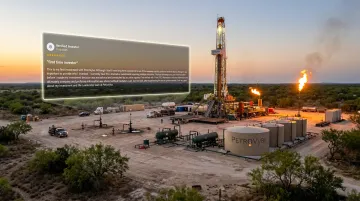
PetroVybe partners have received meaningful tax deductions against active income in recent years, 94% in 2024 and 91% in 2025, a structural advantage most other asset classes simply can't offer.
For accredited investors looking for a tangible way to participate in the alternative fuel transition rather than just read about it, natural gas development offers a direct entry point.
Frequently Asked Questions
What are alternative fuels?
Alternative fuels are EPA-recognized substitutes for gasoline and diesel, including hydrogen, natural gas, propane, alcohols, biofuels, and electricity. They reduce petroleum dependency and, in most cases, lower emissions.
What are the seven most common alternative fuels?
The seven leading categories are biofuels, natural gas (CNG/LNG), propane, hydrogen, electricity, ammonia, and synthetic e-fuels. Each serves different vehicle types and industries, from passenger cars to maritime shipping.
What are the alternative fuels in the US?
The EPA and DOE recognize biodiesel, ethanol, CNG/LNG, propane, hydrogen, and electricity. The Department of Energy's Alternative Fuels Data Center is the authoritative resource for station locations and fuel specifications.
Is natural gas considered an alternative fuel?
Yes. Both the EPA and EU classify natural gas as an alternative fuel because it burns cleaner than gasoline or diesel, despite being fossil-derived. It qualifies under U.S. law (42 USC 13211) and EU Regulation 2023/1804.
Which alternative fuel is most cost-effective for consumers today?
Propane and CNG generally offer the most stable, lower per-gallon-equivalent costs compared to gasoline and diesel right now. Both benefit from decades of established infrastructure and pricing predictability.
Are alternative fuels more expensive than gasoline or diesel?
It depends on the fuel. CNG and propane are often cheaper on a per-mile basis, while hydrogen and e-fuels remain more costly due to limited production scale and early-stage infrastructure.