

Wealth maximization flips that script. Instead of optimizing for this quarter's or this year's income, it treats every financial decision through the lens of long-term, risk-adjusted value creation.
This article breaks down what wealth maximization actually means, how it differs from profit maximization, and which strategies (including tax-efficient investment structures) can help you apply the principle to your own portfolio.
Key Takeaways
- Wealth maximization values cash flow and net present value over short-term profit.
- Risk, time value of money, and sustainability factor into every sound financial decision.
- Diversification, reinvestment, and tax-advantaged vehicles are the practical building blocks.
- Corporate finance principles translate directly into personal wealth-building strategies.
- Legacy and generational planning depend on this mindset, not just annual returns.
What Is Wealth Maximization?
Wealth maximization is the financial objective of increasing the long-term net present value (NPV) of an asset base or cash flow stream, rather than simply boosting short-term earnings. It has long stood as a core principle in corporate financial management, guiding decisions on which projects a company should fund and which it should reject.
The concept originated as a shareholder-value framework, but the underlying logic applies just as well to individuals. Whether you're a corporation evaluating a capital project or an investor evaluating a real asset position, the same question applies: does this decision grow long-term value, or does it just look good on paper this year?
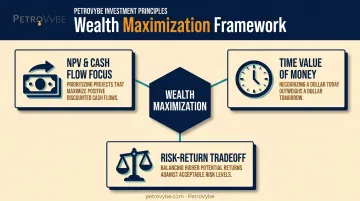
Net Present Value (NPV) & Cash Flow Focus
Wealth maximization evaluates decisions based on real cash inflows and outflows, discounted to their present value, not just what shows up as "profit" on an income statement. A project or investment gets accepted when its NPV is positive, meaning the discounted future cash flows exceed the upfront cost.
This distinction matters because accounting profit can be manipulated or inflated in ways that cash flow cannot. A company can report strong earnings while burning cash. An investor can show a paper gain while their actual liquid position deteriorates. This is why wealth maximization models anchor to actual cash movement rather than reported earnings, since profit figures can mask a business running out of cash.
Time Value of Money (TVM)
A dollar today is worth more than a dollar received five years from now. That's the entire premise of TVM, and it's why wealth maximization places so much weight on timing.
- Money available now can be invested and start compounding immediately.
- Inflation erodes the purchasing power of future dollars.
- The formula FV = PV × (1 + r)^n captures this mathematically, showing how present value grows at a given rate over time.
This is why wealth-focused investors don't just ask "how much will I receive?" They ask "when will I receive it, and what could that capital have earned elsewhere in the meantime?"
Risk-Return Tradeoff
Every wealth maximization decision requires balancing potential returns against the risk taken to achieve them. Higher raw returns often look attractive on the surface, but risk-adjusted performance tells a different story.
Consider this: nearly 93% of large-cap active fund managers underperformed their benchmark over a 20-year period once risk was properly accounted for. Chasing headline returns without adjusting for volatility and downside exposure is one of the most common ways investors sabotage long-term wealth.
Wealth Maximization vs. Profit Maximization
Profit maximization is a short-term goal centered on increasing net income, usually through revenue growth or cost-cutting within a single fiscal period. It's simple, measurable, and often rewarded by markets in the immediate term. But it can conflict directly with long-term value creation.
| Factor | Profit Maximization | Wealth Maximization |
|---|---|---|
| Time horizon | Short-term (quarter/year) | Long-term (years/decades) |
| Risk consideration | Often ignored | Central to every decision |
| Basis of measurement | Accounting profit | Cash flow and NPV |
| Stakeholder impact | Shareholders, near-term | Owners, investors, future generations |
A concrete example of the conflict: About 80% of surveyed executives admit they would delay or cut R&D spending to hit a quarterly earnings target, even knowing it would hurt long-term competitiveness. That's profit maximization winning out over wealth maximization, and it's exactly the tradeoff that erodes company value over time.
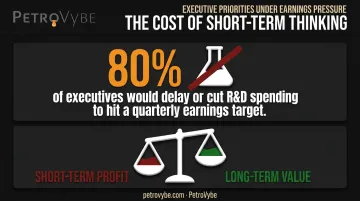
Individual investors make the same mistake constantly, trading long-term value for short-term comfort:
- Selling a strong long-term holding to lock in a quick gain
- Avoiding a tax-advantaged investment because the paperwork feels inconvenient
PetroVybe's structure reflects the wealth-maximization side of that line, built around a 10-year hold period and tax treatment designed for long-term compounding rather than a quick exit. Financial professionals increasingly favor this approach because it aligns decisions with sustainable growth instead of a single reporting period.
Why Wealth Maximization Matters
Short-term thinking produces one-off wins. Wealth maximization produces compounding value that builds on itself year after year.
It matters for three main reasons:
- Sustainable growth. Reinvested returns compound over time instead of resetting to zero every cycle.
- Inflation resilience. Cash sitting in a savings account steadily loses purchasing power, while real assets and cash-flowing investments can outpace rising prices.
- Legacy planning. A wealth-maximization mindset naturally extends beyond your own lifetime, supporting estate transfer and generational wealth rather than just this year's returns.
Traditional savings accounts feel safe, but safety and growth aren't the same thing. Wealth maximization forces a different question: is this asset actually growing my real, inflation-adjusted net worth, or just sitting still while prices rise around it?
Proven Strategies to Maximize Your Wealth
Theory only helps if it changes what you actually do with your capital. Here's the practical playbook connecting wealth maximization principles to real financial decisions.
Diversify Across Asset Classes
Spreading capital across equities, fixed income, real estate, and alternative assets reduces concentration risk and smooths out volatility. A 60/40 stock-bond portfolio averaged a 9.0% annual return between 1926 and 2024, according to Fidelity's diversification research. That balanced mix delivered strong long-term performance without betting everything on one asset class.
Alternative assets, including direct energy investments, add a further layer of diversification because they often move independently of public equity markets.
Prioritize Tax-Efficient Investment Vehicles
Where you hold that diversified capital matters just as much as how it's allocated. Minimizing tax drag is one of the fastest ways to compound wealth, because every dollar saved on taxes is a dollar that keeps working for you. Common vehicles include:
- 401(k) and IRA accounts ($23,000 401(k) contribution limit in 2024)
- Municipal bonds, which offer tax-exempt interest income
- **Direct oil and gas development programs**, which offer substantial upfront deductions through Intangible Drilling Costs (IDCs)
This last category deserves attention because it's underused. IDC deductions typically cover 60% to 80% of invested capital in a new drilling project, and unlike most real estate deductions, they can offset active income, meaning W-2 wages and capital gains, not just passive income.
PetroVybe's ONE program, available to accredited investors, illustrates this in practice. Partners who joined in 2024 received a 94% deduction against active income, while 2025 partners saw that figure land at 91%. One verified investor eliminated a $30,000 tax liability entirely through this structure.

For a high W-2 earner or someone facing a large capital gains event, this is a material shift in after-tax wealth.
Reinvest Cash Flows for Compounding Growth
Spending dividends, interest, or distributions the moment they arrive stops compounding before it starts. Reinvesting those cash flows accelerates long-term value creation because each reinvested dollar starts generating its own returns.
Dividends alone have contributed 31% of the S&P 500's total return since 1926. Investors who reinvested those payouts rather than spending them captured a meaningfully larger share of the index's long-term growth.
Balance Growth With Passive, Inflation-Resistant Income
Growth assets matter, but so does building passive income that holds its value as prices rise. Real assets, royalties, and production-based income streams can offset inflation in ways that fixed-income products often can't.
PetroVybe's development projects, for example, are structured to generate monthly passive distributions projected to exceed $10,000 during peak production, on top of the upfront tax benefit. That combination of tax deduction plus long-term cash flow is exactly the kind of dual-purpose asset a wealth-maximization strategy looks for.
Track Performance With the Right Metrics
Short-term price movement is a poor proxy for long-term value creation. Better metrics include:
- Multiple on Invested Capital (MOIC) – total value returned relative to capital invested
- Internal Rate of Return (IRR) – the annualized rate at which NPV equals zero
- Net Present Value (NPV) – the discounted value of all future cash flows
PetroVybe targets a 10-year MOIC range of roughly 2.2x to 5.8x and an IRR near 26%, figures grounded in third-party engineered reserve data rather than speculative projections. Tracking metrics like these, instead of week-to-week price swings, keeps decisions anchored to actual long-term value.
Skills & Mindset Needed for Wealth Maximization
Wealth maximization isn't just a set of tactics. It requires a specific mindset:
- Financial literacy and analytical skill to evaluate cash flow, risk, and return tradeoffs before committing capital, whether the opportunity is a public stock or a private energy partnership.
- Discipline and patience to resist short-term market noise and stay committed to compounding strategies, even when headlines suggest otherwise.
- Strategic decision-making around asset allocation, tax planning, and diversification, aligning every investment with a long-term goal rather than a short-term itch.
None of these skills require a finance degree. They require a willingness to evaluate decisions, such as a $100,000 stake in a 10-year energy partnership, based on long-term merit rather than immediate appeal.
Frequently Asked Questions
What is wealth management in short?
Wealth management is a holistic advisory service covering investment management, tax planning, and estate planning to grow and protect assets over time. It typically combines multiple financial disciplines under one coordinated strategy.
What is the difference between profit and wealth maximization?
Profit maximization focuses on boosting short-term net income through revenue growth or cost-cutting. Wealth maximization focuses on long-term, risk-adjusted value creation measured through cash flow and NPV.
What skills are needed for wealth maximization?
Financial literacy, analytical skill, discipline, and strategic decision-making around asset allocation and tax planning. These skills help investors evaluate risk and return before committing capital.
What are the main strategies to achieve wealth maximization?
Diversification across asset classes, tax-efficient investment vehicles, and reinvesting cash flows for compounding growth. Tracking performance through MOIC, IRR, and NPV rounds out the approach.
Is wealth maximization only relevant for businesses, or can individuals apply it too?
While the concept originated in corporate finance, individuals can apply the same principles to personal investment and tax decisions. Cash flow, risk, and long-term value work the same way for a personal portfolio as they do for a company.
How does wealth maximization help protect against inflation?
Allocating a portion of a portfolio to real assets and passive income streams, such as royalties or production-based investments like PetroVybe's natural gas partnerships, helps preserve purchasing power over time. This approach offsets the erosion that traditional cash savings typically experience during inflationary periods.