
That gap is exactly what the HNWI designation captures. A high-net-worth individual isn't just someone who earns well — it's someone who has accumulated at least $1 million in liquid financial assets. That threshold isn't arbitrary. Cross it, and your financial life changes in concrete ways: the investments you can access, the tax strategies available to you, and the advisory relationships you can build.
This article covers who qualifies as an HNWI, how the wealth tiers break down, how high-net-worth investors approach investing and taxes differently, and what it actually takes to build that level of wealth.
Key Takeaways
- An HNWI holds $1 million or more in liquid financial assets, excluding their primary residence
- Three distinct tiers exist: HNWI ($1M–$5M), Very-High-Net-Worth ($5M–$30M), and Ultra-High-Net-Worth ($30M+)
- HNWI status typically confers accredited investor designation, opening access to private investments
- Tax minimization through strategies like harvesting, trusts, and IDC deductions is a defining priority at this wealth level
- Building HNWI status requires consistent investing, reducing debt, and diversifying into income-generating assets
What Is a High-Net-Worth Individual (HNWI)?
A high-net-worth individual is generally defined as someone with $1 million or more in liquid financial assets after accounting for liabilities. No single federal law mandates this definition universally, but it's widely adopted by financial institutions, wealth managers, and the SEC when determining eligibility for specialized services and investment access.
What Counts as Liquid?
Liquid assets are those readily convertible to cash without significant loss of value. They include:
- Cash and cash equivalents
- Stocks and bonds
- Money market accounts
- Retirement accounts (IRAs, 401(k)s)
Primary residences, fine art, collectibles, antiques, and personal vehicles are typically excluded. Their value is real but not quickly realizable — which is why a $2 million home doesn't make someone an HNWI if they carry $1.5 million in other liabilities.
The Accredited Investor Connection
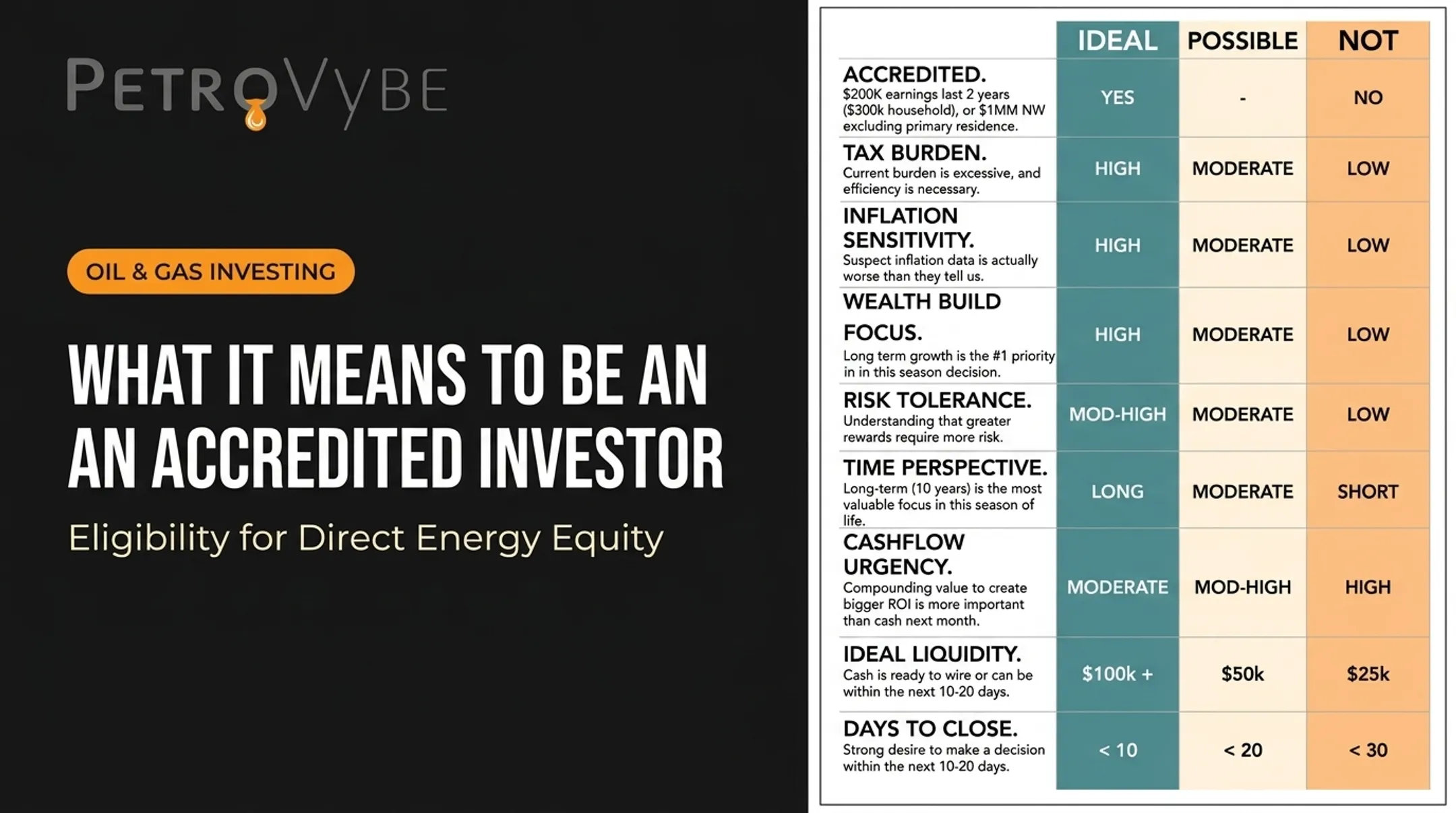
At the $1 million net worth threshold (excluding primary residence), HNWIs typically meet the SEC's definition of an accredited investor. The SEC also recognizes an income route: $200,000 annually as an individual, or $300,000 jointly, in each of the prior two years with a reasonable expectation of the same going forward.
Accredited investor status unlocks access to private securities offerings — hedge funds, private equity, venture capital — that are unavailable to the general public. The SEC restricts these investments because they carry higher risk and limited disclosure; accredited investors are presumed to have the financial sophistication or resources to evaluate those risks.
High Earner vs. High Net Worth
These are not the same thing. Someone earning $400,000 a year but carrying $600,000 in student loans, a $1.2 million mortgage, and car payments may have a negative or negligible net worth. This is the HENRY — High Earner, Not Rich Yet — a term coined by Fortune's Shawn Tully in 2003 for households earning roughly $250,000–$500,000 that haven't yet built corresponding wealth.
The distinction matters because HNWI status is determined by what you've accumulated, not what you earn. A high salary is the starting point; building net worth is the work.
How Many HNWIs Exist?
Once the definition is clear, the scale of this population is striking. According to Capgemini's 2026 World Wealth Report, 25.3 million people globally held HNWI status at year-end 2025, up 7.9% from the prior year. The United States accounted for 8.7 million of those individuals — adding 736,000 in a single year. This is a growing and economically significant category.
HNWI Tiers: From Millionaires Next Door to Ultra-High-Net-Worth
Not all HNWIs are in the same financial situation. Capgemini segments the global HNWI population into three distinct bands, each with different financial needs and complexity.
| Tier | Investable Assets | Global Population | Population Share | Wealth Share |
|---|---|---|---|---|
| Millionaires Next Door | $1M–$5M | 22.65M | 89.7% | 42.5% |
| Mid-Tier Millionaires | $5M–$30M | 2.35M | 9.3% | 22.7% |
| Ultra-HNWIs | $30M+ | 0.25M | 1.0% | 34.8% |
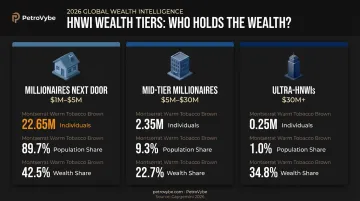
Source: Capgemini World Wealth Report 2026
What Each Tier Actually Needs
The financial complexity at each tier escalates significantly:
- $1M–$5M: Personalized investment management, tax planning, and retirement income structuring. These individuals are building and protecting wealth simultaneously.
- $5M–$30M: Business succession planning, multi-generation trust structures, and more sophisticated estate planning enter the picture.
- $30M+: International holdings, private philanthropies, family offices, and complex multi-entity structures become standard. That degree of concentration requires its own dedicated management infrastructure — family offices exist largely because standard wealth management firms aren't built for it.
The sub-HNWI category ($100,000–$1M in liquid assets) represents millions of wealth builders on the path to the first threshold. Strategy matters just as much at this stage — sometimes more, because early decisions compound over decades.
How HNWIs Invest Differently Than Most Investors
The shift in investment mindset at the HNWI level is substantial. Average investors focus on growing assets. HNWIs increasingly focus on preserving wealth, generating passive income, and transferring assets across generations with minimal tax erosion.
Exclusive Investment Access
Accredited investor status unlocks a different universe of options:
- Hedge funds — actively managed strategies unavailable to retail investors
- Private equity — direct ownership in private companies
- Venture capital — early-stage company investment
- Angel investments — direct funding of startups
- Private placements — securities offerings exempt from standard SEC registration
The SEC notes that these opportunities involve higher risk, limited disclosure, and potential illiquidity — but also return profiles that public markets typically can't match.
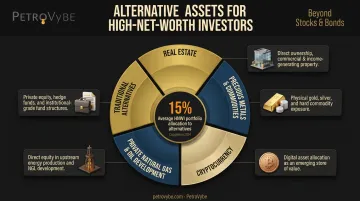
Capgemini's 2024 HNWI portfolio data shows that 15% of HNWI portfolios were allocated to alternatives (including private equity, hedge funds, commodities, and digital assets) — a meaningful slice that most retail investors never access.
Alternative Assets in Practice
Beyond traditional stocks and bonds, HNWIs commonly hold:
- Real estate — direct ownership and commercial property for income and depreciation benefits
- Precious metals and commodities — inflation hedges with low correlation to equities
- Cryptocurrency — increasingly present in HNWI portfolios as a speculative allocation
- Private natural gas and oil development — direct positions in upstream energy projects
Private energy development is often the least-discussed alternative asset class, yet it can be particularly compelling for high-income accredited investors. Through companies like PetroVybe, accredited investors take direct equity positions in private natural gas development projects in South Texas. They participate at the early-stage development phase — before value has been priced into a public-market stock.
That distinction matters. PetroVybe's COO Blaine Yeary scaled a $5 billion asset from zero to 35,000 BOEPD over eight years. That kind of operational track record reflects what direct development participation can offer that a public-market energy stock typically cannot.
The Investor Support Team Difference
Managing this range of assets requires more than one generalist advisor. HNWIs typically build a coordinated team of specialists:
- A CPA for tax planning and compliance
- An estate attorney for trust structures and inheritance planning
- A wealth manager for portfolio strategy and asset allocation
- Specialized advisors for alternative investments, real estate, and business interests
This team-based approach is a direct function of portfolio complexity — the more asset classes you hold, the more specialized knowledge you need managing each one.
Tax Strategies Used by High-Net-Worth Individuals
Higher net worth typically means higher tax exposure. Capital gains on investments, ordinary income from active earnings, and estate taxes at death all compound into a significant burden. HNWIs use proactive, legal strategies to reduce each.
Tax-Loss Harvesting
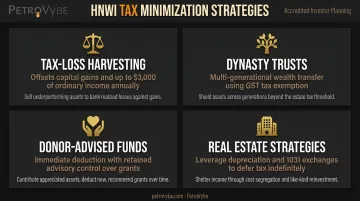
Selling underperforming assets to offset capital gains on winning positions reduces overall taxable income. The IRS allows net capital losses to offset up to $3,000 of ordinary income annually ($1,500 if married filing separately), with unused losses carried forward indefinitely while retaining their short- or long-term character.
Trust Strategies
Placing assets into irrevocable trusts removes them from the taxable estate. Two structures HNWIs commonly use:
- Dynasty trusts — assets benefit multiple generations without triggering generation-skipping transfer tax at each level, provided the GST exemption is properly allocated
- Donor-advised funds (DAFs) — contributions may qualify for a charitable deduction; the donor retains advisory privileges over subsequent grants while the sponsoring 501(c)(3) organization holds legal control
Real Estate as a Tax Strategy
Real estate generates income while simultaneously reducing taxable income through:
- Depreciation on the asset's value over time
- Mortgage interest deductions on investment properties
- 1031 exchanges — deferring gain on qualifying real property exchanges by rolling proceeds into a like-kind property
IDC Deductions: The Oil and Gas Advantage
Real estate deductions are largely passive — they offset passive income. IDC deductions work differently, targeting active income directly. That distinction matters most to high earners with significant W-2 income or capital gains.
Under IRC Section 263(c), qualifying Intangible Drilling Costs (IDCs) — which typically represent 60–80% of a well's total cost according to the American Petroleum Institute — can be expensed rather than capitalized.
The key distinction from real estate: under IRC Section 469(c)(3), working interests held directly (without limited liability) are excluded from passive activity classification. This means qualifying IDC deductions can offset active income — including W-2 earnings and capital gains — not just passive income.
To illustrate: PetroVybe's accredited investor partners achieved 94% first-year tax deductions against active income in 2024, and 91% in 2025. One verified investor, Nizar A., reported the complete elimination of a $30,000 tax liability through PetroVybe's IDC structure — a result of properly structured working interest participation under IRC Section 263(c).
For HNWIs with significant active income, IDC deductions remain underutilized relative to their impact. Under IRC Section 263(c)
Note: At-risk rules, AMT treatment of excess IDCs, and entity structure all affect eligibility. Consult a qualified tax professional for your specific situation.
How to Build High-Net-Worth Status
HNWI status is reached through the intersection of three factors: income or a liquidity event, disciplined saving and investment, and debt minimization. Inheritance, business exits, and legal settlements can accelerate the timeline, but they're not the only path.
The Compounding Foundation
Consistent investing over time remains the most reliable route. Consider this math: a $1,000 monthly contribution earning a hypothetical 7% annual return, compounded monthly, grows to approximately $1.039 million in 28 years — starting from just $336,000 in total contributions, according to the SEC's compound interest calculator. That's an illustration, not a forecast, but it shows what time and consistency can do.
Fidelity recommends saving at least 15% of pretax income annually (including employer contributions) as a baseline for retirement readiness. Financial advisors coaching clients toward HNWI status often target 20–25%.
Practical Steps to Accelerate the Path
- Maximize savings rate before lifestyle inflation erodes income growth
- Invest consistently and stay the course during downturns — selling into fear destroys more long-term wealth than any bear market
- Eliminate high-interest debt aggressively, as debt is the direct inverse of net worth
- Diversify beyond equities into asset classes that generate income and hedge inflation — real estate, commodities, and private market investments all serve this function

Beyond Stocks and Bonds
Reaching HNWI status is one thing. Staying there requires assets that generate income, not just ones that appreciate on paper.
HNWIs don't just hold more of the same assets — they expand into categories that work while they sleep. Private natural gas development is one example. PetroVybe ONE, structured for accredited investors, targets passive monthly distributions projected to peak above $10,000/month during peak production. It also delivers IDC deductions that offset active income — W2 earnings and capital gains — during the investment period.
The project's 10-year MOIC target of ~2.2–5.8x with a forecasted IRR of ~26% reflects what serious diversification into private development can look like beyond the stock market.
Frequently Asked Questions
What is the definition of high net worth?
A high-net-worth individual is generally someone with $1 million or more in liquid financial assets, excluding their primary residence. This threshold is widely used by financial institutions and the SEC to define eligibility for specialized wealth management services and private investment opportunities.
What assets count toward high net worth?
Liquid assets — cash, stocks, bonds, money market accounts, and retirement accounts — count toward high net worth. Illiquid assets like a primary residence, art, collectibles, and personal vehicles are typically excluded because they can't be converted to cash quickly.
What is the difference between HNWI, VHNWI, and UHNWI?
HNWIs hold $1M–$5M in investable assets, Mid-Tier Millionaires (sometimes called VHNWIs) hold $5M–$30M, and Ultra-HNWIs hold $30M or more. At each tier, the planning priorities shift — from basic wealth protection at the HNWI level to complex multi-generational estate structures and institutional-grade investment access at the UHNWI level.
How does HNWI status connect to being an accredited investor?
The SEC's accredited investor net worth threshold — $1 million excluding primary residence — closely mirrors the HNWI benchmark. Crossing that line unlocks access to private investment vehicles that are off-limits to the general public.
What investment opportunities are exclusive to high-net-worth individuals?
HNWIs with accredited investor status can invest in hedge funds, private equity, venture capital, angel investments, and private placements — vehicles that offer potentially higher returns in exchange for higher risk, lower liquidity, and limited disclosure protections.
How do high-net-worth individuals minimize their tax liability?
Common strategies include tax-loss harvesting, irrevocable trust contributions, real estate depreciation and 1031 exchanges, and charitable giving through donor-advised funds. Some investment structures — such as oil and gas development projects — go further, offering IDC deductions that apply directly against active income, including W-2 earnings and capital gains.
Disclosure: PetroVybe and its team members are not licensed financial advisors, and nothing on this website constitutes financial or investment advice or a recommendation to buy, sell, or hold any investment. PetroVybe and its team members are not tax advisors, accountants, or tax strategists, and nothing on this website constitutes tax advice or a tax strategy. PetroVybe and its team members are not attorneys, and nothing on this website constitutes legal advice. All content is provided for general informational purposes only. You should consult your own independent financial advisor, tax professional, and legal counsel before making any decision.