

This article is general education, not investment, tax, or legal advice. Every private investment partnership rests on one foundational document. It's not the pitch deck, and it's not the glossy investor presentation. It's the Limited Partnership Agreement (LPA) — the contract that determines who controls capital, who bears risk, and how profits actually get split.
Many investors evaluating alternative assets like oil and gas development jump straight to return projections without reading the document that governs them. That's backwards. Accredited investors exploring natural gas partnerships, private equity funds, or real estate syndications will encounter an LPA before they wire a dollar, and understanding it matters more than any marketing deck.
This guide breaks down what an LPA is, the provisions that matter most, why investors choose this structure, and what to check before signing.
Key Takeaways
- An LPA locks in fund economics, control rights, and liability rules between GPs and LPs
- Management fees (~2%) and carried interest (~20%) structures determine how profits actually flow
- LPs get liability protection and passive income but give up management control
- Oil and gas LPAs carry unique tax treatment through intangible drilling cost (IDC) deductions
- Legal review before signing isn't optional: LPAs carry real financial consequences
What Is a Limited Partnership Agreement?
An LPA is the legally binding contract between a General Partner (GP) and one or more Limited Partners (LPs) that governs how a fund or partnership operates from formation through liquidation. Think of it as the operating manual and the rulebook combined.
The structure runs on two tiers:
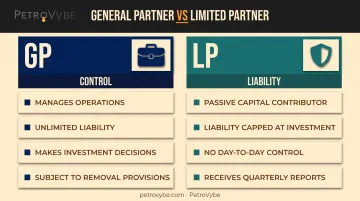
- General Partner: Manages daily operations, makes investment decisions, and holds unlimited personal liability for partnership obligations
- Limited Partners: Contribute capital passively, with liability generally capped at their investment amount
Who Actually Owns the Assets?
This trips up a lot of first-time investors. Under Delaware law, which governs most US partnerships, a partner has no interest in specific limited-partnership property (Delaware Section 17-701). The partnership entity itself holds title to wells, leases, or receivables, not individual LPs.
You own a partnership interest, not a direct slice of any particular asset.
Can a GP Also Be an LP?
Yes. Many GPs make a personal capital commitment (often called a "GP commitment") alongside their LPs. This aligns incentives: if the GP has skin in the game, they're motivated to protect the partnership's downside, not just chase fees.
One last distinction: the LPA is the master document signed at closing. The Private Placement Memorandum (PPM) is the earlier marketing document that describes the opportunity. If the two ever conflict, the LPA governs.
Key Provisions Every LPA Should Address
Economic Terms
Three mechanisms determine how money actually moves:
- Management fees — Commonly around 2% of committed capital, paid to the GP for running fund operations.
- Carried interest — Typically 20% of profits, paid to the GP once LPs clear specific return thresholds.
- Capital calls (drawdowns) — The mechanism by which the GP requests committed capital from LPs, often in installments tied to deployment schedules.
The SEC's glossary treats “2 and 20” as industry shorthand, and ILPA recommends management fees step down sharply after the investment period ends.
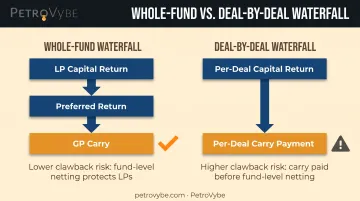
The distribution waterfall — the order in which cash flows to LPs versus the GP — sets who gets paid, and when. A whole-fund waterfall returns all LP capital plus a preferred return before any carry is paid. A deal-by-deal waterfall can pay carry earlier, which sounds attractive to a GP but raises clawback risk if later deals underperform.
Governance & Protective Terms
Well-structured LPAs include:
- Key person provisions — What happens if a named executive leaves, dies, or becomes incapacitated.
- GP removal rights — The voting threshold LPs need to remove a GP for cause or without cause.
- Indemnification carve-outs — Fraud, gross negligence, and willful misconduct should never be protected.
- Clawback provisions — Mechanisms forcing the GP to return carry if the fund underperforms after early distributions.
LP limits matter as much as LP rights. Limited partners cannot actively manage the business, bind the partnership to contracts, or make day-to-day operating decisions. Cross that line and an LP can lose liability protection entirely, a principle rooted in Delaware partnership law.
Most LPAs also require quarterly or annual statements so LPs stay informed without taking a management seat.
Why Investors Choose the Limited Partnership Structure
Investors gravitate toward LP structures for a specific combination of benefits they can't easily get elsewhere:
- Liability protection: Capital at risk is capped at the investment amount
- Passive involvement: No operational burden; the GP handles sourcing, execution, and day-to-day management
- Access to specialized expertise: GPs bring deal-sourcing networks and technical knowledge individual investors typically lack
- Diversification: LP structures open doors to real estate, private equity, and natural resources outside a traditional stock-and-bond portfolio
Pass-through taxation is a major draw. Profits and losses flow directly to each partner's individual tax return, avoiding the double taxation that corporate structures create.
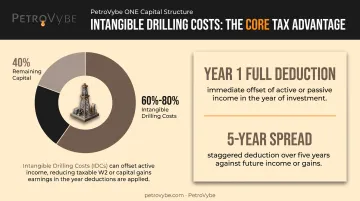
Certain LP structures push this further. Oil and gas development partnerships, for example, can offer intangible drilling cost (IDC) deductions that offset active income (W-2 wages and capital gains, not just passive income). That's a materially different tax profile than most other LP investments offer, though it comes with real limits (more on that below). This treatment requires the investor to elect general partner status in the Subscription Agreement and may be limited in a given year by the excess business loss limitation under IRC §461(l).
The trade-off is control. LPs give up voting power and management authority in exchange for liability protection and passive access. For most accredited investors seeking diversification without a second job, that trade makes sense.
How LPAs Apply to Oil & Gas Development Investments
In an oil and gas development partnership, the LPA defines how capital contributions fund drilling and development activity, and how revenue from produced natural gas or NGLs flows back to partners.
Unlike a typical private equity fund LPA, oil and gas partnership agreements lean heavily on tax mechanics tied to intangible drilling costs (IDCs). IDCs cover items like labor, drilling fluids, and site prep that have no salvage value. They are generally deductible in the year incurred and typically represent a first-year deduction target of approximately 70–80% of invested capital in a new-drilling project. Investors can often claim the full deduction in year one or spread it over five years. This treatment requires the investor to elect general partner status in the Subscription Agreement and may be limited in a given year by the excess business loss limitation under IRC §461(l).
This is exactly why high-income W-2 earners and investors sitting on capital gains favor this asset class. It's rare to find a private investment vehicle where the tax mechanics work this directly against active income.
How that advantage shows up in practice depends on how the partnership is built. PetroVybe structures its accredited investor partnerships (PetroVybe ONE) around this model. The company's 2025 partners reported aggregate tax deductions of 94% against active income, based on IDC and related deductions documented on partner K-1s. Prior result; not a promise of any future deduction. PetroVybe backs its offering with:. This treatment requires the investor to elect general partner status in the Subscription Agreement and may be limited in a given year by the excess business loss limitation under IRC §461(l).
- Third-party engineering validation, including a $48 million PV-09 reserve valuation. Prepared by Lee Keeling & Associates, Tulsa, March 2026.
- A clean 2025 independent audit
- Quarterly investor updates on drilling plans and project status
- A targeted 10-year MOIC range of roughly 2.2x–5.8x and a ~26% target IRR
Specific capital call mechanics, distribution waterfall sequencing, and GP co-investment terms still live in the actual LPA, PPM, and Subscription Agreement—not in marketing summaries. Request and review those documents directly before committing capital.
What to Review Before Signing an LPA
Before wiring a single dollar, work through this checklist:
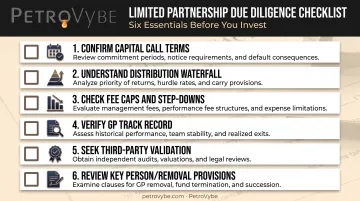
- Confirm capital call terms: How much notice do you get, and what happens if you can't fund a call on time?
- Understand the distribution waterfall: Is it whole-fund or deal-by-deal? The difference affects when you actually see cash.
- Check fee caps and step-downs: Does the management fee reduce after the investment period ends?
- Verify GP track record: Look for specific, verifiable operating history, not just adjectives.
- Seek third-party validation: Independent reserve engineering reports or audited financials signal a well-structured partnership.
- Review key person and removal provisions: What triggers a suspension or replacement if a named executive departs?
Have legal counsel review the actual LPA — not just the summary deck — before you sign. These are dense, binding documents with real financial consequences.
Frequently Asked Questions
What is a limited partnership agreement in private equity?
It's the binding contract between the general partner and limited partners that governs fund economics, governance, and day-to-day operations from formation through liquidation.
Why would someone choose a limited partnership?
Liability protection, passive income potential, pass-through taxation, and access to a GP's specialized deal sourcing and operational expertise all make LP structures attractive to accredited investors.
What can a limited partner not do?
LPs cannot participate in day-to-day management or bind the partnership contractually. Doing so risks losing their limited liability status entirely.
Can a general partner be an LP?
Yes. A GP can also hold an LP interest, and GPs often commit personal capital alongside LPs to show alignment—while their primary role remains managing the partnership.
Who owns the assets in a limited partnership?
The partnership entity holds legal title to all assets. Individual partners hold an interest in the partnership itself, not direct ownership of specific property.
How many LPs can a VC fund have?
There's no fixed federal cap for private funds generally, but SEC exemptions set practical limits. Section 3(c)(1) caps beneficial owners at 100 for most private funds, while qualifying venture capital funds can have up to 250.
Informational requests only. PetroVybe projects are offered solely to verified accredited investors. Submitting this form does not create an investment or advisory relationship.