This article is general education, not investment, tax, or legal advice. The AI boom didn't just arrive. It slammed into a power grid that was never built for this kind of load.
Every ChatGPT query, every AI model training run, every hyperscale campus breaking ground in Texas or Virginia pulls electricity from a system designed decades ago. That collision is now reshaping American energy markets in real time.
U.S. data centers consumed 183 terawatt-hours (TWh) in 2024, according to the International Energy Agency. By 2030, that figure could climb to 426 TWh under the IEA's base case, with other models pushing toward 12% of total U.S. electricity by 2028, up from roughly 4.4% in 2023.
For investors watching this shift, the real story isn't just about servers. It's about who supplies the power behind them. That's creating what looks like a generational opportunity in natural gas development.
Key Takeaways
- U.S. data centers consumed about 183 TWh in 2024—on track to more than double by 2030
- Natural gas already supplies over 40% of data center power and is set to hold that lead through 2030
- Grid strain is pushing developers toward direct power deals with energy producers, including gas developers
- Texas is becoming the epicenter of both data center growth and natural gas development
Why Data Centers Are Consuming So Much Electricity
Data centers run differently than almost any other commercial building. There's no "off" switch, no seasonal slowdown, no nights and weekends.
Three forces drive the load:
- Constant server operation — servers run 24/7/365, unlike office buildings that idle overnight
- Cooling systems — massive heat output from dense server racks requires industrial-scale cooling
- Backup and redundant power — UPS systems, generators, and failover gear keep facilities online with zero downtime
According to DOE and Lawrence Berkeley National Laboratory's 2024 report, roughly 70% of a data center's power goes to IT equipment, with the remainder going to cooling and supporting infrastructure.
AI Workloads Changed the Math
Traditional server racks used to run 5-10 kW. AI-optimized racks now demand far more.
McKinsey reports rack density has climbed sharply in a short window:
- Average density: 8 kW to 17 kW in two years
- AI training systems: often 80+ kW per rack
- Nvidia GB200-based systems: up to 120 kW
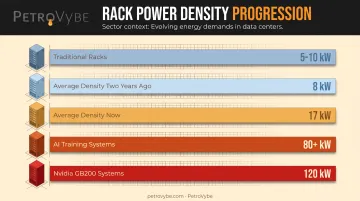
That is power density nobody planned for a decade ago.
Hyperscalers are funding the buildout at scale. Combined 2025 capital spending from Amazon, Microsoft, Google, and Meta tops $200 billion, almost entirely aimed at AI infrastructure and data center capacity.
How Much Electricity Will Data Centers Need?
Data centers used 1.9% of U.S. electricity in 2018. By 2023, that share had grown to 4.4%.
Forecasts for what comes next vary widely, and for good reason.
| Source | Year | Projection |
|---|---|---|
| DOE/LBNL | 2028 | 325-580 TWh (6.7%-12% of U.S. electricity) |
| IEA | 2030 | 426 TWh (base case) |
| EPRI | 2030 | 9%-17% of U.S. electricity |
Why the spread? DOE/LBNL points to uncertainty across several variables:
- GPU shipment volumes
- Chip power draw
- Server utilization rates
- Cooling technology choices
Utilities and data center operators also don't publicly share detailed operating data, so modelers fill gaps with assumptions.
Texas Is Outpacing the Grid Planners
That national uncertainty shows up clearly on the ground in Texas. ERCOT's adjusted 2031 peak demand forecast now sits at 145 GW, a full 60 GW above the state's previous peak record. Transmission providers initially submitted requests totaling 218 GW, a signal of how aggressively developers are trying to secure Texas power capacity.
This isn't hypothetical. Data center developers already face multi-year waits for grid interconnection in high-demand regions, a real-world bottleneck now shaping where facilities get built.
Where the Power Comes From: The Case for Natural Gas
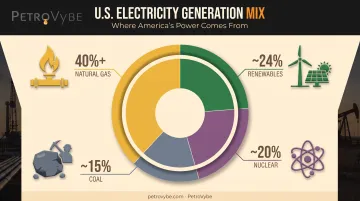
Someone has to generate all this electricity. The current U.S. mix looks like this:
- Natural gas: over 40%
- Renewables: ~24%
- Nuclear: ~20%
- Coal: ~15%
Data centers need what the industry calls "firm power" — continuous, high-density baseload electricity that doesn't fluctuate with weather. Solar drops off at night. Wind dies down without warning. Neither can single-handedly support a facility that can't afford even a momentary outage.
Natural gas fills that gap. It's fast to bring online, scalable, and dispatchable on demand. S&P Global projects 55-65 GW of new U.S. grid-based gas capacity between 2025 and 2030 — roughly double pre-AI-boom expectations. S&P cautions even that buildout may fall short of what's needed.
The Shift Toward Direct Power Deals
Rather than waiting on utility queues, data center developers are increasingly striking direct power purchase agreements with generators, including natural gas producers. This behind-the-meter approach lets developers lock in supply without depending entirely on already-strained grid infrastructure.
That upstream supply story is where PetroVybe sits. The company develops natural gas liquids across a 58,000-acre position in Lavaca County, South Texas — roughly 400 acquired wells plus 57+ planned new wells.
Those assets are positioned against rising AI-driven electricity demand. PetroVybe has not disclosed specific offtake agreements or named hyperscaler relationships; it is a development play at the front of the demand curve, not a completed supply contract.
Texas isn't leaving this to chance, either. Senate Bill 6 sets a 75-MW threshold for "large loads," requiring site-control standards and cost-responsibility rules for interconnection. ERCOT's Large Load Interconnection Process now formally studies and screens these massive new demand requests before approving them.
The Investment Angle: Why This Matters for Accredited Investors
Data center power demand is a multi-decade infrastructure buildout, not a brief spike in load.
Hyperscaler capex alone — Amazon, Microsoft, Google, and Meta combined — exceeded $200 billion in 2024. That capital doesn't disappear once servers get plugged in. It requires sustained electricity generation for years, likely decades, to come.
Early-stage natural gas development sits early in that value chain. Before midstream buildout. Before utility infrastructure catches up. Before the market fully prices in what's coming.
For accredited investors, PetroVybe structures its projects with tax-advantaged mechanics:
- Intangible Drilling Costs (IDC) deductible against active income, including W-2 earnings and capital gains
- 2025 partners achieved a 94% deduction against active income. Prior result; not a promise of any future deduction.
- IDC deductions can be claimed in year one or spread across five tax years. This treatment requires the investor to elect general partner status in the Subscription Agreement and may be limited in a given year by the excess business loss limitation under IRC §461(l).
These are documented historical results, not promises. As PetroVybe's own disclosures state: "These securities involve a high degree of risk and there is no assurance that the investment objectives of the project will be attained. Past performance is no guarantee of future results." Projections such as forecasted returns are forward-looking statements subject to material uncertainty, and prospective investors should review the Private Placement Memorandum and consult independent counsel.
Economic and Grid Challenges to Watch
Rising demand doesn't just create opportunity. It creates friction, and someone ends up paying for it.
- PJM's market monitor attributes $9.3 billion of 2025/2026 capacity-market revenue increases directly to data center load, a 174% jump from this single source
- Virginia's Dominion will apply new large-load tariffs starting in 2027, requiring covered customers to pay at least 85% of contracted transmission costs
- Texas SB6 leans on interconnection screening and cost-responsibility rules instead of broad tariff shifts
- DOE/LBNL estimates U.S. data centers used roughly 17.4 billion gallons of water in 2023 for cooling alone
These pressures don't halt growth. They force regulators, ratepayers, and developers to negotiate who bears the cost.
Sustainability and Efficiency Efforts in the Industry
Data center operators are investing in cleaner power and lower facility overhead as load grows.
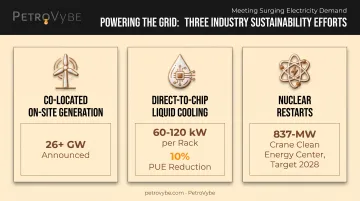
Efforts scaling across the industry include:
- Co-located on-site generation: S&P Global tracks over 26 GW of announced capacity through the early 2030s, often small gas turbines or fuel cells that can come online fast
- Direct-to-chip liquid cooling: handles 60-120 kW per rack and can cut power usage effectiveness (PUE) by roughly 10% versus air cooling
- Nuclear restarts: Constellation’s 20-year power purchase agreement with Microsoft supports bringing the 837-MW Crane Clean Energy Center (formerly Three Mile Island Unit 1) back online, targeting 2028
Natural gas remains the practical bridge. Per EIA data, gas produces less than half the direct CO2 of coal per kilowatt-hour (0.976 lb versus 2.257 lb). It is still the fastest path to reliable new capacity while renewable and nuclear projects scale over the next decade.
Frequently Asked Questions
Why do data centers demand so much electricity?
Constant 24/7 server operation, intensive cooling, and AI's GPU-heavy workloads drive round-the-clock, high-density power use. That load profile is unlike a typical commercial building.
Does the U.S. have enough electricity for data centers?
Current grid capacity is straining in concentrated hubs like Virginia and Texas, with multi-year interconnection waits. New generation, particularly natural gas, is essential to closing the gap.
How much electricity does a single data center use?
A 100-MW hyperscale AI facility can consume roughly as much annual electricity as 100,000 households, according to the IEA. The largest emerging facilities are pushing well beyond that scale.
What percentage of US electricity is used by data centers?
Data centers used roughly 4.4% of U.S. electricity in 2023, with projections reaching 6.7%-12% by 2028 and potentially 9%-17% by 2030 under various models.
Will data centers increase my electricity bill?
Regional rate increases are already visible in PJM markets. Carnegie Mellon modeling projects an 8% average increase in national electricity-generation costs by 2030, with Virginia potentially seeing increases exceeding 25%.
Is natural gas the primary power source for data centers?
Yes. Natural gas supplies over 40% of U.S. data center electricity as of 2024 and is projected to retain that lead through 2030, according to IEA modeling.
Informational requests only. PetroVybe projects are offered solely to verified accredited investors. Submitting this form does not create an investment or advisory relationship.