

Many high-income earners save consistently every year, yet their net worth barely moves. High taxes eat into returns. Inflation quietly erodes purchasing power. And a portfolio parked entirely in stocks and a house isn't diversification, it's concentration with extra steps.
In the Federal Reserve's 2022 Survey of Consumer Finances, families in the top 10% by income had a median net worth of $2,556,200, but the mean was $6,629,600 — a gap that shows income alone doesn't guarantee real wealth. Building it takes structure.
This article covers what wealth accumulation actually means, why it matters, the strategies that work, and the traditional and alternative products (including tax-advantaged direct investments) that make up a modern accumulation portfolio.
Key Takeaways
- Wealth accumulation is a long-term, disciplined process, not a get-rich-quick outcome.
- Combining saving, debt management, diversification, and tax efficiency accelerates net worth growth.
- 401(k)s, IRAs, and real estate remain foundational, but natural gas development adds tax efficiency many portfolios lack.
- Diversifying beyond stocks and bonds improves inflation resistance and reduces market correlation.
What Is Wealth Accumulation?
Wealth accumulation is the systematic increase of assets, investments, and net worth over time, with the goal of long-term financial security. It happens through saving, compounding returns, and reinvesting gains back into productive assets.
Economically, this overlaps with a concept called capital accumulation: reinvesting profit, interest, or capital gains to grow both financial and tangible assets. The Federal Reserve frames it simply — your wealth changes based on saving (income minus consumption), capital gains, and net transfers between family members. Three levers, one outcome: net worth either grows or it doesn't.
Accumulation vs. Preservation
It helps to know which phase of your financial life you're actually in.
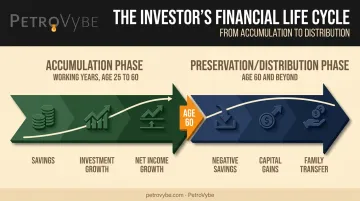
Your accumulation phase covers the working years when income exceeds consumption and you're actively building assets. The preservation/distribution phase follows: saving often turns negative, but net worth can still rise as capital gains and transfers offset the drawdown.
Federal Reserve research shows average per-capita saving turns negative around age 60, yet wealth can keep climbing if the underlying assets appreciate. That's the difference between actively adding to your pile and simply protecting what you've already built.
Why Wealth Accumulation Matters
Wealth accumulation creates options: the freedom to handle emergencies, chase big goals, and live well without leaning on every paycheck.
Emergency protection. A solid accumulation strategy creates a cushion against job loss, medical bills, or a market downturn. Without one, a single bad year can force high-interest debt or liquidating assets at the worst possible time.
Long-term goals. Early retirement, buying a home outright, funding a kid's education, leaving a legacy — none of these happen by accident. They require assets that have been growing for years, sometimes decades, before you need them.
Quality of life. Real median net worth rose 37% to $192,900 between 2019 and 2022, according to Federal Reserve data, showing that disciplined accumulation compounds at the household level, not just in theory. More net worth means more flexibility for experiences, philanthropy, and reduced dependence on a paycheck.
The catch: inflation constantly works against you. The Bureau of Labor Statistics defines purchasing power loss as what happens when a dollar buys less over time. Accumulation strategies that don't account for inflation are running in place.
Proven Strategies for Wealth Accumulation
These strategies require discipline more than complexity, and most people abandon them long before compounding has a chance to work.
Pay Yourself First and Automate Savings
Direct a fixed percentage of every paycheck to savings and investments before you spend a dime elsewhere. Fidelity recommends saving at least 15% of pretax income annually, including any employer match, assuming you start around age 25 and continue to 67.
High earners shouldn't stop at 15%. Increase your automated contribution rate by a percentage point or two each year, ideally tied to raises so you never "feel" the increase in your take-home pay.
Keep Housing and Debt Costs Below Your Means
Thomas Stanley's millionaire research found that when self-made millionaires bought their first home, the median purchase-price-to-annual-income ratio was just 1.49. That's a fraction of what many high earners stretch to today.
- Keep mortgage debt proportional to income, not to what a lender approves you for
- Eliminate high-interest consumer debt before ramping up investment contributions
- Redirect the freed-up cash flow into wealth-building assets, not lifestyle inflation
Diversify Across Asset Classes, Including Alternatives
Vanguard's analysis of 1,514 multiasset funds found that 92.1% of monthly return variability comes from the basic stock-bond policy mix. Translation: most portfolios move together, whether investors realize it or not.
True diversification means adding assets with genuinely different return drivers, not just more mutual funds. Real assets like real estate and private energy development can behave differently than a traditional 60/40 portfolio, especially when public markets are volatile.
Prioritize Tax-Efficient Investment Vehicles
Minimizing tax drag deserves the same attention as choosing your investments. Vanguard estimates that tax-aware asset location alone can improve after-tax returns by 0.05% to 0.30% annually over 30 years — and that's just from choosing which account holds which asset.
Certain direct investments go further. Oil and gas development, for example, can offer deductions well beyond what a typical retirement account allows. Unlike most real estate deductions, these can offset active income such as W-2 wages and capital gains, not just passive income.
Reinvest and Compound Consistently
Time in the market beats almost everything else. Fidelity's own modeling shows that investing $6,000 annually at a 7% return from age 25 to 67 produces nearly $1.5 million. Start at 30 instead, and you end up with just over $1 million, roughly $450,000 less, from only five fewer years of contributions.
That gap comes from giving compounding more time to work, not from contributing more money.
Real-World Examples of Wealth Accumulation
Strategy is one thing. Here's what it looks like in practice.
- Building an emergency fund — Start with $1,000, then build toward three to six months of essential expenses. This step prevents debt reliance when income gets interrupted.
- Contributing to retirement accounts — Consistent 401(k) and IRA contributions, paired with an employer match, put compounding to work automatically. Vanguard's 2025 data shows the average employer match sits at 4.6% of pay, pushing total contribution rates to roughly 12% on average.
- Building a diversified portfolio: blending equities, bonds, and real estate or rental property balances growth against stability, rather than betting everything on one asset class.
- Strategic debt management — Not all debt is equal. A mortgage on an appreciating rental property is "good debt" that builds equity. High-interest credit card balances are "bad debt" that erodes it.
- Direct participation in real asset development — Accredited investors increasingly look beyond public markets to tangible, income-producing assets. Natural gas development is one example: it pairs appreciation potential and passive income with real tax advantages in a single structure.

That last example deserves a closer look: it's one of the few strategies that delivers cash flow, asset growth, and tax efficiency at the same time.
Wealth Accumulation Products: From Traditional to Alternative Assets
A "wealth accumulation product" is any financial vehicle or asset class designed to grow capital over time. That spans everything from a basic savings account to a private equity stake in an energy project.
Traditional Products
These remain the backbone for most investors:
- 401(k) and IRA accounts — Tax-advantaged retirement savings, often with employer matching
- Brokerage accounts — Flexible investment accounts for stocks, bonds, and funds
- CDs and savings accounts — Low-risk, FDIC-insured vehicles with fixed terms and modest interest
Real Estate and Business Equity
Property ownership and equity stakes in private businesses offer tangible, appreciating value that doesn't move in lockstep with the stock market, at least not entirely. Morningstar found a 0.83 three-year correlation between REITs and U.S. stocks, a reminder that publicly traded real estate diversifies less than direct property ownership.
Alternative and Private Investments
For accredited investors, private placements open the door to asset classes retail investors rarely see. The SEC recorded $2.148 trillion raised through Regulation D offerings in 2024 alone, an indication of how much capital is now flowing into private markets outside the public stock exchange.
PetroVybe is one example of this shift. The private Texas natural gas development company gives accredited investors direct access to early-stage development projects, structured with substantial upfront tax deductions against active income. In 2024, PetroVybe partners realized a 94% tax deduction against active income, followed by 91% in 2025.
Both figures stem largely from intangible drilling cost deductions that, unlike most real estate write-offs, apply against W-2 wages and capital gains, not just passive income.
Beyond the tax structure, the projects target long-term passive income, with monthly distributions projected to peak above $10,000 during full production. The demand thesis is specific: natural gas already supplies roughly 42% of U.S. grid electricity, and AI-driven data center power demand is projected to keep climbing through 2030.
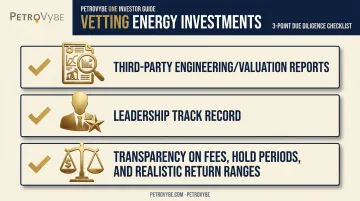
A word of caution: alternative investments carry real risk, including illiquidity and total loss of capital. The SEC is explicit that accreditation is an eligibility test, not an endorsement. Before committing capital, verify:
- Third-party engineering or valuation reports (PetroVybe cites a $48 million proved reserves valuation, PV-09, from a licensed third-party engineering firm)
- Leadership track record (PetroVybe's chief geophysicist has a documented 75.2% career success rate on well selection, versus an industry average below 40%)
- Transparency around fees, hold periods, and realistic return ranges rather than best-case-only projections
Frequently Asked Questions
What is the meaning of wealth accumulation?
Wealth accumulation is the process of growing your assets and net worth over time through saving, investing, and reinvestment. The goal is long-term financial security, not a quick windfall.
What are wealth accumulation products?
They include retirement accounts (401(k)s, IRAs), brokerage investments, real estate, business equity, and alternative private investments such as energy development. Each serves a different role in a diversified portfolio.
What is the difference between wealth accumulation and wealth preservation?
Accumulation focuses on growing assets during your working years. Preservation shifts the focus to protecting and distributing that wealth once you've reached or entered retirement.
How much of my income should I save for wealth accumulation?
Fidelity recommends saving at least 15% of pretax income annually, including employer contributions. Higher earners with aggressive goals should aim above that baseline.
Can alternative investments like oil and gas help with wealth accumulation and taxes?
Yes. Qualifying direct energy investments can offer substantial deductions against active income, including W-2 wages, while also generating passive cash flow. PetroVybe partners, for example, received a 94% deduction against active income in 2024 and 91% in 2025.
At what age should I start accumulating wealth?
The earlier, the better. Fidelity's modeling shows five extra years of compounding (starting at 25 instead of 30) can add roughly $450,000 by retirement. That said, disciplined strategies can still build meaningful wealth starting in your 40s or 50s.