Many teams overlook the residual value locked inside surplus assets. Equipment gets forgotten, liability exposure grows, and capital that could fund the next well pad stays frozen instead of compounding. This guide breaks down what surplus asset management actually is, why it matters, the best practices that protect value, and how auctions fit into the disposition process.
Key Takeaways
- Surplus assets retain resale or functional value; they aren't scrap or waste.
- About 10% of capital equipment sits idle at any time, per Investment Recovery Association data.
- Texas Railroad Commission rules tie inactive-well status to strict equipment removal deadlines.
- Matching disposition channel (private sale, broker, or auction) to asset type protects recovered value.
- Independent third-party validation strengthens surplus asset pricing and reserve valuations.
What Is Surplus Asset Management (SAM)?
Surplus asset management is the structured process of identifying, valuing, tracking, and disposing of or redeploying assets that no longer serve core operations but still hold usable or resale value.
Surplus vs. scrap: Surplus property is no longer needed anywhere in the organization but still retains functional or monetary worth. Scrap only has value for its raw material content, and misclassifying a serviceable pump or idle rig as scrap can mean leaving real money on the table.
Oil & Gas Examples of Surplus Assets
In upstream operations, surplus commonly shows up as:
- Decommissioned drilling rigs no longer assigned to active pads
- Excess casing and tubing inventory left over after a drilling program
- Idle wellhead equipment from wells that have been shut in or reworked
- Retired vehicles, generators, and support machinery replaced during fleet upgrades
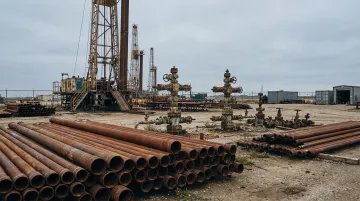
Each item retains market value long after it stops contributing to production.
Where SAM Fits in the Asset Lifecycle
SAM operates as a continuous layer within broader asset lifecycle management, the same discipline governing assets from acquisition through operation, maintenance, and eventual disposal or repurposing. Disciplined operators treat surplus recovery as an ongoing capital efficiency strategy rather than a periodic cleanup, capturing value that would otherwise go unnoticed.
Why Surplus Asset Management Matters
Unused equipment doesn't just sit quietly. It drains capital, creates liability, and complicates compliance, three problems that compound the longer an asset goes unmanaged.
The Capital Efficiency Case
Every dollar tied up in an idle rig or a forgotten pipe stack is a dollar not funding the next well pad, workover, or acquisition. The Investment Recovery Association estimates that 10% of an organization's capital equipment sits surplus at any given time (Investment Recovery Association).
That figure comes from the association's broader membership rather than an oil-and-gas-specific study, but it's directionally useful for any capital-intensive operator gauging idle exposure.
Recovering even a fraction of that locked capital means more cash available for higher-return projects instead of storage fees.
Risk and Regulatory Exposure
Idle equipment is both a financial drag and a liability. Unmanaged assets raise safety, environmental, and insurance risks, and in Texas, regulators treat inactive equipment as an active compliance concern rather than a background issue.
The Texas Railroad Commission defines an inactive well as one with no reported production, disposal, injection, or other permitted activity for 12 consecutive months (Texas Railroad Commission). Wells inactive that long trigger electricity-disconnection requirements, and surface equipment must come off once a well hits 10 years of inactivity.
Statewide Rule 8 also prohibits pollution of surface or subsurface water. Equipment left to corrode risks becoming a genuine regulatory violation, not just an eyesore.
Operational Efficiency and Reinvestment
Beyond compliance, surplus assets quietly inflate overhead:
- Racking up storage and yard fees for equipment nobody's using
- Requiring maintenance on machinery with no assigned project
- Inflating insurance premiums calculated against idle inventory
- Cluttering the balance sheet and obscuring true capital efficiency
Clearing this backlog does more than tidy the books. It frees up capital to reinvest in projects that compound, the same reinvestment discipline that keeps assets scaling instead of decaying in a yard.
Key Best Practices for Effective Surplus Asset Management
Strong SAM programs share a common thread: they treat disposition as a disciplined, ongoing process from day one.
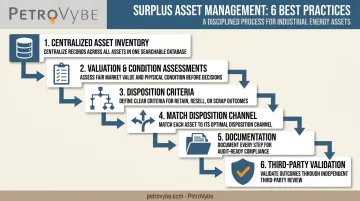
Build a centralized asset inventory. Maintain one system of record tracking location, condition, and status for every piece of equipment. Without visibility, surplus assets simply disappear into a yard and get forgotten.
Conduct regular valuation and condition assessments. Schedule periodic reviews to determine whether an asset should be redeployed, sold, or retired. Pricing decisions should reflect current condition; a valuation set on acquisition day quickly grows stale.
Establish clear disposition criteria. Define upfront which categories of assets get redeployed internally, sold, recycled, or scrapped, based on documented condition and current market demand.
Match the disposition channel to the asset. Private sale, broker networks, and auction platforms each fit different asset types and market conditions. High-demand equipment might move faster through a broker; specialized inventory may need a targeted auction audience.
Maintain thorough documentation. Compliance audits, environmental reporting, and internal reviews all depend on paper trails. Missing records can turn a routine sale into a legal headache.
Use independent, third-party validation for high-value assets. An outside appraisal or engineering review protects against underpricing valuable equipment, or overpaying to acquire it. Defensible valuations require documented condition, use, and market comparables.
Consistent process and disciplined follow-through matter more than sophisticated tools.
Surplus Asset Auctions: How They Work
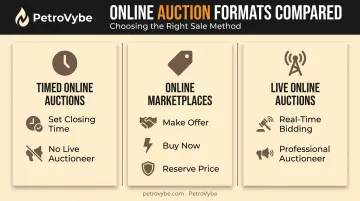
When internal redeployment isn't an option, auctions are often the fastest route to recovering value from surplus equipment. Three formats dominate the industrial and oilfield space.
Common Auction Formats
- Timed online auctions: bidding closes at a set time with no live auctioneer; late bids can extend the closing window
- Online marketplaces: platforms supporting Make Offer, fixed Buy Now pricing, or Reserve Price listings, giving sellers flexibility on how inventory moves
- Live online auctions: remote bidders watch a live auction ring and bid in real time as lots proceed in order
Ritchie Bros' Marketplace-E platform, for example, reported more than 22,000 items and roughly $500 million in sales within its first year of operation. That volume shows how much surplus equipment moves through structured online channels rather than word-of-mouth private sales.
Payment Methods to Expect
Payment terms vary by venue, but most established auction houses require full payment within a tight window.
| Auction House | Payment Deadline | Accepted Methods |
|---|---|---|
| Ritchie Bros. | 7 days | Wire transfer, online bank payment, debit or credit card (subject to venue limits) |
| Euro Auctions | 7 days | Bank wire, cashier or certified check, qualifying company check |
Large transactions often route through escrow arrangements for added security on both sides.
Tips for Buyers and Sellers
- Request inspection reports before bidding; condition claims should be verifiable, not just descriptive
- Benchmark pricing against recent comparable sales, not the asking price alone
- Confirm payment deadlines upfront, since missed windows can forfeit a winning bid
- Verify auction house reputation and settlement track record before committing to a high-value transaction
How PetroVybe Approaches Asset Optimization & Stewardship
PetroVybe applies the same discipline to legacy production assets that sound surplus asset management demands elsewhere. Nothing gets treated as disposable by default.
The company's PROTECT strategy centers on acquiring legacy production assets and executing targeted workovers rather than writing off underperforming wells. Instead of abandoning equipment once output slows, PetroVybe invests in restoring performance. That same logic separates strategic redeployment from reflexive scrapping.
Luke McIntosh, VP of Asset Intelligence & Performance, oversees the operational and production data behind these calls. His work translates field-level metrics into decisions about which assets get reinvestment and which get retired, keeping the process grounded in numbers rather than guesswork.
Independent validation backs the approach. PetroVybe's proved reserves, valued at $48MM (PV-09), were determined by a licensed third-party engineering firm, one of three separate engineering reports covering the company's development areas. That same principle of outside verification, rather than self-reported figures, mirrors what sound surplus asset valuation requires:
- Documented condition of the asset
- Market comparables for pricing context
- An appraiser with no stake in the outcome
This stewardship-driven mindset extends to how PetroVybe structures capital deployment for accredited investors. The company's natural gas development opportunities, open to accredited investors at a $100,000 minimum investment, apply the same protect-and-compound philosophy to production assets in Lavaca County, Texas. The structure pairs tax-advantaged benefits with a long-term hold instead of a short-term flip.
Frequently Asked Questions
What is a surplus asset in surplus asset management?
A surplus asset is physical or financial property no longer needed for core operations but that still holds usable or resale value. It's distinct from scrap, which only has raw material worth.
What forms of payment do surplus asset management (SAM) auctions accept?
Most auction houses accept wire transfer, bank payment, and certified or cashier's checks, with payment typically due within seven days. Larger transactions often use escrow arrangements for added security.
How is the value of a surplus asset determined?
Valuation generally combines a condition assessment, market comparables, and sometimes an independent third-party appraisal. Established approaches weigh replacement cost, age, and functional obsolescence.
What industries rely most heavily on surplus asset management?
Capital-intensive sectors like oil and gas, manufacturing, construction, and heavy equipment rely most on structured SAM programs. These industries carry large physical asset bases that regularly cycle out of active use.
How is surplus asset management different from simple asset disposal?
SAM is an ongoing, strategic process built to maximize recovered value across an asset's lifecycle. Disposal is usually a one-time, reactive action taken only after an asset is declared unwanted.
Can effective surplus asset management improve a company's overall financial performance?
Yes. Recovered capital and lower carrying costs free up cash that can be reinvested into higher-return projects, improving both liquidity and long-term returns.