This article is general education, not investment, tax, or legal advice. Tax rules change and apply differently to every taxpayer. Oil and gas taxation is one of the most misunderstood corners of the tax code. Most investors assume energy investing means volatile commodity bets. Few realize it also offers some of the most aggressive deductions available anywhere in U.S. tax law.
Between severance taxes, depletion allowances, and intangible drilling cost (IDC) deductions, both companies and individual investors face a layered but potentially lucrative landscape. Get it right, and you can offset active income in ways real estate and stock losses simply can't match. This treatment requires the investor to elect general partner status in the Subscription Agreement and may be limited in a given year by the excess business loss limitation under IRC §461(l).
This guide breaks down how oil and gas taxes actually work, what deductions exist, and how accredited investors use them strategically.
Key Takeaways
- IDC deductions offset active income—including W-2 wages and capital gains—not only passive income
- Depletion allowances let royalty and working interest holders deduct a share of income each year as reserves decline
- Severance tax varies by state; Texas has no individual income tax and taxes production directly
- Restored 100% bonus depreciation under the 2025 OBBBA expanded first-year write-offs for qualifying costs. This treatment requires the investor to elect general partner status in the Subscription Agreement and may be limited in a given year by the excess business loss limitation under IRC §461(l).
What Is Oil and Gas Tax? Understanding the Basics
Oil and gas taxation isn't one tax. It's a stack of them.
The layered structure includes:
- Federal income tax on profits or distributive shares
- State income tax (where applicable)
- Severance tax on extracted resources
- Property/ad valorem tax on equipment and mineral interests
Royalty payments to landowners or mineral rights holders aren't taxes, but they reduce net revenue before tax is calculated.
Working Interest vs. Royalty Interest
This distinction drives how income and deductions get treated.
A working interest means active participation, including cost-sharing in drilling and operations. Holders can deduct IDCs against active income. This treatment requires the investor to elect general partner status in the Subscription Agreement and may be limited in a given year by the excess business loss limitation under IRC §461(l). They generally aren't subject to passive-loss limitations—even without material participation—as long as liability isn't limited under IRC partnership rules.
A royalty interest is passive. No cost-sharing, no drilling risk, and no IDC deductions. Royalty income is typically reported on Schedule E.
Entity structure matters as much as interest type. Federal C corporations pay a flat 21% corporate tax rate. Direct development partnerships generally don't pay tax at the entity level. Profits and losses pass through to partners, who report their share on their own returns.
Intangible Drilling Costs: The Biggest Tax Advantage for Investors
IDCs cover costs with no salvage value once a well is drilled, including:
- Survey work, wages, and fuel
- Drilling services and fracturing
- Expendable supplies, ground preparation, and geology services
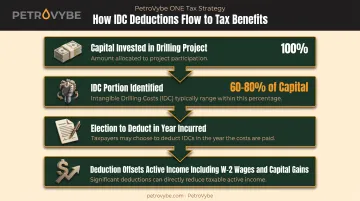
Under IRC Section 263(c), taxpayers with an operating or working interest can elect to deduct these costs in the year incurred, rather than capitalizing them over time.
Why this matters: IDCs typically represent a first-year deduction target of approximately 70–80% of invested capital in a new-drilling development project. Most of your capital can become deductible in the first year. This treatment requires the investor to elect general partner status in the Subscription Agreement and may be limited in a given year by the excess business loss limitation under IRC §461(l).
The Active Income Advantage
Most investment losses only offset passive income. IDCs are different.
A working interest held directly (or through an entity that doesn't limit liability) isn't treated as passive regardless of material participation. That means IDC deductions can offset:. This treatment requires the investor to elect general partner status in the Subscription Agreement and may be limited in a given year by the excess business loss limitation under IRC §461(l).
- W-2 wages
- Capital gains
- Other active income sources
This is rare in the tax code. Real estate losses can't do this for most investors. Neither can typical stock losses.
PetroVybe's own numbers illustrate the mechanism: partners in its development programs received a 94% first-year deduction against active income in 2025. Prior result; not a promise of any future deduction. This treatment requires the investor to elect general partner status in the Subscription Agreement and may be limited in a given year by the excess business loss limitation under IRC §461(l).
IDC deductions pass through on Schedule K-1—either fully in year one or spread evenly over five years, depending on structuring. This treatment requires the investor to elect general partner status in the Subscription Agreement and may be limited in a given year by the excess business loss limitation under IRC §461(l).
AMT Considerations
Large corporations face Alternative Minimum Tax limitations on IDC benefits. For individual accredited investors, this is generally less of a concern.
For 2025, excess IDC only enters AMT preference calculations to the extent it exceeds 65% of net oil-and-gas income, and independent producers get a further exception limiting inclusion to amounts exceeding 40% of AMTI computed under current Form 6251 instructions. Most individual investors in direct partnerships won't hit these thresholds.
Depletion Allowance: Ongoing Tax Relief on Production Income
Depletion works like depreciation, except instead of an asset wearing out, it's a resource running out.
Two calculation methods:
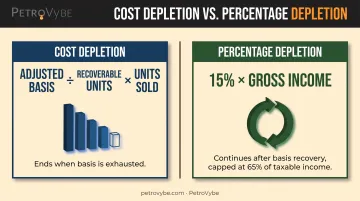
- Cost depletion - Divide your adjusted basis by total recoverable units, then multiply by units sold that year
- Percentage depletion - Apply 15% to gross income from eligible production
Percentage depletion is generally available to independent producers and royalty owners on up to 1,000 barrels per day (or the natural gas equivalent).
Here's the part that makes percentage depletion especially valuable: it keeps going even after you've fully recovered your original investment basis. Long-life wells can generate this deduction year after year, long after cost depletion would have run out.
Percentage depletion is capped so the deduction generally can't exceed 65% of specially computed taxable income, with disallowed amounts carrying forward. It's also restricted for large retailers and refiners above certain thresholds, which is why this benefit tends to favor independent producers and direct investors over integrated majors.
One caveat: whether a specific partnership structure classifies investors as working interest holders, royalty owners, or both for depletion purposes depends entirely on the offering documents. Review this carefully in any Private Placement Memorandum before assuming eligibility.
Other Industry Taxes Investors and Owners Should Know
Federal IDC and depletion get most of the attention, but state and local taxes still shape net returns for owners and limited partners.
Severance and State-Level Taxes
Most oil and gas producing states levy a severance tax on extraction, and it is generally deductible against federal income tax.
Texas is a clear example of the tradeoff:
- No state individual income tax
- 4.6% crude oil production tax on market value
- 7.5% natural gas production tax on market value
For projects in Texas basins, including PetroVybe's Lavaca County and Gulf Coast Basin positions, severance tax is a cost of doing business. The lack of state income tax on the personal side is a meaningful offset for investors.
Property and Ad Valorem Taxes
Mineral leases, drilling rigs, and storage facilities can all face property tax based on assessed value. Texas requires income-producing property renditions by April 15 each year, and appraisal districts use that data to set taxable values.
Confirm in any partnership agreement who bears ad valorem cost. That allocation directly affects partner-level net returns.
Recent Tax Law Changes Affecting Oil and Gas Investors
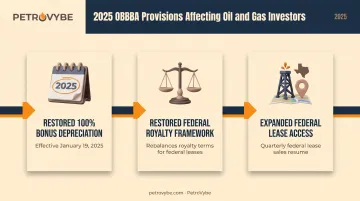
The 2025 One Big Beautiful Bill Act (OBBBA), signed into law as P.L. 119-21, made several changes relevant to individual investors:
- Restored 100% bonus depreciation for qualifying equipment placed in service after January 19, 2025
- Restored the prior federal royalty framework for onshore leases, after repealing an Inflation Reduction Act provision
- Expanded lease access, requiring quarterly federal onshore lease sales and mandating a minimum number of ANWR and National Petroleum Reserve-Alaska sales over the next decade
Federal offshore royalties now fall in a range of 12.5% to 16.67%, not a flat 12.5% figure. Most of these federal leasing provisions only matter to a private partnership if it acquires or participates in federal leases.
Net effect for private development participants: these changes generally expanded available tax advantages.
Looking ahead to 2026: Two bills are worth watching:
- H.R.383 would repeal IDC and percentage depletion entirely
- H.R.8034 would raise the depletable oil quantity limit from 1,000 to 2,000 barrels
Neither is enacted law as of this writing, but both show these provisions remain politically active. Confirm current status with a CPA before basing investment decisions on today's rules.
How Accredited Investors Use Oil and Gas Tax Benefits to Build Wealth
Passive stock ownership in energy companies doesn't unlock IDC or depletion deductions. Direct participation in development does.
That structural gap is why accredited investors favor direct partnerships over energy ETFs or MLPs. PetroVybe, for example, structures partnerships so investors hold a direct position in Texas oil and natural gas development.
What that position is designed to deliver:
- K-1 reporting that can pass through IDC deductions against active income (including W-2 and capital gains, when eligible)
- Depletion allowances tied to production over the hold period
- Long-term return targets expressed as MOIC and IRR, driven by reinvested cash flow and compounding output
- Passive quarterly distributions during the production phase, without operating the assets yourself. This treatment requires the investor to elect general partner status in the Subscription Agreement and may be limited in a given year by the excess business loss limitation under IRC §461(l).
Tax savings free up capital; production economics are meant to compound it. Credibility still rests on third-party work—reserve valuations, engineering reports, and independent audits that support depletion and IDC claims. PetroVybe includes a $48 million PV-09 valuation from a licensed third-party engineering firm and a clean 2025 audit opinion from Weaver in its investor diligence materials. Prepared by Lee Keeling & Associates, Tulsa, March 2026.
None of this replaces individual tax advice. Eligibility for IDC deductions and percentage depletion depends on your tax situation, income sources, and how the partnership is structured. Talk to a CPA before committing capital.
Frequently Asked Questions
Are gas taxes changing in my state?
Pump-level gas excise taxes do change with state legislation, but they are separate from oil and gas industry income taxation. Check your state's Department of Revenue for current rates.
What is the difference between a working interest and a royalty interest for tax purposes?
Working interest holders share drilling costs and can offset active income with IDC deductions. Royalty interests are passive, involve no cost-sharing, and are reported on Schedule E. This treatment requires the investor to elect general partner status in the Subscription Agreement and may be limited in a given year by the excess business loss limitation under IRC §461(l).
Can I deduct oil and gas investment losses against my W-2 income?
Yes—IDC deductions from a working interest can offset active income, including W-2 wages. That treatment differs from most passive losses on real estate or securities. This treatment requires the investor to elect general partner status in the Subscription Agreement and may be limited in a given year by the excess business loss limitation under IRC §461(l).
How is percentage depletion different from cost depletion?
Percentage depletion applies a flat 15% to eligible gross income and continues after basis is fully recovered. Cost depletion is based on adjusted basis divided by recoverable units. Taxpayers must use whichever method yields the larger deduction.
Do I need to be an accredited investor to invest in oil and gas development projects?
Many private development partnerships, including PetroVybe's, are limited to accredited investors under SEC Regulation D Rule 506(c), which requires third-party income or net worth verification.
Are oil and gas tax deductions likely to change under future legislation?
Pending bills such as H.R.383 and H.R.8034 could affect IDC or depletion rules. Consult a CPA and review legislative updates each year.
Informational requests only. PetroVybe projects are offered solely to verified accredited investors. Submitting this form does not create an investment or advisory relationship.