Introduction
Sit on a billion barrels of oil, and you'd expect prosperity to follow. Often, it doesn't.
A 2026 Princeton-led study published in PNAS found that resource windfalls erode the public institutions meant to manage them, trapping countries in cycles of extraction dependence rather than lasting growth.
The pattern shows up at every scale. Whether you're a nation, a community, or an individual investor, resource wealth can compound into generational prosperity or evaporate through mismanagement, volatility, and weak oversight.
This guide breaks down what natural resource wealth means, why the "resource curse" happens, and how top-performing nations like Norway avoid it. Then we'll show how the exact same principles apply when individual investors evaluate resource-based investment opportunities.
Key Takeaways
- Institutional strength and reinvestment discipline, not resource wealth alone, decide the outcome
- The "resource curse" can leave resource-rich regions poorer, more corrupt, and less diversified than peers
- Norway proves the curse is avoidable through transparent, rules-based revenue management
- Investors face the same choice: transparency and reinvestment discipline separate winners from losers
What Is Natural Resource Wealth?
Natural resource wealth is the economic value derived from fossil fuels, minerals, water, and land-based assets: the resources underpinning energy supply and industrial production. It's the crude beneath the Permian Basin, the natural gas in a Gulf Coast reservoir, the lithium in a Chilean salt flat.
Managing that wealth matters at two very different levels:
- National/macroeconomic level: Government revenue, GDP contribution, and public investment decisions
- Personal/portfolio level: Direct investment in resource-producing assets, from royalty interests to working interests in producing wells
- Industry/operator level: Extraction costs, production efficiency, and profit margins that determine project returns
Physical abundance is only half the story. What matters more is how effectively a country or investor converts that abundance into actual revenue.
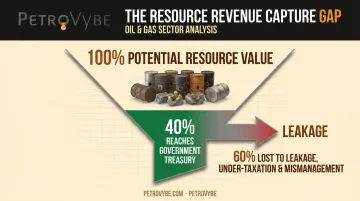
Sub-Saharan African nations collect, on average, only about 40% of the revenue they could potentially derive from their natural resources, according to a 2023 World Bank report.
Sixty percent of potential value simply never gets captured. That gap between what's in the ground and what actually reaches a treasury (or an investor's bank account) is the real story of resource wealth management.
The Resource Curse Explained: When Abundance Becomes a Liability
The "resource curse," also called the paradox of plenty, describes a strange but well-documented reality: countries rich in oil, gas, or minerals frequently experience slower growth, weaker democratic institutions, and worse development outcomes than countries with far fewer natural resources.
The Princeton-led PNAS study modeled why this happens. Resource windfalls tend to degrade public institutions over time, reducing the incentive for governments to build strong tax accountability. Resource revenue doesn't require the same citizen buy-in that income or sales taxes do.
The study found that each additional percentage point of GDP derived from natural resources correlates with a 0.2 percentage-point reduction in tax revenue as a share of GDP. Small on paper, compounding over decades.
Dutch Disease: How Resource Booms Crowd Out Other Industries
The term originated in 1959, when the Netherlands discovered the massive Groningen gas field. Currency inflows from gas exports pushed up the value of the guilder, making Dutch manufactured exports more expensive and less competitive abroad. The Economist coined the phrase "Dutch disease" in 1977 to describe the mechanism.
Modern examples show the same pattern, just with sharper consequences:
| Country | Extractive dependence signal |
|---|---|
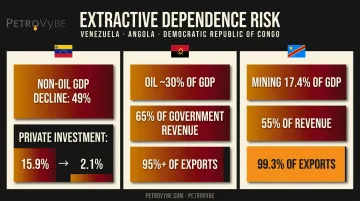
| Venezuela | Non-oil GDP fell 49% (2013-2018); private investment dropped from 15.9% to 2.1% of GDP |
| Angola | Oil accounts for ~30% of GDP, 65% of government revenue, and over 95% of exports |
| DRC | Mining represents 17.4% of GDP, 55% of revenue, and 99.3% of exports (2017) |
None of these countries diversified fast enough before the resource cycle turned against them.
Institutional Erosion and the "Leakage" Problem
Researcher Nusrat Molla, co-author of the Princeton study, describes institutions as a pipeline. When that pipeline is strong, resource revenue flows into education, infrastructure, and public services. But when it's weak, revenue "leaks" out through corruption, patronage, and mismanagement before it ever reaches the public good it was meant to fund.
The model finds corruption tends to rise alongside resource revenue in weak-institution settings, reinforcing the same tax-accountability gap mentioned above. The starting point matters enormously. Countries with stronger institutions before a resource boom hold onto more of that wealth. Those without them tend to see it siphoned away.
Revenue Volatility and Boom-Bust Cycles
Commodity price swings compound the leakage problem. Oil prices nearly quadrupled during the 1973-74 embargo, from $2.90 to $11.65 per barrel. More recently, monthly average WTI crude fell 69.3% between its June 2008 peak of $133.88 and its December low of $41.12.
Governments that spend resource revenue as it arrives, rather than reserving it against downturns, get whipsawed. Budgets planned around $130 oil collapse when prices hit $40. Individual investors face this same exposure: without hedging or reserve discipline, price swings can erase returns just as fast as they crater national budgets.
Which Countries Hold the Most Natural Resource Wealth?
Russia, the United States, Saudi Arabia, Canada, Iran, China, and Brazil are commonly cited among the countries with the largest natural resource reserves, spanning oil, gas, timber, and minerals. No single authoritative index combines all these asset classes into one clean global ranking, so treat any "top 10" list with some skepticism.
Reserve size alone tells you almost nothing about outcomes. Compare two oil-rich economies:
| Metric (2025) | Norway | Venezuela |
|---|---|---|
| GDP per capita | $94,594 | $3,495 |
| Corruption Perceptions Index score/rank | 81/100, rank 4 of 182 | 10/100, rank 180 of 182 |
Both countries sit on massive petroleum reserves. One built one of the world's wealthiest societies. The other collapsed into economic crisis. The difference is management, not geology.
The United States offers its own instructive case. Texas' Gulf Coast Basin has converted resource abundance into consistent economic value through strong property rights and regulatory oversight.
The Texas Railroad Commission anchors that oversight, licensing operators and permitting every well drilled in the state — PetroVybe operates its South Texas projects under this same OpCo licensing structure. That framework creates a public paper trail:
- Investors can verify exactly who operates a given well
- Regulators can confirm operators hold active, compliant licenses
- Landowners can trace ownership and production history over time
It's a small-scale version of the institutional strength that separates Norway from Venezuela.
How Nations Successfully Manage Resource Wealth
The Princeton study and World Bank research converge on one core prescription: invest resource windfalls into human, social, and physical capital, such as education, infrastructure, and health, before extraction declines. Wait too long, and the window closes.
Norway is the benchmark. Its Government Pension Fund Global held NOK 21.268 trillion at the end of 2025.
Petroleum revenues flow into the fund and get invested abroad, insulating the domestic economy from oil-price swings. Spending is capped by a fiscal rule tied to the fund's expected long-term real return, roughly 3% annually, rather than however much oil happens to sell for that year.
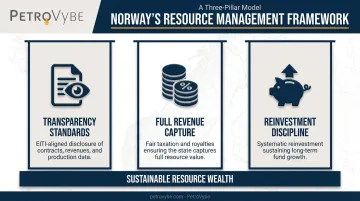
Three structural elements make this model work:
- Transparency standards: Initiatives like the Extractive Industries Transparency Initiative (EITI) require disclosure of extraction rights, contracts, and revenue flows, making it harder for narrow interests to quietly capture resource wealth
- Full and fair revenue capture: The World Bank recommends governments collect the full taxation and royalty value owed on extraction, rather than under-taxing to attract investment and losing revenue outright
- Continuous reinvestment discipline: Even diversified economies can slide back into resource dependency after an external shock. Reinvestment discipline has to continue indefinitely, well past the initial windfall years
Skip any one of these and the curse finds a way back in.
Applying These Lessons to Personal Natural Resource Wealth Management
Here's the thing: the same forces that make or break a nation's resource wealth apply almost exactly to an individual investor evaluating an oil and gas opportunity. Transparency, institutional strength, and reinvestment discipline aren't abstract policy concepts. They're due diligence checklist items.
Third-party validation functions like strong institutions at the national level. Weak oversight lets revenue leak away, and the same leak happens when investors rely solely on an operator's own claims.
Independent, third-party engineering review closes that gap. PetroVybe, for example, backs its offerings with a $48 million PV-9 proved reserves valuation completed by a licensed third-party engineering firm, not a self-reported figure. Investor reviews are similarly independent, verified through Invest Clearly rather than collected in-house.
Operator track record matters as much as governance quality matters for a country. Governments with a history of managing windfalls well tend to keep doing so, and operators are no different: a documented history of successful well selection predicts future success.
PetroVybe's Chief Geophysicist, Michael Stamatedes, has a 75.2% career hit rate over 48 years identifying profitable well locations, against an industry peer average below 40%. That gap directly affects decline-curve outcomes and long-term returns.
Reinvestment discipline mirrors the national playbook exactly. Norway doesn't spend its oil revenue as it arrives; it reinvests for the long term.
PetroVybe applies the same logic through what it calls strategic compounding: cash flow from producing wells gets redeployed into new development rather than paid out as a one-time distribution. This principle drives PetroVybe ONE's 10-year target MOIC of roughly 2.2x to 5.8x, growth built by stacking wells over time rather than betting on a single outcome.
Tax efficiency reduces the "leakage" that erodes personal returns, just as full royalty capture reduces leakage at the national level. Intangible Drilling Cost (IDC) deductions let qualifying working-interest investors offset a substantial share of active income, W-2 wages and capital gains, not just passive income. PetroVybe partners received a 94% deduction against active income in 2024 and 91% in 2025.
Finally, capturing value at the point of extraction rather than ceding it to intermediaries is exactly what resource-rich nations do best when they succeed. Direct participation in early-stage natural gas development, rather than passive commodity exposure through an ETF or MLP, gives accredited investors that same entry-point advantage.

Frequently Asked Questions
What is the resource wealth paradox?
The resource wealth paradox, or paradox of plenty, describes how countries rich in natural resources can experience slower growth and weaker institutions than resource-poor countries. The failure traces back to governance and reinvestment decisions, not the resources themselves.
Which country has the most natural resource wealth?
Russia, the United States, Saudi Arabia, Canada, Iran, China, and Brazil are commonly cited among the most resource-rich nations. No single ranking combines every asset class, and abundance alone doesn't determine economic outcomes.
What is the difference between the resource curse and Dutch disease?
Dutch disease is a specific mechanism: currency appreciation from resource exports that harms other export sectors. The resource curse is the broader phenomenon, covering governance, conflict, and growth effects, with Dutch disease as one contributing factor.
Can the resource curse be avoided or reversed?
Yes. The Princeton study found that strong pre-existing institutions and reinvestment in human and social capital can prevent or reverse the curse. Norway remains the standard example of this working in practice.
How can individual investors benefit from natural resource wealth without the risks tied to the resource curse?
Prioritize transparency, third-party validation, and experienced operators with documented track records. Disciplined reinvestment into new development, rather than one-time payouts, mirrors the same principles that protect nations from mismanagement.
Is investing in oil and gas development still a smart wealth-building strategy today?
Direct participation in well-managed, transparently operated natural gas development can offer meaningful tax efficiency, passive income, and asset growth. Companies like PetroVybe pair third-party reserve engineering with experienced operators, the kind of independent oversight that separates disciplined investments from speculative ones.