
This article is general education, not investment, tax, or legal advice. Tax treatment depends on individual circumstances.
Receiving a percentage of production revenue from a well you've never set foot on — no rig operations, no crew management, no operational headaches — is an idea that resonates with accredited investors navigating inflation, heavy tax burdens, and market volatility.
That appeal is exactly why oil and gas royalty investments are drawing serious attention from high-net-worth individuals and family offices.
This guide covers everything an accredited investor needs to evaluate this asset class: how royalties are defined, which interest types exist, how payments are calculated, what tax advantages apply, what risks to plan for, and how to identify a credible opportunity.
Key Takeaways
- Royalty interest owners receive a share of gross production revenue with no drilling or operating cost obligations
- Working interest owners bear production costs but access different tax advantages, including IDC deductions against active income — and accept cost obligations, unlimited liability exposure, and the risk of loss of invested capital
- 15% depletion deduction: royalty income qualifies for this reduction under current IRS rules for independent producers
- All wells decline naturally over time, making production history and third-party reserve estimates non-negotiable before committing capital
- Private interests deliver direct ownership and different tax treatment; publicly traded royalty trusts trade those advantages for liquidity
What Are Oil and Gas Royalties?
Oil and gas royalties are payments made to a rights holder — typically a percentage of revenue from hydrocarbons extracted from a property — without requiring the owner to bear drilling or operating costs. The royalty owner sits above the cost line: production happens, revenue flows, and they receive their share.
Two concepts that often get conflated are worth separating cleanly:
- Mineral rights = ownership of the subsurface resource itself, which can include leasing rights, bonus payments, and the right to receive royalties
- Royalty interest = the right to receive a portion of production revenue derived from those mineral rights, without executive rights or bonus entitlements in most cases
Mineral rights grant broader control. A royalty interest is narrower — income from extraction, without a say in how or when operations run. That distinction matters most when evaluating what you're actually buying.
How Royalty Arrangements Work
A royalty agreement begins when an operator or working interest owner leases mineral rights from a landowner or rights holder. In exchange, the rights holder receives a defined royalty percentage of production revenue for the life of the well or lease.
The split between gross revenue interest and net revenue interest defines who bears the cost burden:
- Royalty owners receive a share of gross production value — before operating expenses are deducted
- Working interest owners receive net revenue after costs are taken out
That separation is why royalty ownership is considered passive. The royalty holder doesn't fund operations, and in exchange, they don't capture the full upside either.
Why Investors Pay Attention to Oil and Gas Royalties
The appeal is straightforward:
- Passive income with no operational involvement or management decisions
- Long production timelines — conventional fields can produce for decades, though unconventional shale wells commonly decline more than 50% in year one
- Asset appreciation potential if nearby drilling activity increases or commodity prices rise
- Portfolio diversification beyond stocks, bonds, and real estate
Types of Oil and Gas Royalty Interests
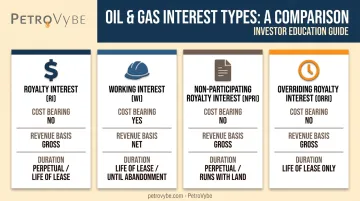
Understanding which interest type you hold — or are purchasing — determines your income rights, tax treatment, and cost exposure. There are four primary structures in U.S. oil and gas investment.
Royalty Interest (RI)
A Royalty Interest entitles the holder to a percentage of gross production revenue without bearing any drilling or operating costs. The RI holder retains mineral ownership even after production ceases, though royalty payments stop when production does.
Key characteristics:
- No cost obligations — purely passive income
- Typically carved from the mineral estate
- Subject to percentage depletion deduction (currently 15% of gross royalty income for qualifying independent producers and royalty owners under IRC §613A)
- Royalty income reported on Schedule E — generally not subject to self-employment tax
Working Interest (WI)
A Working Interest owner shares in drilling and operating costs but receives a proportionally larger share of net production revenue after royalties. Unlike royalty interests, WI is not passive ownership — investors carry operational risk, cost obligations, and liability exposure in exchange for different tax advantages.
The most important distinction involves Intangible Drilling Costs (IDCs): labor, fuel, chemicals, and site preparation. Under IRC §263(c), working interest owners can elect to deduct these costs in the year incurred. Under IRC §469(c)(3), those deductions are not restricted to passive income — they can offset active income including W-2 wages and capital gains. This treatment requires the investor to elect general partner status and may be limited in a given year by the excess business loss limitation under IRC §461(l).
Non-Participating Royalty Interest (NPRI) and Overriding Royalty Interest (ORRI)
These two interests are frequently confused but carry meaningfully different rights and durations:
- NPRI is carved from the mineral owner's royalty. Holders receive a share of production revenue but hold no executive rights — no lease bonuses, no new lease negotiations. Often perpetual unless the conveyancing instrument limits it.
- ORRI is carved from the working interest, not the mineral estate. A third party — often a geologist or land broker — receives a production revenue share, but the interest expires when the underlying lease terminates. No mineral estate ownership transfers.
| Interest Type | Cost Bearing | Revenue Basis | Duration |
|---|---|---|---|
| RI | No | Gross production | Lease/ownership instrument |
| WI | Yes | Net after royalties | Lease term |
| NPRI | No | Gross production | Often perpetual |
| ORRI | No | Gross production | Ends with lease |
How Oil and Gas Royalty Payments Are Calculated
The basic formula: Mineral Owner's Interest × Royalty Rate = Net Revenue Interest (NRI)
A practical example: if you own a 25% mineral interest in a tract subject to a 20% royalty rate, your NRI on production value is 5%. On $500,000 in gross production, that equals $25,000 — before any permitted post-production deductions for transportation, processing, or marketing.
Factors That Affect Royalty Payment Amounts
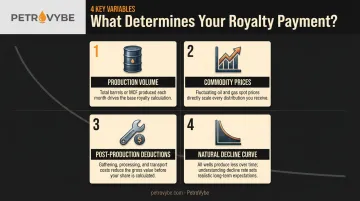
Four variables move royalty checks up or down:
- Production volume — how many barrels or MCF the well produces in a given month
- Commodity prices — oil and gas prices at time of sale; WTI crude moved from $133.88/barrel in June 2008 to $41.12 by December of that same year — royalty income moves with it
- Post-production deductions — transportation, processing, and marketing costs may be contractually deductible before your royalty is calculated, depending on state law and lease terms (Texas and West Virginia treat these differently)
- Natural decline curve — production is highest early and decreases over time; SPE data shows unconventional wells often decline more than 50% in year one
The rate you receive depends on whether your minerals sit under federal or private land — and the rules differ significantly:
- Federal onshore leases: The 2022 Inflation Reduction Act raised the minimum royalty rate to 16.67%, up from the historical 12.5% floor
- Private land leases: Rates are negotiated and lease-specific; Pennsylvania sets a statutory minimum of 12.5%, while active shale plays typically command higher rates
- State variations: Lease terms and deduction rules vary by jurisdiction — what's deductible in one state may not be in another
Understanding these rate structures helps you evaluate what any given royalty position is actually worth before committing capital.
Tax Advantages of Oil and Gas Royalty Investments
The U.S. tax code provides specific incentives for domestic energy production that aren't available in most other asset classes. Which advantages apply depends entirely on the type of interest you hold.
Depletion Deduction for Royalty Owners
Royalty owners can deduct 15% of gross royalty income through percentage depletion — an allowance that accounts for the gradual exhaustion of the resource. This is available to qualifying independent producers and royalty owners under IRC §613A, subject to a property-level taxable income limit and an overall 65% of taxable income ceiling.
Two additional advantages:
- Royalty income is reported on Schedule E and is generally not subject to self-employment tax
- Cost depletion is an alternative method when it produces a larger deduction
Intangible Drilling Cost (IDC) Deductions for Working Interest Owners
The tax picture shifts considerably when working interests enter the frame — and the difference matters most to investors carrying significant W-2 income or capital gains.
Working interest owners can deduct 100% of Intangible Drilling Costs in the year incurred under IRC §263(c). These costs — labor, fuel, chemicals, site preparation, engineering services — typically represent the majority of total project investment.
Under IRC §469(c)(3), working interest oil and gas investments held in a structure that does not limit the taxpayer's liability are not classified as passive activities, meaning IDC deductions can offset W-2 wages and capital gains directly. This treatment requires the investor to elect general partner status and may be limited in a given year by the excess business loss limitation under IRC §461(l). This is the critical distinction royalty income cannot match.
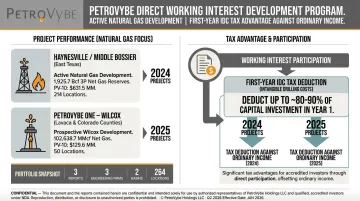
PetroVybe's direct development participation model is structured around this mechanism. Their 2024 and 2025 projects delivered 91% and 94% first-year tax deductions, respectively, against ordinary income — including W-2 earnings. These are prior-program results; not a promise of any future deduction.
Capital Gains Deferral
Beyond income-year deductions, royalty interest owners can defer capital gains taxes through a 1031 exchange when selling a qualifying royalty interest and reinvesting in a like-kind property. Revenue Rulings 68-226 and 73-428 support real-property treatment for qualifying oil and gas leasehold and royalty interests, though this analysis is interest-specific and requires current tax advice.
Risks to Understand Before Investing in Oil and Gas Royalties
Commodity Price Volatility
Royalty payments are directly tied to market prices at the time of production. The historical range tells the story: WTI averaged $16.55/barrel in April 2020 and $114.84 in June 2022. Henry Hub natural gas ranged from $1.63/MMBtu in June 2020 to $8.81 in August 2022. Anyone investing in royalties needs a clear-eyed view of this volatility and a reserve budget that accounts for low-price periods.
Production Decline and Reserve Depletion
Every well follows a decline curve. Production is highest early and decreases — often sharply in unconventional plays. Before purchasing any royalty interest, review:
- The well's production history by month
- The estimated decline rate and remaining reserves
- An independent reserve report from a qualified engineering firm (SPE PRMS — Society of Petroleum Engineers Petroleum Resources Management System — standards)
A single-well royalty is particularly exposed to decline. Multi-well or basin-level interests spread this risk.
Liquidity and Divestment Challenges
Private royalty interests are illiquid. There is no open exchange, and finding a buyer can take months.
Publicly traded royalty trusts (such as Permian Basin Royalty Trust (PBT) and Sabine Royalty Trust (SBR), both NYSE-listed) offer exchange liquidity, but they carry production decline exposure and yield sensitivity to commodity prices. BP Prudhoe Bay Royalty Trust (BPT) terminated December 31, 2024 and entered wind-up proceedings — reinforcing that trust assets are static and exhaustible. Plan your exit strategy before committing capital.
How to Evaluate and Invest in Oil and Gas Royalties
Due Diligence Steps
The four steps below apply to direct royalty purchases — buying a royalty or mineral interest from a landowner or broker. They are not the diligence path for a development partnership: a prospective PetroVybe partner is not purchasing a royalty interest and will not have a division-order decimal to verify. For development participation, PetroVybe provides offering documents, a third-party engineering report, pro forma financials, and redacted K-1 samples as the diligence materials.
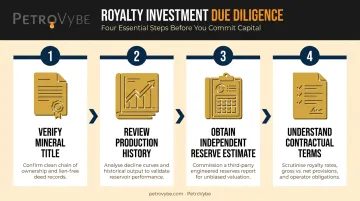
Before purchasing any royalty interest, an accredited investor should complete four steps:
- Verify mineral ownership title — confirm the recorded chain of title, legal description, ownership fraction, lease status, pooling documents, and division-order decimal
- Review production history — examine monthly production data, identify the decline curve, and assess how much productive life remains
- Obtain an independent reserve estimate — a third-party engineering report following SPE PRMS standards is the only responsible basis for projecting long-term income
- Understand contractual terms — know exactly what post-production deductions (transportation, processing, marketing) are permitted under the lease before calculating your expected NRI
Ways to Access Oil and Gas Royalty and Development Investments
Four primary access methods exist, each with different risk, return, and tax profiles:
- Direct royalty interest purchase from landowners or brokers — highest customization, requires deep due diligence on title and reserves
- Publicly traded royalty trusts (PBT, SBR) — exchange liquidity, but static asset pools that decline over time with no new development
- Private royalty funds — pooled vehicles with minimum investment thresholds and lock-up periods; terms vary significantly by fund
- Direct working interest participation through a development company operating its own projects — higher minimums, higher complexity, but access to IDC deductions against active income and stronger revenue upside
Of these four models, direct working interest participation carries the most complexity — and the most due diligence requirements. Operator experience matters as much as geology.
PetroVybe's natural gas development projects illustrate what that looks like in practice: IDC deductions against active income (not just passive income), a modeled 10-year MOIC range of approximately 2.2–5.8x across conservative, base, and optimistic cases, with a base case of approximately 4.2x, and NGL production positioned to benefit from rising AI-driven electricity demand. Modeled returns are not guaranteed. Its current PetroVybe ONE project is focused on East Texas and the Gulf Coast Basins. Chief Geophysicist Michael Stamatedes brings a 48-year career in identifying profitable well locations, built at prior companies and not indicative of PetroVybe results.
Frequently Asked Questions
How do I invest in oil and gas royalties?
The main paths are purchasing royalty interests directly through brokers or mineral rights marketplaces, buying units in publicly traded royalty trusts, or joining a private development program as a working interest partner. Accredited investors should compare the tax treatment of each before committing — passive royalty interests and working interests carry very different deduction profiles.
How much royalty income can I earn from an oil or gas well?
It varies based on royalty rate, production volume, and commodity prices. Using the NRI formula: a 25% mineral interest with a 20% royalty rate yields a 5% NRI. On a well producing $200,000/month in gross revenue, that's $10,000/month before permitted deductions — though production and prices fluctuate constantly.
What is the minimum royalty rate for oil and gas leases?
The federal minimum for new onshore public lands leases is currently 16.67% following the 2022 Inflation Reduction Act, up from the historical 12.5%. Private land royalties are negotiated lease by lease; Pennsylvania sets a statutory floor of one-eighth, while active shale plays like the Permian Basin typically command higher rates.
Are oil and gas royalties a good investment?
They offer passive income and portfolio diversification, but returns depend heavily on commodity prices, production longevity, and the price you pay at acquisition. Investors in higher tax brackets should also compare passive royalty interests to working interest programs — the IDC deduction advantage for working interest owners may offset a substantial portion of first-year investment costs, subject to basis, at-risk, and excess business loss limitations, through deductions that royalty interests cannot access.
What is the difference between a royalty interest and a working interest?
Royalty interest owners collect a share of gross revenue with no cost obligations but limited deduction benefits. Working interest owners cover a share of drilling and operating costs in exchange for a larger net revenue share and upfront IDC deductions under IRC §263(c) — deductions that can offset W-2 wages and capital gains, not just passive income. This treatment requires the investor to elect general partner status and may be limited in a given year by the excess business loss limitation under IRC §461(l).
What taxes do you pay on oil and gas royalty income?
Royalty income is taxed as ordinary income federally and at the state level, reported on Schedule E. Qualifying independent producers and royalty owners can apply a percentage depletion deduction — currently 15% of gross royalty income — to reduce their taxable amount. Unlike working interest holders, royalty owners cannot use IDC deductions to offset active income.
Informational requests only. PetroVybe projects are offered solely to verified accredited investors. Submitting a contact form does not create an investment or advisory relationship.
Disclosure: PetroVybe and its team members are not licensed financial advisors, and nothing on this website constitutes financial or investment advice or a recommendation to buy, sell, or hold any investment. PetroVybe and its team members are not tax advisors, accountants, or tax strategists, and nothing on this website constitutes tax advice or a tax strategy. PetroVybe and its team members are not attorneys, and nothing on this website constitutes legal advice. All content is provided for general informational purposes only. You should consult your own independent financial advisor, tax professional, and legal counsel before making any decision.