That demand story is real, but it doesn't mean every well investment pays off. Results vary wildly depending on the structure you choose — royalty, working interest, public stock, or private fund — and how carefully you vet the sponsor behind it.
This guide walks through exactly how to invest, who it fits, what actually drives returns, the mistakes that sink investors, and the alternatives worth knowing about.
Key Takeaways
- Royalties, working interests, dividends, and funds each carry distinct risk and tax profiles
- Working interest programs unlock the largest tax deductions but require accredited investor status
- Operator track record, well geology, and commodity mix drive returns more than price alone
- Vetting a sponsor's engineering credentials and reserve reports is the biggest risk-reduction step
- Public alternatives offer liquidity and low minimums, trading away most of the tax advantages
How to Invest in Oil and Gas Wells for Passive Income
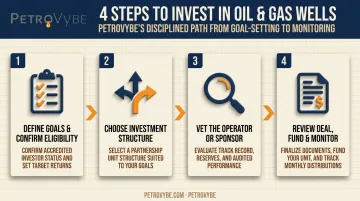
Step 1: Define Your Goals and Confirm Investor Eligibility
Before touching a single deal, decide what you actually want out of this asset class. That answer changes everything downstream.
- Cash flow now — you want monthly or quarterly distributions
- Tax offset — you're carrying a heavy W-2 or capital gains tax bill and want deductions
- Long-term appreciation — you're comfortable waiting years for a multiple on invested capital (MOIC)
Most private well offerings, including working interest and direct participation programs, are restricted to accredited investors under SEC Regulation D. To qualify, you generally need:
- A net worth over $1 million, excluding your primary residence, or
- Income over $200,000 individually (or $300,000 jointly) in each of the last two years, with reasonable expectation of the same this year (SEC, updated 2026)
Minimums differ by offering. Some private placements start in the low five figures; others, like PetroVybe ONE, set the bar at $100,000 per unit. That figure should inform how much of your portfolio you're willing to concentrate in a single illiquid asset.
Step 2: Choose Your Investment Structure
Not all oil and gas exposure works the same way. Here's how the main paths stack up:
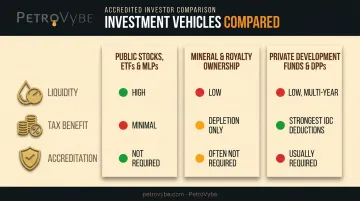
| Structure | Passive income potential | Tax benefit | Liquidity | Accreditation |
|---|---|---|---|---|
| Non-operated working interest | High | Strongest (IDC deductions) | Low, multi-year | Usually required |
| Mineral/royalty ownership | Moderate | Depletion allowance only | Low | Often not required |
| Public stocks, ETFs, MLPs | Low-moderate | Minimal | High, daily | Not required |
Working interest ownership offers the biggest upside because it lets you deduct intangible drilling costs (IDCs) against active income. But it also carries the most operational risk and the longest hold periods.
Royalties are more hands-off but skip most of the tax advantages. Public securities give you an exit any day the market's open, at the cost of losing the direct-well tax treatment entirely.
Match the structure to how hands-off you actually want to be, not just to the headline return.
Step 3: Vet the Operator or Sponsor Thoroughly
This step matters more than any single financial projection. An operator's track record determines whether wells actually produce as modeled.
Vet any sponsor against these four checks:
- Historical success rates: EIA data from 2001-2010 puts the aggregate national dry-hole rate at roughly 11%, an implied 89% success share across exploratory and development wells combined (EIA, 2012). Treat this national figure as a rough reference, not a basin-specific benchmark, and ask operators for their own numbers.
- Independent reserve reports: A credible sponsor will have proved reserves valued by a licensed third-party engineering firm, not just internal estimates. PetroVybe, for example, points investors toward a $48 million PV-9 proved reserves valuation, plus a clean 2025 independent audit from Weaver.
- Technical team credentials: PetroVybe's Chief Geophysicist, Michael Stamatedes, brings a documented 75.2% career hit rate on profitable well locations across 48 years, including a stretch at ExxonMobil, against a sub-40% industry peer benchmark.
- Licensing and reviews: Check verified investor reviews on platforms like Invest Clearly, confirm the operator's state license through a body like the Texas Railroad Commission, and cross-reference well API numbers against public records.
Demand this level of specificity from any sponsor: a named track record tied to a number, not a vague claim, before you wire funds.
Step 4: Review the Deal, Fund the Investment, and Monitor Performance
Once you've vetted the operator, the private placement memorandum (PPM) is where the real terms live. Look for:
- Projected IRR and MOIC: Whether the numbers rely on a conservative or aggressive price deck
- Distribution schedule: When payments start and how often they're paid
- Use of proceeds: How much capital actually goes into drilling versus fees
On taxes, the mechanics matter. IDCs typically represent 60%-80% of total well cost according to API estimates, and eligible IDCs can often be expensed in year one (API, 2016).
For a qualifying direct working interest, this deduction can flow through a K-1 and offset active income, not just passive gains. PetroVybe's partners, for instance, received 91-94% first-year deductions against active income in 2024 and 2025.
After funding, expect a fairly standard cadence: subscription documents, wire confirmation, then periodic production updates, annual K-1s, and investor portal access for tracking distributions as wells come online.
Is Oil and Gas Well Investing Right for You?
This asset class isn't universally suitable. It depends heavily on your income level, liquidity needs, and appetite for illiquid, concentrated risk.
Who this suits:
- High-income earners or business owners carrying a heavy active-income tax burden who want legitimate, structural deductions
- Investors with $100,000+ in investable capital who can commit to a 5-10 year hold without needing that money back sooner
- Portfolio diversifiers looking to move beyond traditional stocks, bonds, and real estate
What you need before investing:
- Verified accredited investor status, plus a basic grasp of how passive versus active loss treatment works under IRS rules
- A relationship with a transparent, licensed operator — confirm state operator licenses and third-party audits rather than taking a promoter's word for it
- Patience to review third-party engineering reports and audited reserve valuations before committing capital
If you need liquidity within a year or two, or you're not in a high enough tax bracket to benefit from IDC deductions, this probably isn't your best entry point into energy.
Key Factors That Affect Your Passive Income Returns
Unlike a bond or fixed annuity, a well's cash flow depends on variables you can partially control and others you can't.
Well Location and Geology
Proven basins with strong reservoir data materially reduce dry-hole risk. Teams that apply rigorous geological screening, rather than drilling speculative acreage, can post well success rates above 75%, compared to a general industry average below 40%. That gap is why operator-specific geology credentials matter more than a national average.
Operator Track Record and Team Expertise
Experienced operators make better calls on drilling sequencing, workovers, and production timing, all of which affect when and how much you get paid. Before committing capital, research an operator's historical production scaling (BOEPD growth) and EBITDAX trends. A team that's grown production from zero to over 1,000 BOEPD, or scaled a multibillion-dollar asset to 35,000 BOEPD, has demonstrated the execution ability that spreadsheets alone can't prove.
Investment Structure and Tax Treatment
Working interest structures allow IDC deductions against active income; royalties are treated as passive income only, with no equivalent deduction. First-year IDC deductions often run 70%-90%+ of invested capital, though the exact figure depends on the offering's cost structure. Model your after-tax cash flow using the actual percentage in the PPM, not an industry average.
Commodity Type and Pricing
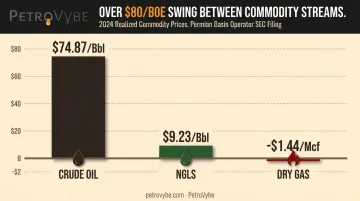
Oil and natural gas liquids (NGLs) typically command premium pricing over dry gas. A 2025 SEC filing from a Permian Basin operator shows 2024 realized prices of $74.87/Bbl for crude and $9.23/Bbl for NGLs, versus -$1.44/Mcf for dry gas after fees and differentials. That's a swing of over $80 per barrel of oil equivalent between commodity streams. As AI-driven electricity demand pushes natural gas value higher over time, evaluate a project's specific commodity mix rather than assuming "oil and gas" means one price story.
Common Mistakes and Risks to Avoid
Most losses in this asset class trace back to a handful of avoidable errors.
- Skipping due diligence on operator history. A Costa Mesa "boiler room" raised $11 million, spent less than 10% on actual wells, and landed the operator a 10-year prison sentence, according to a 2016 DOJ press release. Verify reserve reports and licensing before wiring funds.
- Treating the tax deduction as the whole thesis. A deduction doesn't matter if the underlying wells never produce. Evaluate well economics first, tax benefit second.
- Underestimating illiquidity. Private placements routinely lock up capital for 5-10 years. Don't commit money you might need in three.
- Overlooking downside scenarios. Always stress-test projected IRR and distributions against low oil and gas price environments before wiring funds.
Alternative Ways to Invest in Oil and Gas for Passive Income
Direct working interest ownership isn't the only door into this sector. The right vehicle depends on your liquidity needs and risk tolerance.
Publicly Traded Energy Stocks, ETFs, and MLPs
This route suits investors who want daily liquidity, low minimums, and no accreditation requirement. Expect significantly lower tax benefits and more correlation to broad stock market swings than direct well economics.
Mineral Rights and Royalty Ownership
Ideal for investors wanting fully passive income with zero operating cost exposure: no drilling bills, no capital calls. However, income depends entirely on the operator's production decisions, and deduction potential runs far lower than working interest.
Private Development Funds and Direct Participation Programs
Accredited investors seeking maximum tax efficiency and direct exposure to early-stage well economics often choose this path — the kind of structure offered by operators like PetroVybe. It demands rigorous operator vetting, higher minimums (often $100,000+), and multi-year illiquidity in exchange for the strongest tax and return potential.
Frequently Asked Questions
Can you invest in oil drilling?
Yes. Accredited investors can invest directly in drilling through working interests or direct participation programs, typically via a private placement with a licensed operator.
Is investing in oil and gas wells truly passive income?
Royalty and non-operated working interest structures generally qualify as passive since you're not involved in daily operations, though income fluctuates with production volumes and commodity prices.
How much money do you need to invest in an oil well?
Private placements often require minimums in the tens of thousands of dollars or more. PetroVybe ONE, for example, starts at $100,000 per unit, while public stocks and ETFs can be purchased for far less.
What tax benefits come with investing in oil and gas wells?
Working interest deals allow intangible drilling cost deductions and depletion allowances, with IDCs able to offset active income, a benefit most other asset classes don't offer.
Do I need to be an accredited investor to invest in oil wells?
Private working interest and fund offerings usually require accredited status. Public stocks, ETFs, and some royalty funds don't.
How risky is investing in oil and gas wells?
Risk ranges from moderate (diversified ETFs or royalties) to high (single-well working interests), depending heavily on operator competence and commodity price swings.