

This happens to more taxpayers than you'd think. Passive losses can freeze in place for years if you don't understand the rules governing them, quietly costing you tax savings you've already earned but can't yet use. The good news: carryover losses aren't gone. They're dormant.
This guide breaks down what passive income carryover actually is, the IRS rules that control it, and the concrete moves you can make to put those trapped deductions back to work, including a lesser-known oil and gas angle that changes the equation entirely.
Key Takeaways
- Suspended passive losses carry forward indefinitely, never carry back, and offset only passive income until released
- No blanket limit caps the carryover, though MAGI phase-outs and excess business loss rules can limit your annual deduction
- A fully taxable sale releases all suspended losses at once, against any income type
- Direct oil and gas working interests bypass passive activity rules, unlocking active-income deductions real estate can't match
Understanding Passive Income Carryover
Under IRC Section 469(d)(1), a passive activity loss is simply the amount by which your total passive losses exceed your total passive income for the year. When that happens, the IRS doesn't let you deduct the excess against your wages or business income.
Instead, that excess becomes a suspended loss carryover, tracked and held until you have passive income to soak it up.
Here's a detail that trips up a lot of investors: carryovers aren't tracked as one big combined pool. They're tracked per activity. If you own three rental properties—or hold working interests in multiple oil and gas wells—and one runs a loss while another turns a small profit, each activity's carryover balance is calculated separately.
That distinction matters enormously when you sell one property years down the road, since only that property's suspended losses release, not your entire portfolio's.
How Carryovers Are Calculated
Form 8582 does the heavy lifting here. According to the 2025 IRS instructions for Form 8582, it aggregates income and losses across all your passive activities, then determines what's deductible now versus what's suspended.
Say you own a rental generating $18,000 in gross income, offset by $30,000 in depreciation, mortgage interest, repairs, and management fees. That's a $12,000 loss. Without enough other passive income to absorb it (and assuming you don't qualify for the special allowance discussed below), that $12,000 doesn't vanish. It carries forward, waiting for:
- Future passive income from the same or another passive activity
- A special allowance you qualify for
- A full disposition of the activity itself
How Long Carryovers Last and How They're Released
Suspended losses don't expire. They carry forward indefinitely until one of two things happens: you generate passive income to offset them, or you dispose of the entire activity.
Crucially, these losses cannot be carried back to prior tax years. You can't apply a current loss against passive income you earned in a previous year.
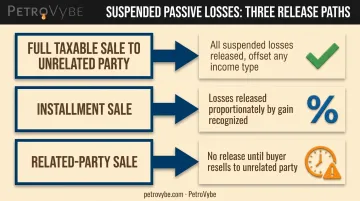
The cleanest release valve is a full, taxable disposition of the activity. Under IRC 469(g)(1), when you sell your entire interest to an unrelated party in a fully taxable transaction, all remaining suspended losses are released in that tax year.
This is where it gets powerful: released losses can offset any type of income, not just passive gains. That means they can be used against your W-2 wages, business income, or capital gains.
Two exceptions worth flagging:
- Installment sales release losses proportionately, based on the ratio of gain recognized that year to total gain from the sale (IRC 469(g)(3))
- Related-party sales don't trigger release at all until the buyer later resells to an unrelated party in a fully taxable transaction
This is why timing your exit matters. Selling a rental to your adult child, for instance, won't free up your carryover the way selling to a stranger would.
Income Limits and Special Allowances That Affect Your Deduction
Here's a question that comes up constantly: is there an income limit on passive loss carryovers? The direct answer is no, not on the carryover balance itself. Your suspended losses keep accumulating regardless of your income level. What income does affect is how much you can deduct in any given year through special allowances.
The $25,000 rental real estate allowance. Active participation is a lower bar than material participation—it just means reasonable involvement in decisions like approving tenants or setting rent. If you meet that standard, you can deduct up to $25,000 of passive losses against active income each year.
That allowance phases out as your Modified Adjusted Gross Income climbs, per the 2025 Instructions for Form 8582:
| Filing Status | Full Allowance | Phase-Out Range | Fully Eliminated |
|---|---|---|---|
| Single/Joint | $25,000 | $100,000-$150,000 MAGI | $150,000+ |
| MFS (living apart all year) | $12,500 | $50,000-$75,000 MAGI | $75,000+ |
| MFS (lived together anytime) | $0 | N/A | Always $0 |
The excess business loss limitation. Separately, IRC 461(l) caps how much total business loss (including certain passive losses) you can deduct against nonbusiness income in a year. The 2025 thresholds, per Rev. Proc. 2024-40, are:
- Single filers: $313,000 (up from $305,000 in 2024)
- Joint filers: $626,000 (up from $610,000 in 2024)
Losses disallowed under this rule don't disappear either. They convert into a net operating loss carryover, which follows its own separate set of rules from your passive loss carryover.
Strategies to Put Your Passive Loss Carryover to Work
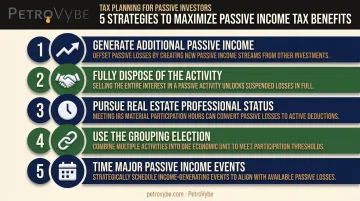
Once you understand the mechanics, the real question becomes: how do you actually unlock the deduction? Here are five approaches worth discussing with your tax advisor.
Generate additional passive income deliberately. If you have suspended losses sitting idle, investing in something that produces passive income (another rental property, a working interest in an oil and gas development project, or a passive partnership interest) can absorb them. This is one of the more underused strategies, since most investors think about minimizing income rather than intentionally creating passive income to unlock old deductions.
Fully dispose of the activity in a taxable sale. This remains the cleanest way to release everything at once. It's particularly useful if you're planning a high-income year or a liquidity event where a large offsetting deduction would have real value.
Pursue Real Estate Professional Status where you qualify. REPS requires more than 750 hours and more than half your personal service time in real property trades where you materially participate. REPS only changes how future activity is treated—it does not retroactively free suspended losses from prior years.
Use the grouping election under Treasury Regulation 1.469-4. Combining similar activities into one "appropriate economic unit" can help you clear material participation thresholds and simplify how future losses get used. Groupings generally must stay consistent year to year, so this isn't a decision to make casually.
Time major passive income events strategically. If you know a property sale or a new income-generating investment is coming, consider timing it for a year when your active income is already high. This maximizes the value of the offset.
Grouping and REPS elections can lock in treatment for years. Talk to a CPA before making either move.
Why Oil & Gas Working Interests Offer a Distinct Path to Unlock Carryover Losses
Most passive loss discussions stay inside real estate. But there's a statutory exception that changes the math entirely for oil and gas.
Under IRC 469(c)(3)(A), a direct working interest in an oil or gas property, held with unlimited liability, is not treated as a passive activity at all, regardless of how much or little the investor participates. That's a meaningful distinction from real estate, where passive treatment is the default unless you clear a material participation or REPS bar.
This structure creates two practical advantages beyond what real estate offers:
- Direct offset against active income: intangible drilling cost deductions from a qualifying working interest reduce W-2 wages, business income, and capital gains, without the passive activity fence blocking them.
- No material participation test: the exception applies regardless of how much or little the investor participates, unlike real estate's material participation or REPS requirements.
- A secondary income stream: ongoing production income from the same working interest can help absorb suspended losses carried over from entirely unrelated activities, like a rental property sitting on frozen deductions for years.
PetroVybe, a Texas-based natural gas development company operating in Lavaca County and the broader South Texas and Gulf Coast Basin region, is one example of this space. Its program is structured so intangible drilling cost deductions flow through to offset active income, with reported results including:
- IDC deductions typically covering 60-80% of invested capital
- A 94% total deduction against active income for 2024 partners
- Roughly 91% for 2025 partners, with first-year deductions historically near 70%
- A 75.2% well success rate from Chief Geophysicist Michael Stamatedes over a 48-year career, well above the industry peer average of under 40%

Beyond the upfront deduction, production distributions during the operating phase serve as a separate, ongoing income stream, one investors can potentially use toward absorbing suspended losses from unrelated passive activities.
One important clarification: this isn't a mechanism to convert your existing suspended carryover losses into oil and gas deductions. The two run on separate tracks, working as a complementary strategy, new active-income deductions on one hand, new income to absorb old losses on the other.
Structuring specifics vary by offering. Confirm how any given program qualifies under IRC 469(c)(3) with your CPA and the deal's private placement memorandum before committing capital.
Common Mistakes That Keep Carryover Losses Trapped
A few recurring errors keep otherwise-savvy taxpayers from ever using deductions they've already earned:
Assuming REPS retroactively frees old losses. REPS reclassifies future activity, not prior suspended losses, which stay governed by the old passive-loss rules until offset or released.
Failing to track carryovers per activity. Selling one property requires its own suspended balance, not a blended portfolio average; sloppy tracking creates real errors on Form 8582.
Overlooking at-risk basis limitations. Passive income can free a carryover, but an at-risk limitation (Form 6198) may still cap your deduction. These are separate limits, not one combined pool.
Frequently Asked Questions
Is there an income limit for passive losses?
No direct cap exists on the carryover itself. However, MAGI-based phase-outs on the $25,000 rental allowance, plus excess business loss thresholds, can limit how much you deduct in any single year.
What is a passive income excess limit?
This refers to the excess business loss limitation under IRC 461(l). Losses beyond the annual inflation-adjusted threshold ($313,000 single/$626,000 joint for 2025) convert into a net operating loss carryover instead of an immediate deduction.
How many years can you carry forward passive losses?
Indefinitely. Suspended losses carry forward until offset by passive income or released through a full disposition of the activity, with no expiration date.
Can passive losses offset capital gains?
No, unless that capital gain itself qualifies as passive activity income, such as gain from selling a passive activity interest. Gains from portfolio or investment property don't count.
What happens to passive loss carryovers when I sell the property?
A full, taxable sale of your entire interest to an unrelated party releases all suspended losses for that activity, which can then offset any type of income in that tax year.
Are oil and gas working interests considered passive activities?
No. Direct working interests held with unlimited liability are statutorily excluded from passive activity treatment under IRC 469(c)(3), regardless of the investor's participation level.