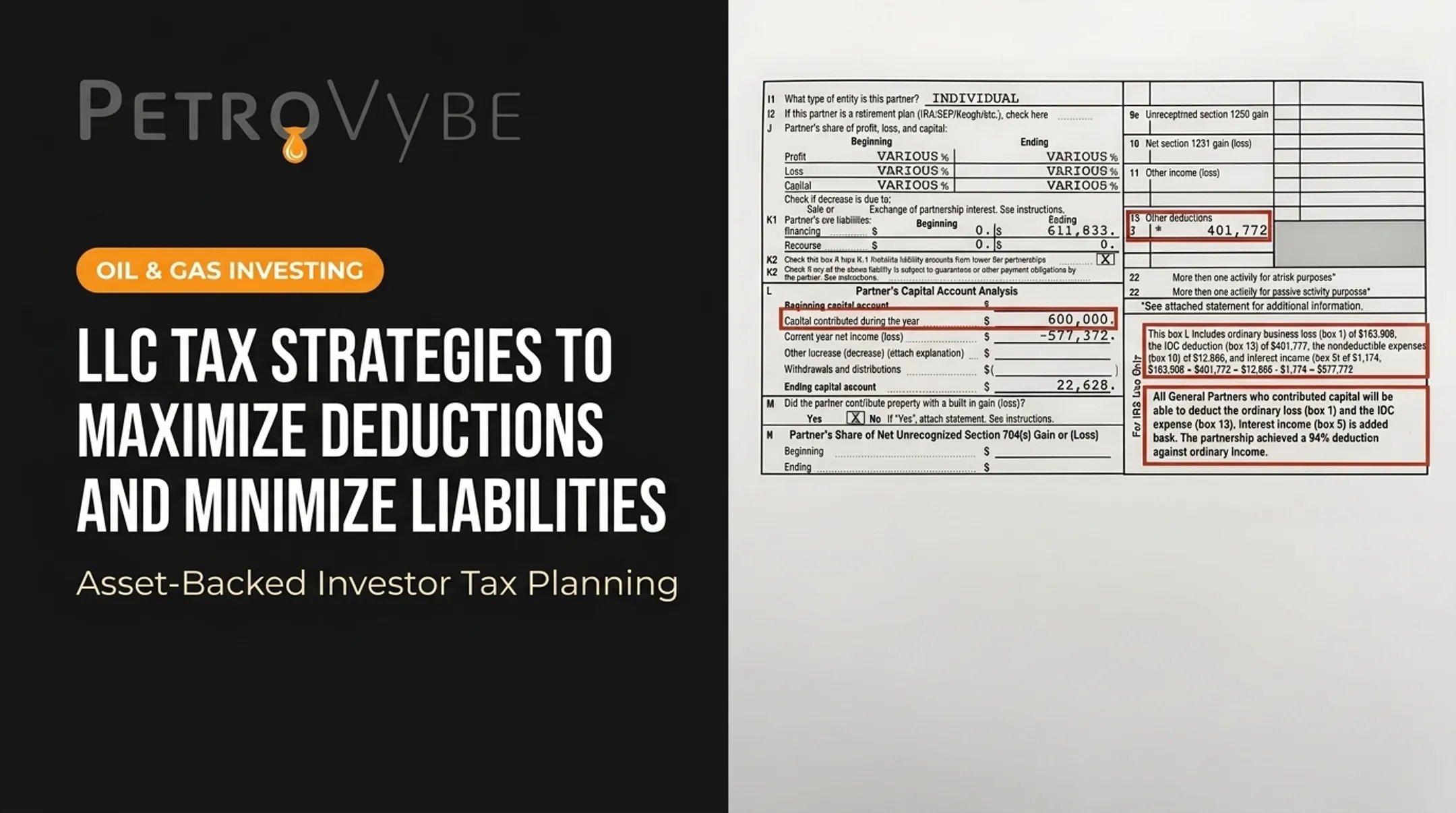
This article is general education, not investment, tax, or legal advice. Partnerships run on debt. Development-stage oil and gas programs, in particular, often lean on financing to acquire leases, drill wells, and fund operations before revenue arrives. How that debt gets classified for tax purposes isn't a technicality buried in a footnote. It directly changes a partner's tax basis, their at-risk amount, and whether they can actually deduct the losses showing up on their K-1.
For accredited investors evaluating asset-heavy partnerships like oil and gas development programs, this distinction matters enormously. Intangible drilling costs (IDCs) are often the headline draw, sometimes representing a first-year deduction target of approximately 70–80% of invested capital in a new drilling project. But a large deduction on paper means nothing if basis or at-risk limitations stop you from claiming it against active income. This treatment requires the investor to elect general partner status in the Subscription Agreement and may be limited in a given year by the excess business loss limitation under IRC §461(l).
This article breaks down recourse and nonrecourse liabilities, compares their tax treatment, and shows how allocation rules shape what an investor can actually deduct.
Key Takeaways
- Recourse debt makes a partner personally liable and generally increases both basis and at-risk amount.
- Nonrecourse debt increases basis for all partners but usually doesn't count toward at-risk, with one narrow exception.
- Allocation methods differ sharply—constructive liquidation for recourse debt, minimum gain rules for nonrecourse.
- Qualified nonrecourse financing under Sec. 465(b)(6) is the narrow exception that can increase a partner’s at-risk amount.
Recourse vs. Nonrecourse Liabilities: Quick Comparison
| Factor | Recourse | Nonrecourse |
|---|---|---|
| Who bears risk | Partner or guarantor personally liable beyond partnership assets | Lender only; collateral is the sole recovery source |
| Basis impact | Increases outside basis for the liable partner(s) | Increases basis for all partners per allocation rules |
| At-risk (Sec. 465) | Generally counts | Generally does not count, unless qualified nonrecourse financing |
| Common example | GP personal guarantee on a loan | Mortgage secured solely by partnership property |
| Allocation method | Constructive liquidation analysis (Reg. 1.752-2) | Minimum gain chargeback safe harbor (Reg. 1.704-2) |
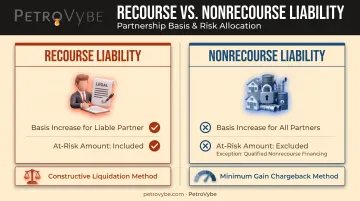
These differences drive who gets basis, who can take losses, and who is on the hook if the deal goes bad. The sections below break down each type.
What Is a Recourse Liability in a Partnership?
Under Reg. 1.752-2, a liability is recourse only to the extent a partner (or someone related to them) bears the "economic risk of loss." The test is a hypothetical: assume the partnership liquidates immediately, every liability becomes due, and every asset is worth zero. Whoever would have to reach into their own pocket to pay bears the risk. That partner is the one to whom the debt gets allocated.
Why this matters practically: recourse debt generally increases the guarantor-partner's basis and at-risk amount. That's the combination that lets a partner deduct losses currently instead of suspending them to future years.
A common misconception is that recourse liability spreads evenly across all partners. It doesn't. Allocation depends entirely on who actually bears the risk — often the general partner, or occasionally a limited partner who has personally guaranteed a specific obligation.
Where Recourse Liabilities Show Up
- General partnership loans requiring personal signatures
- Personally guaranteed development financing
- "Bad boy" carve-out guarantees in real estate and energy loan agreements
On that last point: Sullivan & Cromwell's analysis of bad-boy guarantees notes that commercial lenders commonly require a controlling partner to guarantee debt if specific bad acts occur, such as unauthorized transfers, involuntary bankruptcy, or fraud.
A remote, unlikely-to-be-triggered bad-boy carve-out generally does not convert otherwise nonrecourse debt into recourse debt for tax purposes. The label on the loan document is not the last word; the actual likelihood of the trigger matters.
What Is a Nonrecourse Liability in a Partnership?
A nonrecourse liability, under Sec. 752, is one where no partner bears personal economic risk. If the borrower defaults, the creditor's only remedy is to seize the collateral (the property or asset securing the loan). Nobody's personal assets are on the line.
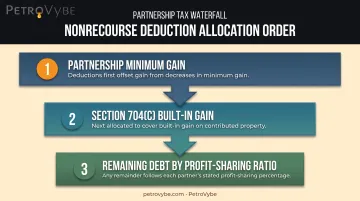
Allocation works differently. Nonrecourse deductions (depreciation or IDCs that exceed the equity cushion in an asset) get allocated using a three-tier method:
- Partnership minimum gain
- Section 704(c) built-in gain
- Remaining debt, generally by profit-sharing ratio
This follows the partners' interest in the partnership rather than who bears economic risk, because with nonrecourse debt, nobody bears personal risk in the traditional sense.
The Qualified Nonrecourse Financing Exception
Sec. 465(b)(6) carves out an exception for development deals: qualified nonrecourse financing (QNF) can count toward at-risk basis even though it's nonrecourse. To qualify, the financing must:
- Finance an activity of holding real property
- Be secured by real property used in that activity
- Be nonconvertible into an equity interest
- Come from a government source or a "qualified person" actively in the lending business
IRS Publication 925 is explicit that oil and gas exploration and exploitation remains subject to at-risk rules, and its real-property financing exception uses language distinguishing it from mineral property. Translation: don't assume a real-estate QNF result automatically transfers to an oil and gas deal. Each loan needs to be checked against every element of the exception.
Where Nonrecourse Liabilities Show Up
- Property-secured loans in real estate funds
- Project financing in energy and natural resource partnerships
- Asset-backed facilities where the lender looks only to collateral
- Development capital stacked with partner equity and reinvested cash flow
This is directly relevant to how development partnerships structure capital. PetroVybe's "Protect and Scale" capital model, for instance, incorporates nonrecourse debt alongside partner equity and reinvested cash flow specifically to help limit investor exposure to downside risk beyond their investment. Properly classifying that debt, and how it interacts with IDC allocations, is what protects the large first-year deduction figure on a partner's K-1. This treatment requires the investor to elect general partner status in the Subscription Agreement and may be limited in a given year by the excess business loss limitation under IRC §461(l).
When the Collateral Gets Foreclosed: A Real Example
Minimum gain chargebacks aren't just theoretical. The Tax Adviser walked through a foreclosure scenario: a property with $700 in basis carries an $800 nonrecourse loan. The bank forecloses in full satisfaction of the debt.
That triggers $100 of debt-relief gain, and partnership minimum gain drops from $100 to zero. If Partner A previously received $30 of the related nonrecourse deductions and Partner B received $70, the chargeback allocates gain right back in that same 30/70 split.
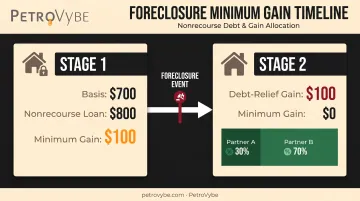
Nonrecourse deductions taken early reverse later if the asset is foreclosed on or disposed of. Model the exit-year consequences, not just the entry-year deduction.
Recourse vs. Nonrecourse: Which Matters More for Your Deductions?
What matters is which structure supports the basis and at-risk position you need for your specific deduction strategy.
If you're a W-2 earner trying to offset active income with a large first-year deduction, here's what actually determines whether that deduction sticks:
- Basis limitation (Sec. 752): Do you have enough outside basis to absorb the loss?
- At-risk limitation (Sec. 465): Is the debt behind that basis recourse, or does it qualify as qualified nonrecourse financing (QNF)? Ordinary nonrecourse debt usually fails here even when it passes the basis test.
- Passive activity rules (Sec. 469): Does your involvement structure allow the loss against active income at all?
These three limitations apply in sequence. A liability can create outside basis under Sec. 752 and still fail the at-risk gate under Sec. 465. That gap catches investors who treat a debt allocation on their K-1 as proof the loss is deductible.
Practical takeaway: Partnership agreements should spell out liability allocation methods and minimum gain chargeback provisions. Vague language invites disputes later and can undo the tax outcome an investor thought they locked in.
Frequently Asked Questions
What is the difference between recourse and nonrecourse liabilities?
Recourse liabilities make a partner personally liable beyond partnership assets. Nonrecourse liabilities limit the creditor's recovery to the collateral itself, with no partner bearing personal risk.
What are nonrecourse liabilities in a partnership?
These are liabilities where no partner bears the economic risk of loss. Typically, they're loans secured by partnership property where the lender's only remedy is seizing that asset.
What is a recourse liability in a partnership?
A recourse liability is one where a partner (or related person) must pay the creditor or contribute capital in a hypothetical liquidation. That partner bears personal economic risk for the debt.
Can you give me an example of a nonrecourse liability?
A mortgage on development property where the lender's sole recourse upon default is foreclosure, with no partner having personally guaranteed the loan, is a classic example.
How does liability type affect a partner's basis?
Both recourse and nonrecourse liabilities can increase outside basis under Sec. 752. However, only recourse debt and qualified nonrecourse financing typically increase at-risk basis under Sec. 465.
Why would a partnership prefer one type of liability over another?
It's a tradeoff between risk tolerance and tax objectives. Nonrecourse debt protects personal assets; recourse debt or qualified nonrecourse financing can unlock larger current-year deductions by satisfying at-risk requirements.
This article is for general informational purposes and doesn't constitute tax or legal advice. Liability classification, basis calculations, and at-risk determinations depend on the specific terms of a partnership's loan documents, PPM, and LPA. Accredited investors evaluating a development partnership like PetroVybe ONE should review those governing documents with their own tax and legal counsel before relying on any projected deduction figures.
Informational requests only. PetroVybe projects are offered solely to verified accredited investors. Submitting this form does not create an investment or advisory relationship.