

Introduction
Most people's investment knowledge stops at stocks, bonds, and mutual funds. These are the assets that fill 401(k) menus and brokerage dashboards. A broader category exists beyond them: alternative investments.
Alternatives were once the exclusive territory of university endowments, pension funds, and the ultra-wealthy. Accredited investors today can access private equity, direct energy development, private credit, and more — assets that offer diversification, inflation protection, and returns that don't move in lockstep with public markets.
According to Preqin, global alternative assets under management stood at $16.8 trillion at year-end 2023 and are projected to reach $29.2 trillion by 2029 — a 9.7% annualized growth rate. That kind of capital migration doesn't happen without reason — and the reasons are worth understanding.
This article covers the clear definition, major types, key benefits, real risks, and how to evaluate whether alternatives belong in your wealth-building strategy.
Key Takeaways
- Alternative investments are any financial assets outside stocks, bonds, and cash — including private equity, real estate, commodities, and more
- Most alternatives offer low correlation to public markets, come with less SEC oversight, and trade far less frequently than stocks
- Many require accredited investor status — $1M+ net worth or $200K+ annual income
- Oil and gas IDC deductions can offset W2 income and capital gains — a tax advantage most alternatives don't offer
- Alternatives work best alongside traditional investments, adding diversification without replacing them
What Are Alternative Investments?
Alternative investments are financial assets outside the conventional categories of stocks, bonds, and cash. The umbrella is broad: private equity, hedge funds, real estate, commodities, private credit, digital assets, and direct participation programs like oil and gas development all qualify.
Three Defining Characteristics
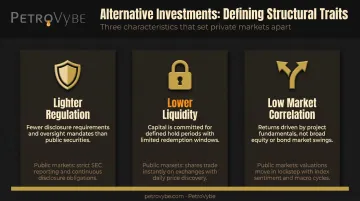
Most alternatives share three structural traits that distinguish them from publicly traded securities:
- Lighter regulation — Most alternatives don't register with the SEC. They operate under exemptions (like Regulation D), meaning fewer required disclosures than public markets require
- Lower liquidity — Converting alternatives to cash quickly is difficult or impossible. Capital is often committed for months to years
- Low correlation to public markets — Their value doesn't necessarily rise and fall with stocks or bonds, making them a practical tool for portfolio diversification
The Accredited Investor Requirement
Many alternatives are legally restricted to accredited investors — individuals who meet at least one of these thresholds:
- Net worth exceeding $1 million, excluding primary residence
- Annual income of $200,000+ individually (or $300,000 combined with a spouse) in each of the prior two years
- Holders of qualifying professional credentials (Series 7, Series 65, or Series 82 licenses)
The restriction reflects the nature of the asset class. Alternatives carry real regulatory complexity, limited liquidity, and a due diligence burden that demands financial sophistication — not just capital.
Types of Alternative Investments
"Alternatives" is a broad umbrella covering very different asset types — each with distinct risk profiles, return drivers, and liquidity windows. Here's a working breakdown.
Private Equity and Venture Capital
Private equity involves investing directly in companies not listed on public exchanges — through buyouts, growth capital, or venture capital targeting early-stage startups. Returns can be substantial. Cambridge Associates' benchmark data shows US private equity delivered 15.1% annualized over 10 years versus 13.3% for the S&P 500 (matched using private fund cash-flow timing). Over 25 years, that gap widens: 12.1% vs. 9.1%.
The tradeoff: capital is often locked up for a decade or more.
Private Credit
Private credit means lending directly to businesses outside of bank or public bond markets. Investors earn income through interest payments. The yield premium is real — Cambridge Associates estimates 200–600 basis points above public markets, depending on credit quality. BlackRock's data shows a 4.2 percentage-point average yield premium over the 10 years ended June 2025.
Higher yields come with higher default risk and illiquidity compared to investment-grade bonds.
Real Estate
Real estate alternatives split into two distinct approaches:
- Direct property ownership — full control, full management burden, and meaningful tax benefits through depreciation
- REITs (Real Estate Investment Trusts) — publicly traded REITs distribute at least 90% of taxable income as dividends, accessible to any investor. Private REITs offer exposure to institutional-quality real estate but with limited liquidity and longer commitment periods
Hedge Funds and Liquid Alternatives
Hedge funds use active strategies — leverage, short-selling, arbitrage — to pursue returns regardless of market direction. Industry-wide average fees run approximately 1.34% management and 15.79% incentive, per HFR's 2Q25 data. Access is typically restricted to institutional and accredited investors with high minimums.
Commodities and Natural Resources — Including Oil and Gas
Commodities include gold, silver, agricultural products, oil, and natural gas. They serve as inflation hedges because their value tracks real-world supply and demand. CME Group, citing Vanguard research, reports that broad commodities rose 7–9% for each 1 percentage point of unexpected inflation over the preceding decade.
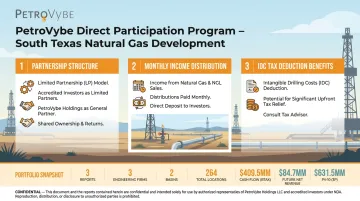
Within this category, oil and gas direct participation programs (DPPs) offer a structure most investors overlook. Rather than accessing energy through futures or ETFs, accredited investors can take direct equity positions — ownership stakes in the wells themselves. Key structural features include:
- Distributes production income monthly during the active production phase
- Provides tangible asset exposure backed by third-party reserve valuations
- Generates Intangible Drilling Cost (IDC) deductions applicable against active income — W2 wages and capital gains included
PetroVybe operates in this space, offering accredited investors direct partnership units in natural gas development projects in South Texas. Partners in 2024 achieved a 91% tax deduction against active income; 2025 partners reached 94%. Both figures are K-1-documented actuals.
Collectibles and Digital Assets
Collectibles (fine art, rare wine, vintage cars, sports memorabilia) are tangible alternatives driven by scarcity and cultural value. Markets are illiquid and require deep expertise. Net capital gains from collectibles face a maximum 28% federal tax rate — higher than long-term capital gains rates on most securities.
Digital assets (cryptocurrency, NFTs) represent a newer alternative class with high volatility and still-evolving regulatory treatment. The IRS treats virtual currency as property, subject to capital gains rules.
Key Benefits of Alternative Investments
Diversification
Because alternatives often have low or negative correlation to public equity and bond markets, adding them to a portfolio can reduce overall volatility. When stocks fall, certain alternatives may hold or increase in value — smoothing performance without necessarily sacrificing long-term returns.
Inflation Protection
Hard assets tend to maintain or grow in value during inflationary periods because their prices are tied to real-world scarcity and demand, not financial instruments subject to monetary policy. Asset classes that fit this profile include:
- Real estate (income-producing property)
- Commodities and precious metals
- Energy infrastructure and direct energy investments
Each of these holds intrinsic value in ways cash and fixed-income securities don't. When inflation rises, those paper instruments lose purchasing power. Hard assets generally don't.
Enhanced Return Potential
Many alternatives — including private equity, private credit, and direct energy investments — target higher absolute returns because investors accept illiquidity and complexity as part of the trade. The Cambridge Associates data referenced earlier illustrates this over multiple decades: private equity has consistently outpaced the S&P 500 on a dollar-weighted basis over 10-, 20-, and 25-year horizons.
Tax Efficiency
This is where alternatives diverge sharply from traditional investments:
| Alternative | Tax Advantage |
|---|---|
| Real estate | Depreciation on income-producing property |
| Oil & gas development | IDC deductions against active income (W2 + capital gains) |
| Long-term stock investments | 15–20% capital gains rate |
| Collectibles | Maximum 28% rate (disadvantage) |
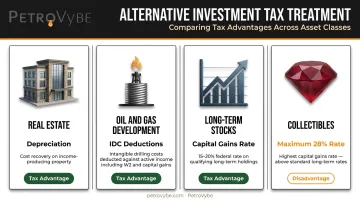
Oil and gas stands out. IDC deductions aren't restricted to passive income the way real estate depreciation typically is. For investors in qualifying working interests or certain partnership structures, IDC losses can reduce W2 wages, capital gains, and other active income directly. That's a mechanism nearly no other asset class offers.
Access to Private Market Value Creation
Public markets price in information almost immediately, leaving little upside for retail participants who arrive after the initial value creation. Private alternatives — direct investments in private companies, real assets, or energy development — let investors participate before public markets set the price.
Risks and Considerations
Illiquidity Risk
Most alternatives require committing capital for extended periods without the ability to quickly exit. Private equity may require over 10 years, per SEC Investor.gov guidance. Direct oil and gas development follows a similar timeline — PetroVybe, for example, structures its partnerships around a 10-year investment horizon, with first distributions typically arriving 2–3 years after investment.
Investors must honestly assess their liquidity needs before committing. Forced early exits in illiquid markets can result in significant capital losses.
Complexity, Fees, and Due Diligence
Alternatives carry higher fee structures than index funds:
- Private equity: Mean management fees of 1.74% (buyout) and 1.93% (growth equity) for 2024-vintage funds
- Hedge funds: ~1.34% management and ~15.79% incentive industry-wide
Beyond fees, the due diligence burden is real. Reviewing third-party engineering reports, audited financials, operator track records, and offering documents takes genuine work. Shortcuts here are where investors get hurt.
Regulatory and Transparency Risks
That due diligence burden intensifies because most alternatives don't register with the SEC, meaning there is less mandated disclosure. The SEC explicitly warns that Regulation D offerings can be used for fraud. Key red flags to watch for:
- Guaranteed returns or pressure to invest quickly
- Missing offering documents or audited financials
- Any claim of SEC approval or endorsement
Investors should prioritize operators who voluntarily provide independent reviews, third-party performance validation, and transparent reporting. PetroVybe, for instance, maintains a verified review profile on Invest Clearly (5.0/5.0, 100% five-star), commissioned independent engineering reports from three separate firms, and holds KYB compliance certification — details investors can verify directly.
Who Are Alternative Investments Best Suited For?
The primary candidate: an accredited investor with $100,000+ in available liquidity who has already built a foundation of traditional investments and is seeking diversification, higher returns, or tax efficiency — not speculation with money they need back next year.
Specific profiles that tend to benefit most:
- High-income W2 earners with heavy tax burdens seeking to offset active income — particularly suited for oil and gas IDC deductions
- Investors with large capital gains events (business sales, stock liquidations, real estate transactions) looking for tax-advantaged deployment in the same year
- Long-term wealth builders focused on MOIC and inflation protection over 5–10+ year horizons
- Retirees or near-retirees seeking inflation-protected passive income from hard assets

The right alternative depends on what problem you're trying to solve. An investor carrying a heavy W2 tax burden has different needs than someone building passive income for retirement — and the alternative investment category is wide enough that no single structure fits both. A fee-only financial advisor and a CPA familiar with alternative structures should both weigh in before capital moves into anything illiquid.
Frequently Asked Questions
What are the 7 types of investment?
The commonly recognized categories are stocks, bonds, cash and cash equivalents, real estate, commodities, derivatives, and alternative investments (private equity, hedge funds, etc.). "Alternative investments" is itself a broad bucket that covers most of the non-traditional types listed above.
Where can I put $10,000 to make the most money?
Stocks and index funds suit long-term, liquid strategies with this amount. Most private alternatives require minimums of $100,000+ and accredited investor status, putting them out of reach at this level.
Where is the safest place to put $100,000?
FDIC-insured accounts protect up to $250,000 per depositor, per bank, making them the safest option. Treasury bonds offer government-backed security. Adding real estate or commodities can help preserve purchasing power if you're willing to accept some managed risk.
Are alternative investments only available to accredited investors?
Many alternatives — private equity, hedge funds, and direct private placements — are restricted to accredited investors by SEC regulation. However, publicly traded REITs, commodity ETFs, and certain crowdfunding platforms are accessible to all investors without accreditation requirements.
How are alternative investments taxed?
Tax treatment varies by asset class:
- Collectibles: up to 28% capital gains rate
- Real estate: benefits from depreciation deductions
- Oil and gas development: investors may deduct Intangible Drilling Costs against active income, including W2 wages
- Cryptocurrency: treated as property, subject to capital gains rules
What percentage of my portfolio should be in alternative investments?
A commonly cited guideline suggests limiting higher-risk alternatives to 10–20% of total portfolio value. The right allocation depends on your liquidity needs, time horizon, and capacity to absorb illiquidity.
Disclosure: PetroVybe and its team members are not licensed financial advisors, and nothing on this website constitutes financial or investment advice or a recommendation to buy, sell, or hold any investment. PetroVybe and its team members are not tax advisors, accountants, or tax strategists, and nothing on this website constitutes tax advice or a tax strategy. PetroVybe and its team members are not attorneys, and nothing on this website constitutes legal advice. All content is provided for general informational purposes only. You should consult your own independent financial advisor, tax professional, and legal counsel before making any decision.