

Introduction
Even a well-built portfolio can get blindsided. A concentrated position in stocks gets hammered by a rate hike. A bond-heavy allocation loses purchasing power during an inflationary spike. A real estate bet stalls when credit tightens. These aren't edge cases — they're recurring patterns in how markets work.
The core failure in each scenario is the same: when asset classes move together during a macro shock, diversification stops working. Multi-asset strategies address this by spreading capital across economically distinct categories — stocks, bonds, real assets, cash, and alternatives — so that no single shock can devastate the whole portfolio.
This guide covers what multi-asset strategies are, which asset classes they include, the main strategy types, key risks, and how to select the right approach for your financial goals.
Accredited investors will also find specific guidance on how direct energy positions fit into this framework and why they carry structural advantages that traditional asset classes cannot replicate.
Key Takeaways
- A multi-asset strategy allocates capital across two or more distinct asset classes — stocks, bonds, cash, real assets, and alternatives — to reduce risk and pursue specific outcomes.
- Strategies range from conservative (income-focused) to aggressive (growth-focused) and can be actively or passively managed.
- Morningstar's 150-year stress test found a 60/40 portfolio experienced 45% less aggregate "pain" than an all-equity portfolio.
- Time horizon, risk tolerance, income needs, and tax situation all shape which multi-asset approach fits best.
What Are Multi-Asset Strategies?
A multi-asset strategy allocates capital across multiple, distinct asset classes rather than concentrating in a single type. The goal is to reduce risk while pursuing a range of financial outcomes: growth, income, capital preservation, or inflation protection — often in combination.
The logic is straightforward: different asset classes respond differently to economic conditions. Each behaves according to its own return driver:
- Bonds may hold value when equities fall
- Commodities tend to rise when inflation accelerates
- Cash provides a buffer when markets dislocate
Combining these distinct drivers smooths overall portfolio performance across market cycles.
Multi-Asset vs. Diversified Equities
This distinction matters more than most investors realize. The SEC distinguishes between diversification within an asset category and diversification between asset categories.
Owning 500 stocks across many sectors is diversified within equities — but you're still fully exposed to equity-market risk. A true multi-asset portfolio crosses asset class boundaries entirely, adding categories with different economic behavior.
As BlackRock defines it: a multi-asset strategy combines asset classes such as stocks, bonds, real estate, and cash to create a more nimble, broadly diversified portfolio.
That institutional definition, however, describes only one path. Multi-asset strategies aren't exclusively executed through funds. Accredited investors can construct portfolios directly — holding positions across asset classes, including private market investments in energy development — and gain exposure at the point where asset value is created, not inherited.
Asset Classes in a Multi-Asset Portfolio
Each asset class plays a distinct role. Understanding those roles is what separates deliberate portfolio construction from random diversification.
| Asset Class | Primary Role | Key Risk |
|---|---|---|
| Equities | Growth engine; long-run capital appreciation | Highest historical loss exposure |
| Fixed Income | Stability and income; cushions equity drawdowns | Interest rate, credit, inflation risk |
| Cash & Equivalents | Liquidity buffer; capital stability | Erodes in value during inflation |
| Real Assets (Commodities, Energy) | Inflation hedge; tangible return driver | Commodity price volatility |
| Alternatives | Low correlation to public markets; additional return streams | Liquidity, valuation, manager complexity |
A Closer Look at Real Assets
Real assets deserve particular attention because they do something the other categories cannot: they tend to appreciate with inflation rather than against it.
Real assets deserve particular attention because they do something the other categories cannot: they tend to appreciate with inflation rather than against it.
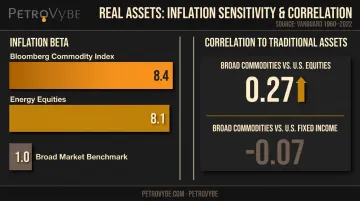
Vanguard's research covering 1960–2022 found that the Bloomberg Commodity Index had an estimated inflation beta of 8.4, and energy equities had an inflation beta of 8.1, confirming these assets move in step with rising prices. Broad commodity indexes carried a correlation of only 0.27 with U.S. equities and -0.07 with U.S. fixed income — genuine diversification, not just theoretical.
For accredited investors, direct participation in energy development goes further than commodity funds. Companies like PetroVybe offer direct positions in natural gas development projects: ownership in the producing asset itself, where return potential and tax efficiency work together in ways commodity funds typically cannot replicate.
Types of Multi-Asset Strategies
Most multi-asset strategies fall into four categories, each suited to a different investor profile. Knowing which type aligns with your timeline and risk tolerance is the starting point for building a portfolio that actually fits your goals.
Aggressive / Growth-Oriented
- Allocation: 80–100% equities, minimal fixed income
- Suited for: Long time horizons, high tolerance for short-term swings
- Historical context: Vanguard's 80/20 model returned 9.6% annually (1926–2024), with a worst year of -34.9%
Conservative / Income-Oriented
- Allocation: Heavy fixed income, cash equivalents, dividend-paying equities
- Suited for: Investors near or in retirement who need dependable cash flow
- Historical context: Vanguard's 20/80 model returned 6.6% annually, with a worst year of -10.1%
Balanced / Moderate
- Allocation: Roughly equal equities and fixed income — the classic 60/40
- Suited for: Investors seeking moderate growth with downside cushioning
- Historical context: 8.7% average annual return (1926–2024), worst year -26.6%
Target-Date / Lifecycle
- Structure: Automatically shifts from aggressive to conservative as a set retirement date approaches
- Example: Vanguard's glide path starts near 90% stocks at age 20, reaches approximately 50% stocks at age 65, and settles at 30% stocks by age 72
- Suited for: Investors who prefer a managed, gradually de-risking approach without active oversight
Key Benefits of Multi-Asset Investing
Risk Reduction Through Diversification
When asset classes don't move in lockstep, losses in one can be offset by stability or gains in another.
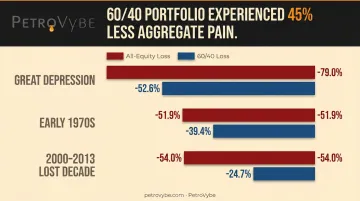
Morningstar's stress test across 150 years of market history found that a 60/40 portfolio experienced 45% less aggregate "pain" — measured by drawdown depth and recovery time — than an all-equity portfolio. The specific drawdown comparisons tell the story clearly:
| Market Crisis | All-Equity Loss | 60/40 Loss |
|---|---|---|
| Great Depression | -79.0% | -52.6% |
| Early 1970s | -51.9% | -39.4% |
| 2000–2013 "Lost Decade" | -54.0% | -24.7% |
The trade-off is real — diversification reduces upside too. Vanguard's data show 100% equities returned 10.3% annually versus 8.7% for 60/40, with a best year of 54.2% versus 36.7%. That's the honest cost of smoother rides.
Inflation Protection
Standard stock-and-bond portfolios offer limited protection when inflation rises sharply, because both assets can decline simultaneously when rates jump. A well-constructed multi-asset portfolio that includes real assets — commodities, energy, real estate — adds exposure to inflation-sensitive return drivers that paper assets don't provide.
Direct energy positions are one example of how this works in practice. Natural gas assets generate revenue tied directly to commodity prices, so their income tends to rise with inflation rather than erode beneath it — a dynamic that purely paper-based portfolios can't replicate.
Flexibility Across Life Stages
Multi-asset strategies can be engineered for almost any financial objective and adjusted as goals evolve. A single-asset approach locks you into one return driver — and one set of risks — regardless of where you are financially.
Common objectives multi-asset portfolios can be structured around include:
- Growth — equity-heavy allocations targeting long-term capital appreciation
- Income — dividend stocks, bonds, or energy distributions generating regular cash flow
- Capital preservation — defensive assets prioritizing stability over return
- Inflation protection — real assets and commodities that track purchasing power
- Tax efficiency — structures that offset ordinary income or defer gains
What Are the Risks?
Complexity and Manager Risk
Actively managed multi-asset strategies require sophisticated judgment. Morningstar found that tactical-allocation funds returned just 5.0% annualized over 20 years — versus 7.8% for a basic 60/40 portfolio. Their average expense ratio was 1.4%, and 126 of 243 funds were merged or liquidated during the period.
One telling example: tactical funds cut average equity exposure to 40% and raised cash to 29% by late 2022 — then missed the 2023 rebound entirely. Allocation timing is harder than it looks.
Lower Upside in Bull Markets
That same diversification that limits downside also caps upside. During extended equity rallies, a multi-asset portfolio will typically underperform a concentrated stock portfolio. Investors who abandoned their multi-asset allocation during the 2010s bull market to chase equity returns often paid for it when conditions shifted.
Alignment Risk
Perhaps the most overlooked risk: choosing a strategy that doesn't match your actual situation. A mismatch in either direction creates problems:
- An overly conservative allocation for a 40-year-old leaves decades of compounding on the table
- An aggressive allocation that triggers panic during drawdowns produces poor timing decisions — often selling at the worst possible moment
The right strategy isn't the one with the best historical returns. It's the one you can actually hold through a downturn.

How to Choose the Right Multi-Asset Strategy
Start With Your Investment Objectives
Before selecting any strategy, define the outcome you're pursuing:
- Income → conservative, fixed-income-heavy allocation
- Long-term growth → equity-heavy, aggressive allocation
- Capital preservation → cash, short-duration bonds, stable assets
- Inflation protection → real assets, commodities, energy
- Tax efficiency → asset selection shaped by how each class is taxed
Different objectives point toward fundamentally different asset class mixes. Trying to optimize for all five simultaneously without clear priorities is how investors end up with a portfolio that does none of them well.
Factor In Time Horizon and Risk Tolerance
A longer time horizon generally permits more aggressive allocation — more equities, more real assets, more illiquid positions. Shorter horizons call for more stability and liquidity.
Equally important: your emotional tolerance for portfolio swings. A mathematically optimal allocation that you can't hold through a 30% drawdown isn't actually optimal. If volatility triggers panic selling, a slightly more conservative mix that you'll actually maintain through market stress will outperform in practice.
Consider Tax Efficiency as Part of Asset Selection
Sophisticated investors — particularly those with significant W-2 income or capital gains — should evaluate not just return potential but the after-tax return of each asset class in their portfolio.
This is where direct energy investments stand apart from conventional options. Under IRC 263(c), qualifying intangible drilling costs (IDCs) can be elected to expense in the year incurred rather than capitalized.
For investors who hold working interests directly through entities that don't limit liability, those positions may be treated as non-passive under IRC 469(c)(3) — potentially allowing the deduction to offset active income rather than only passive income.
PetroVybe partners received 94% first-year tax deductions against active income in 2025, and 91% in 2024 — actual delivered results, not projections. On a $100,000 investment, that translates to a deduction of roughly $60,000–$80,000 from IDCs alone, which can reduce W-2 or capital gains tax liability in the year of investment.

One verified investor eliminated a $30,000 tax liability entirely through this structure.
This is a structural tax advantage unavailable through stocks, bonds, real estate (unless you qualify as a full-time real estate professional), or commodity funds. That changes the after-tax return profile of a multi-asset allocation in ways no conventional asset class can match.
Every investor's tax situation is different. These benefits should be evaluated with a qualified CPA or tax advisor before making any investment decision.
Frequently Asked Questions
What is a multi-asset?
A "multi-asset" is an investment approach or fund that holds two or more distinct asset classes — such as stocks, bonds, cash, commodities, or real assets — within a single portfolio. The goal is to diversify risk and pursue financial outcomes that no single asset class can reliably deliver alone.
What is the difference between a multi-asset strategy and a balanced fund?
Balanced funds typically hold a fixed mix of stocks and bonds — often near 60/40. Multi-asset strategies are broader and more flexible: they can include commodities, alternatives, real assets, and cash, and may actively shift allocations based on market conditions or specific investment goals rather than maintaining a static ratio.
What are the main types of multi-asset strategies?
Four primary types exist:
- Aggressive/growth-oriented — equity-heavy, prioritizes long-term capital appreciation
- Conservative/income-oriented — weighted toward bonds and cash for stability
- Balanced/moderate — roughly equal mix of equities and fixed income
- Target-date/lifecycle — automatically shifts toward lower-risk holdings as a retirement date nears
What are the risks of multi-asset investing?
Key risks include misalignment between the strategy and your actual goals, potential underperformance versus concentrated equity positions during strong bull markets, and complexity risk in actively managed approaches — particularly from poor timing decisions and elevated fees.
Can real assets like energy investments be part of a multi-asset strategy?
Yes. Real assets — including energy, commodities, and real estate — provide inflation protection and low correlation to stocks and bonds, making them a practical portfolio diversifier. Accredited investors can also access direct energy development positions, which may offer stronger return potential and tax advantages not available through public funds.
How do I know which multi-asset strategy is right for me?
Start by defining your investment objective, time horizon, and risk tolerance. Then factor in your tax situation and income needs — particularly if you carry significant W-2 income or capital gains, since certain asset classes offer deductions that directly offset active income.
Disclosure: PetroVybe and its team members are not licensed financial advisors, and nothing on this website constitutes financial or investment advice or a recommendation to buy, sell, or hold any investment. PetroVybe and its team members are not tax advisors, accountants, or tax strategists, and nothing on this website constitutes tax advice or a tax strategy. PetroVybe and its team members are not attorneys, and nothing on this website constitutes legal advice. All content is provided for general informational purposes only. You should consult your own independent financial advisor, tax professional, and legal counsel before making any decision.