
Alternative platforms give investors access private markets used to reserve for institutions: real estate debt, farmland, private credit, pre-IPO shares. The appeal is straightforward. Diversification away from public markets, and in some structures, real tax efficiency. This guide breaks down the platforms worth your attention, plus one direct-investment category most reviews skip entirely.
TL;DR
- Alternative platforms span real estate, private credit, farmland, hedge funds, and pre-IPO equity—with different minimums and lockups
- Liquidity is the most overlooked risk factor; most alternatives lock up capital for 3-10 years
- Fees and accreditation range from $10 minimums to $150,000+ fund buy-ins
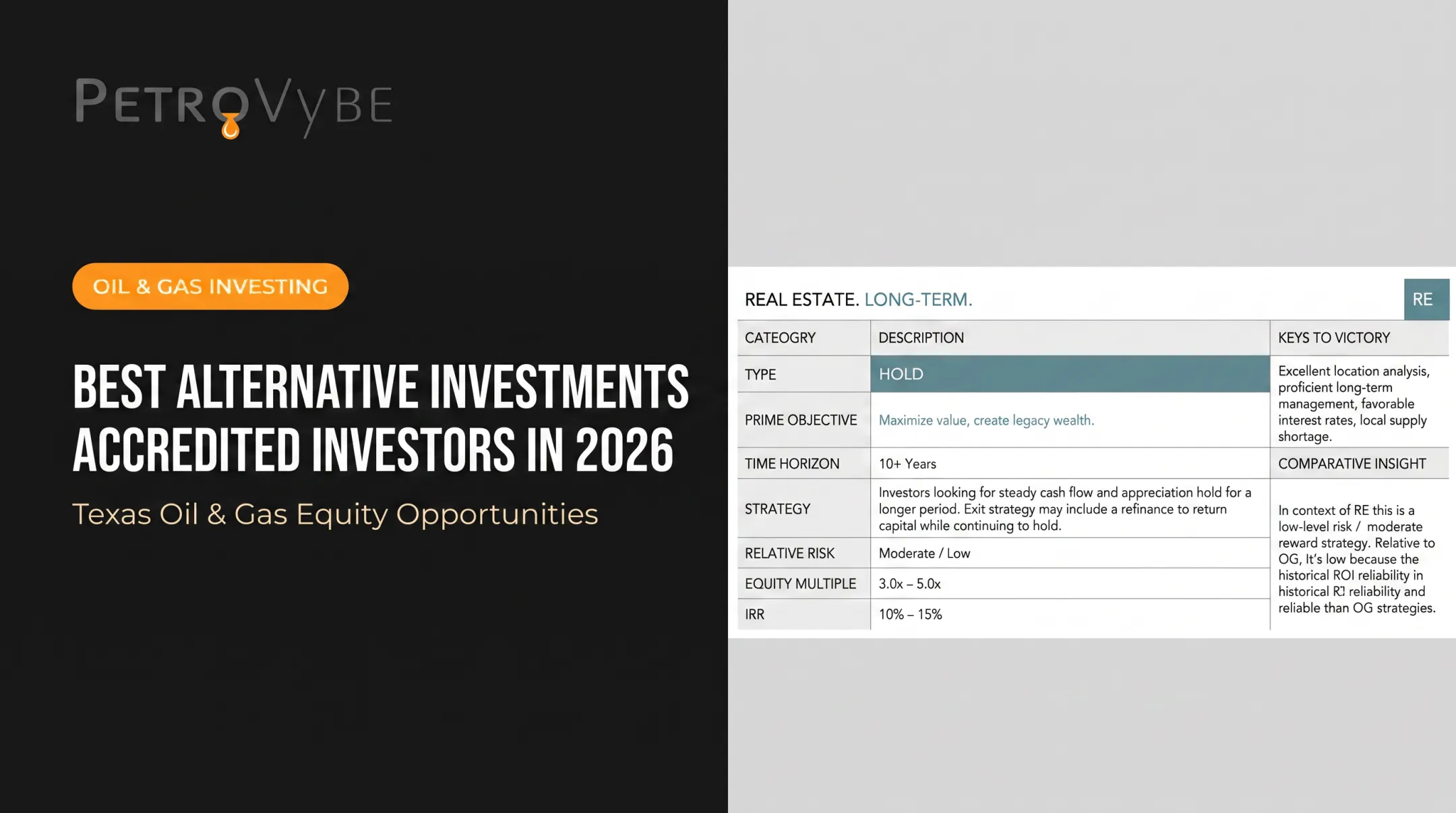
- Direct working-interest deals (like natural gas development) offer tax advantages platforms can't match
- The best platform depends on your liquidity needs, tax situation, and risk appetite
Overview of Alternative Investment Platforms in the US Market
Alternative investment platforms are online marketplaces that connect investors with private-market deals, real estate, private credit, venture capital, and more, without going through a traditional brokerage or fund manager.
Private markets are large and still growing. Preqin reported North America-focused private capital fundraising hit $861 billion in 2025, up from $762 billion in 2024. Regional private-capital assets under management reached $8.46 trillion by mid-2025.
Below, we review five leading platforms across:
- Real estate
- Private credit
- Farmland
- Pre-IPO shares
We also cover a direct-investment category—natural gas development—that operates outside the typical pooled-fund model entirely.
Top Alternative Investment Platforms for 2026
We evaluated each platform on minimum investment, asset classes, liquidity terms, hold periods, and investor eligibility.

Yieldstreet
Yieldstreet (now operating under Willow Wealth branding) is a multi-asset marketplace spanning real estate debt, private credit, art finance, and legal finance. Most private placements require accreditation and warn of 5-7 year holds with restricted, illiquid securities.
Its separate Alternative Income Fund is open to non-accredited investors as well, targeting 50+ income-focused positions with quarterly distributions. Redemptions, however, are discretionary and limited—not guaranteed.
| Minimum Investment | Asset Classes | Liquidity |
|---|---|---|
| $10,000 (Alternative Income Fund) | Real estate debt, private credit, art, legal finance | Quarterly windows, discretionary and capped |
Fundrise
Fundrise built its reputation on accessibility. Taxable accounts can start with just $10; IRAs require $1,000. Its eFund and eREIT structures let everyday investors get real estate exposure without accreditation.
The tradeoff is redemption friction. A 2021 policy update imposed a 1% penalty for shares held under five years, and repurchase requests aren't guaranteed. A 2025 notice confirmed Flagship Fund quarterly repurchases cap at just 5% of shares.
| Minimum Investment | Asset Classes | Liquidity |
|---|---|---|
| $10 | Residential and industrial real estate | Quarterly, capped at ~5% of fund shares |
AcreTrader
AcreTrader offers fractional farmland ownership through Regulation D offerings. Current listings start at $15,000 for individual farms and $150,000 for its Proterra fund.
Due diligence is genuinely rigorous: sourcing, screening, third-party soil and drainage testing, then investment-committee review. Holding periods vary by offering, from 3-5 years up to a full decade. Farmland is stable, but it's not fast money.
| Minimum Investment | Asset Classes | Liquidity |
|---|---|---|
| $15,000–$150,000 | US farmland | Illiquid; 3–10 year target holds |

iCapital
iCapital is built for advisors and their high-net-worth clients, offering curated access to hedge funds, private equity, private credit, and structured products. Asset coverage is broad: buyout, growth equity, venture capital, distressed debt, macro strategies, and more.
There's no published platform-wide minimum, but context matters here. Direct GP commitments in this space typically run $5 million to $20 million, and many underlying funds require qualified-purchaser status. This isn't a platform for a first-time alternative investor.
| Minimum Investment | Asset Classes | Liquidity |
|---|---|---|
| Advisor-dependent (often $25K–$100K+ per fund) | Hedge funds, PE, private credit, structured products | Multi-year lockups, fund-specific |
Hiive
Hiive is a secondary marketplace for pre-IPO shares in venture-backed companies, letting accredited investors buy stakes from existing shareholders with real price transparency.
The catch: these are unregistered securities. Hiive's own disclosures call them "highly speculative" and warn they may have no available market at all. Even after a company goes public, shares often stay locked up for 90-180 days.
| Minimum Investment | Asset Classes | Liquidity |
|---|---|---|
| Deal-specific (varies by listing) | Pre-IPO private company shares | Highly illiquid; lockups post-IPO |
Beyond Platforms: Direct Access to Energy Development as an Alternative Investment
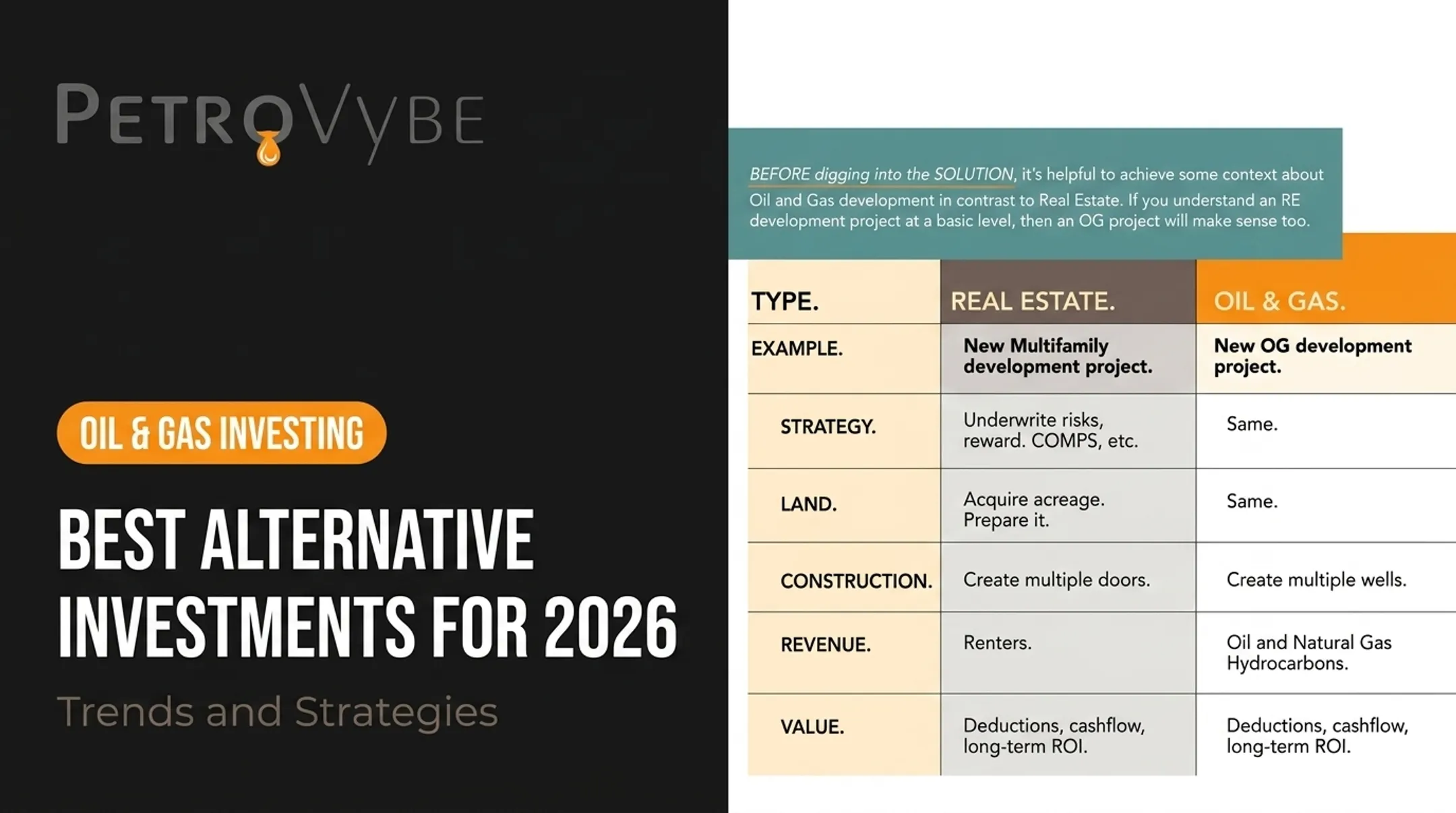
Every platform above pools your money into a fund. There's another path: direct participation in a physical asset through a working interest.
PetroVybe is a Texas-based natural gas development company offering accredited investors direct equity stakes in early-stage development projects, tied to the surging electricity demand from AI and data centers. The EIA projects data-center servers could account for up to a third of commercial electricity use by 2050 in high-demand scenarios, and natural gas is positioned to help meet that load.
What makes this structure different:
- Tax treatment: 91-94% deductions against active income (W-2 and capital gains) in 2024-2025 via IDC and depletion
- Targeted returns: ~2.2x-5.8x MOIC and ~26% IRR over a 10-year hold
- Asset base: ~400 acquired legacy wells plus 57+ planned new wells across 58,000 acres in Lavaca County, Texas
- Third-party validation: $48 million PV-09 reserves valuation from an independent engineering firm, plus a clean 2025 audit

Under IRS Publication 925, a working interest held directly is not classified as a passive activity—so it can offset active income where most fund structures cannot.
This is not a pooled marketplace fund. It is a direct working interest governed by a Private Placement Memorandum and Limited Partnership Agreement.
Accreditation is required, and so is independent due diligence—including testing decline-curve assumptions against nearby producing wells.
How We Chose the Best Alternative Investment Platforms
Investors chase headline returns and skip the fine print on liquidity and fees. That's the single most common mistake we see.
Our evaluation weighed:
- Historical returns relative to public-market benchmarks
- Liquidity terms — redemption windows, lockup periods, secondary-market access
- Risk protections — collateral, principal safeguards, or lack thereof
- Accreditation requirements — who qualifies and who doesn't
- Reporting transparency — how clearly the platform discloses fees and performance
Interval funds, a common structure in this space, typically repurchase just 5-25% of assets per window, according to CAIS. Miss the deadline, and your money's locked another quarter.

Conclusion
There's no single "best" alternative investment platform. Each option leads in a different area:
- Fundrise wins on accessibility
- AcreTrader wins on stability
- iCapital wins on institutional breadth
Your right answer depends on liquidity needs, risk tolerance, and tax situation. That last factor gets overlooked more often than it should.
If you're an accredited investor with a heavy active-income tax burden and want tangible asset ownership instead of a fund share, add PetroVybe's natural gas development model to your due-diligence list alongside the platforms above.
Frequently Asked Questions
What are the best alternative investment platforms?
Top options include real estate (Fundrise, Yieldstreet), farmland (AcreTrader), institutional products (iCapital), pre-IPO equity (Hiive), and direct energy development (PetroVybe). The right fit depends on your liquidity needs, risk tolerance, and tax goals.
Are alternative investment platforms safe for retail investors?
Risk varies widely by platform and asset class. Most offerings lack principal protection, and some require accreditation. Always verify a platform's track record and read redemption terms before committing capital.
What is the minimum investment needed for alternative investment platforms?
Minimums range from $10 (Fundrise) to $15,000+ (AcreTrader) and up to $150,000 for certain funds. Direct accredited-investor deals, like oil and gas development, often start at $100,000.
How liquid are alternative investments compared to stocks?
Most alternative investments lock up capital for 3-10 years, versus daily liquidity in public markets. Some platforms offer quarterly redemption windows, but requests aren't guaranteed and can be capped or paused.
Do I need to be an accredited investor to use these platforms?
It depends. Fundrise accepts non-accredited investors for its eREITs and eFunds. Yieldstreet's private placements, iCapital, Hiive, and direct energy development deals like PetroVybe require accreditation.
Can alternative investments offer tax benefits?
Most platform investments offer limited tax benefits beyond standard K-1 pass-through treatment. Direct oil and gas participation can generate large IDC and depletion deductions against active income.