Many high-income earners and accredited investors evaluate direct private investments as an alternative to stocks, bonds, mutual funds, and REITs, yet the mechanics remain poorly understood at the deal level. Confusion is common: "direct investing" gets mixed up with direct stock purchase plans or Foreign Direct Investment (FDI), which are different concepts entirely.
This article breaks down what direct investing actually is, why investors choose it, how the process works step by step, where it shows up in real portfolios, and when it isn't the right fit. Understanding this matters for tax planning, risk management, and control over where your money actually goes.
Key Takeaways
- Direct investing means owning a stake in one specific asset, not fund shares
- It offers greater control, fewer fees, and stronger tax advantages
- The process moves from deal vetting to subscription documents to K-1 distributions
- Common in real estate, private equity, and oil and gas working interests
- It typically requires accredited status, limited liquidity, and reliance on operator quality
What Is Direct Investing?
Direct investing is capital deployed straight into a specific private asset, project, or operating business, without a fund manager pooling your money across dozens of unrelated holdings. There's no blind pool. You know exactly what you own.
The intended outcome is transparent, asset-level exposure: a documented ownership or working interest stake whose performance you can track directly, rather than a fund share whose value depends on a manager's collective decisions across an entire portfolio.
Direct vs. Indirect Investment
Indirect (or portfolio) investment, think mutual funds, ETFs, REITs, or a brokerage-managed account, pools capital from many investors and delegates all the decision-making. You buy an interest in the fund, and a manager decides what the fund holds.
Direct investment flips that. You get:
- A specific, identifiable stake in one asset or entity
- Visibility into how that exact investment performs
- No layer of fund-level decision-making between you and the deal
Direct private investing is also frequently confused with Foreign Direct Investment (FDI), but they're not the same thing. FDI is a macroeconomic term economists and governments use to track cross-border capital flows.
The OECD's benchmark definition of FDI ties it to a resident of one economy gaining a lasting interest and significant management influence in an enterprise abroad, statistically defined as owning at least 10% of voting power.
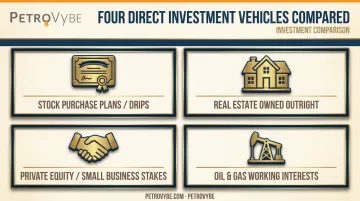
For individual accredited investors, "direct investing" simply means placing capital into a specific private deal, domestic or otherwise. Common vehicles include:
- Stock purchase plans that bypass brokers (DRIPs)
- Real estate owned outright
- Equity stakes in private companies or small businesses
- Working interests in energy development, such as oil and gas wells
Why Investors Choose Direct Investing
Control is the biggest draw. Direct investors can review the specific asset, the operator's track record, and the actual deal terms, instead of trusting a fund manager's blind pool of unrelated holdings they'll never individually evaluate.
Fee efficiency matters too. Fewer layers of management and performance fees mean more of the return actually reaches you. Hedge funds, for example, typically charge 1%-2% of assets plus 20% of profits, and even small ongoing fees compound into meaningful drag over time. Direct deals cut out that layered fee stack.
Tax Efficiency: The Biggest Differentiator
Tax efficiency is where direct investing gets genuinely interesting. Certain structures carry deductions that portfolio investors simply can't access. Direct working interests in oil and gas development, for instance, qualify for intangible drilling cost (IDC) deductions under IRS rules governed by 26 CFR 1.612-4, and those deductions apply against active income, not just passive gains.
This is the exact structure PetroVybe builds its accredited investor offerings around. In 2024, PetroVybe ONE partners received a 94% tax deduction against active income; in 2025, that figure was 91%.
A redacted K-1 on file shows a $600,000 capital contribution generating $401,772 in deductions in a single year. Real estate deductions, by contrast, generally can't touch W-2 income or capital gains unless you qualify as a full-time real estate professional.
Diversification rounds it out. Direct investing lets you add tangible assets, real estate, energy, and private businesses that don't move in lockstep with public stocks and bonds.
Without direct access, the friction shows up fast:
- Fund-level fees erode net returns before they reach you
- Delayed reporting leaves you guessing about real-time performance
- Returns get diluted across holdings you can't evaluate individually
Direct investing remains a preference, not a mandate — accredited investors choose it for the control and tax efficiency SEC-permitted structures allow.
How Direct Investing Works (Conceptual Flow)
You identify a specific opportunity, verify your eligibility, run due diligence, commit capital directly to that project or business, and then participate in its ongoing cash flow and eventual exit. No fund basket. No intermediary picking dozens of assets on your behalf.
The process typically involves:
- Investor capital committed directly to the deal
- Accredited investor verification before funding
- Subscription and partnership documents establishing ownership
- Third-party validation, such as independent engineering reports or audits
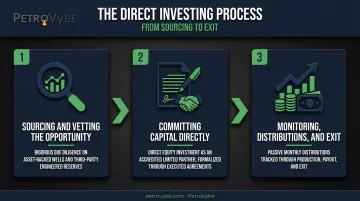
Step 1: Sourcing and Vetting the Opportunity
Since there's no fund manager pre-filtering the deal, you (or your advisor) evaluate the operator's track record, asset quality, and terms yourself. This is where credentials matter enormously.
Take PetroVybe's approach as an example. Chief Geophysicist Michael Stamatedes brings a 48-year career including a leadership role at ExxonMobil, with a 75.2% success rate on profitable well locations against an industry peer average below 40%.
Site selection runs through decline curve comparisons against the ten nearest producing wells and independent engineering review before a dollar gets committed.
Step 2: Committing Capital Directly
Funds transfer per a subscription agreement directly into the specific project or entity, establishing a documented ownership or working interest. Before that happens, most sponsors require third-party accreditation verification through a CPA, tax attorney, or licensed financial advisor under SEC Rule 506(c), plus signed offering documents. This verification step protects both the investor and the sponsor by confirming SEC compliance before any funds move.
Step 3: Monitoring, Distributions, and Exit
Investors receive ongoing performance reporting, often quarterly updates plus a data portal, and cash distributions once production or operations ramp up. Tax documentation typically arrives as an annual K-1, showing capital contributions, IDC deductions, and ending capital balances.
For a project like PetroVybe ONE, distributions are structured as Monthly Passive Distributions once production ramps, projected to peak above $10,000/month per unit, though the hold-to-first-distribution window is usually two to three years.
Eventual returns come through cash flow, refinancing, or sale of the underlying asset over a targeted 10-year hold, with the model forecasting a 2.2x to 5.8x MOIC and roughly 26% IRR.
Where Direct Investing Is Applied
Direct investing shows up across several asset classes:
- Real estate ownership
- Private equity or small business stakes
- Stock purchases and DRIP plans
- Working interests in oil and gas development
It tends to fit accredited investors who've already maxed out traditional retirement and brokerage accounts and want ground-floor access to development-stage projects. Cambridge Associates estimates co-investment activity accounts for nearly 20% of overall private equity market activity, reflecting real investor appetite for this kind of direct, deal-level exposure.
That deal-level exposure looks like PetroVybe's current project, which sits on a 58,000-acre basin in Lavaca County, Texas in the broader Gulf Coast Basin between Houston and San Antonio. The asset base includes roughly 400 acquired producing wells plus 57+ planned new wells, backed by a $48 million third-party engineered reserves valuation (PV-09) and a clean 2025 audit from Weaver.
For investors weighing whether this structure fits their goals, typical triggers for pursuing a direct deal include:
- Heavy tax burden on active income (W2 earnings or capital gains)
- Desire for passive income disconnected from public market swings
- Existing relationship with a sponsor offering a specific direct opportunity
Common Misconceptions and When Direct Investing May Not Be Right for You
More control doesn't mean less risk. Outcomes still hinge on the underlying asset's performance and the operator's execution, regardless of how much visibility you have into the deal.
Another common mix-up: "direct" ownership doesn't mean easy exit. Most direct private investments lock up capital for years, with no public exchange to sell into early. The SEC notes that private placement securities may carry no public trading market and can require indefinite holding periods.
A few realities worth weighing before you commit:
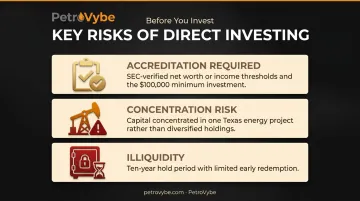
- Accreditation is mandatory. Most direct opportunities are restricted to SEC-defined accredited investors, meaning net worth over $1 million (excluding primary residence) or income over $200,000 individually/$300,000 jointly.
- Concentration risk is real. FINRA warns that putting a large share of your portfolio into one deal amplifies losses if that specific asset underperforms.
- Illiquidity isn't a footnote. Direct oil and gas partnerships often run 10-year hold periods, and your capital stays committed until distributions or an exit event materializes.
Direct investing may not suit you if you need short-term liquidity, can't commit time to due diligence, or won't accept concentration risk in a single asset class. And one clear warning sign: chasing a direct deal purely for the tax deduction without evaluating the operator's track record or asset quality. The deduction is a benefit, not a substitute for due diligence.
Frequently Asked Questions
What is direct and indirect investment?
Direct investment means owning a specific asset or business stake directly. Indirect investment means pooling money into a fund, ETF, or managed portfolio that owns many assets on your behalf.
What's the difference between direct investing and foreign direct investment (FDI)?
FDI is a macroeconomic term tracking cross-border corporate investment, defined by at least 10% voting-power ownership. Direct investing for individual accredited investors simply means placing capital into any specific private deal, domestic or international.
Who is eligible to make direct private investments?
Most opportunities are restricted to SEC-defined accredited investors: net worth over $1 million excluding primary residence, or income over $200,000 individually ($300,000 jointly) in each of the past two years.
What are the main risks of direct investing?
Illiquidity, concentration in a single asset, and heavy reliance on the operator's execution and due diligence quality. There's no fund manager diversifying the risk for you.
How much capital do I need to start investing directly in a private deal?
Minimums vary widely by sponsor and asset type, often ranging from the tens of thousands into the $100,000+ range. PetroVybe, for example, sets its minimum at $100,000 in liquidity per unit.
Can direct investing offer tax advantages that traditional portfolio investing doesn't?
Yes. Direct working interests in oil and gas drilling allow intangible drilling cost deductions against active income, including W-2 earnings and capital gains, a benefit passive fund investments typically can't offer. PetroVybe partners, for instance, claimed IDC deductions between 91-94% of invested capital in recent tax years.