Introduction
Inflation keeps eating into paychecks. Tax bills climb. Economic headlines swing between recession warnings and record markets.
A third of employed Americans now say they live paycheck to paycheck, with little or nothing left after covering basic expenses, according to a 2024 Bankrate survey.
That pressure makes purposeful money management non-negotiable.
Financial stewardship offers a different lens on that pressure. Instead of treating money as something to spend, hoard, or worry about, stewardship treats it as a resource you've been entrusted with, whether by God, your family, or your future self. That shift changes everything about how you earn, save, spend, and give.
This guide covers what financial stewardship means, its biblical roots, the five pillars of responsible money management, and practical steps to grow and protect wealth for the long haul.
Key Takeaways
- Financial stewardship means intentional, accountable management of resources for long-term goals, not just monthly budgeting
- Its roots trace to the Parable of the Talents, framing resource multiplication as duty, not greed
- Five pillars form the foundation: earning, saving/investing, spending, giving, and planning/protecting
- True stewardship grows resources through diversified, tax-efficient investments aligned with your values
What Is Financial Stewardship?
Financial stewardship is the responsible management of income, assets, and resources to meet both today's needs and tomorrow's goals. It stands in contrast to a pure ownership mindset, where money exists purely for personal consumption with no accountability attached.
Stewardship differs from basic budgeting in one key way: purpose.
Budgeting tracks dollars in and dollars out. Stewardship asks a bigger question: what is this money for? A steward manages resources on behalf of something beyond themselves, whether that's a family's future, a community, or a legacy that outlives them.
The need for this mindset shift is measurable. The Federal Reserve's 2025 report on U.S. households found that 19% of adults described themselves as "just getting by," with another 8% saying they're "finding it difficult to get by."
Nearly a third felt financially worse off than the year before. Numbers like these don't describe a lack of income alone. They describe a lack of direction.
Stewardship applies far beyond personal checking accounts:
- Personal finances: everyday earning, spending, and saving decisions
- Business decisions: how a company deploys capital and treats employees
- Inherited wealth: managing what's been passed down responsibly
- Investment capital: deploying money into productive assets rather than letting it sit idle
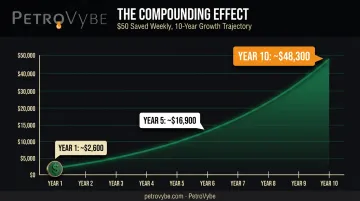
The daily decisions matter more than most people realize. A $50 saved instead of spent each week doesn't feel significant in isolation. Over ten years, invested at a modest return, it compounds into tens of thousands of dollars. Stewardship is a long game, and the compounding works whether you're paying attention or not.
The Biblical Foundation of Financial Stewardship
Scripture makes an uncomfortable claim right from the start: none of this is really yours. Psalm 24:1 puts it plainly: "The earth is the Lord's, and the fulness thereof." Under this framework, individuals aren't owners of their resources. They're managers, entrusted with something bigger than themselves.
The Parable of the Talents
Matthew 25:14-30 tells the story of a man who entrusts his servants with "talents," a form of currency, before leaving on a journey. Two servants put their talents to work and doubled them. The third, afraid of losing what he'd been given, buried it in the ground.
When the master returns, he praises the two active servants: "Well done, thou good and faithful servant." He rebukes the third as "wicked and slothful" for his inaction.
The lesson isn't subtle. Fear-based hoarding is treated as poor stewardship, not caution. Multiplying what's entrusted to you, taking intelligent, purposeful risk, is the expectation, not the exception.
Supporting Principles
A handful of other passages round out the biblical case for stewardship:
- Generous giving (2 Corinthians 9:6-7): "he which soweth bountifully shall reap also bountifully," with giving done cheerfully, not grudgingly
- Avoiding debt (Proverbs 22:7): "the borrower is servant to the lender"
- Diligent planning (Proverbs 21:5, 6:6-8): comparing careless haste to the diligence of an ant that gathers food before it's needed
PetroVybe was built directly on these principles. The company was founded on the idea that capital deployed into tangible, productive assets, rather than left idle, reflects the same "multiply what's entrusted" mandate found in the parable. Natural gas development represents that same mandate in modern form: putting resources to work rather than burying them in the ground.
The Five Pillars of Responsible Money Management
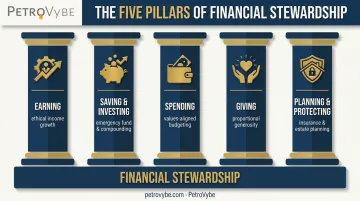
Stewardship works as a system of five interconnected pillars, each one supporting the next.
Earning
Ethical, intentional earning is the foundation everything else rests on. This means maximizing your potential through skills, education, and deliberate career growth, rather than settling for whatever income happens to show up. Without a solid earning foundation, the other four pillars have nothing to work with.
Saving & Investing
A consistent savings habit comes next, starting with an emergency fund. Financial experts like Fidelity recommend 3-6 months of essential expenses as the standard benchmark, covering housing, utilities, food, insurance, and minimum debt payments (Fidelity, 2025).
Once that cushion exists, long-term investing takes over. Compounding growth rewards those who start early and stay consistent, even through market swings.
Spending
Intentional spending means aligning your dollars with your actual values, not just your impulses. That requires distinguishing needs from wants. A budget then becomes a tool for freedom, telling your money where to go, rather than a restriction that limits you.
Giving
Giving reflects an abundance mindset rather than a scarcity one. Proportional giving, often expressed as tithing or structured charitable contributions, keeps generosity consistent rather than sporadic. U.S. charitable giving reached $592.50 billion in 2024, with individuals contributing roughly two-thirds of that total (Giving USA, 2025). Generosity, done consistently, is a discipline worth building.
Planning & Protecting
The final pillar covers insurance, estate planning, and tax planning. These aren't glamorous topics, but they're what keeps everything you've built from unraveling due to an unexpected illness, a lawsuit, or a poorly planned inheritance. Good stewardship protects resources so they can keep serving their purpose for decades, not just years.
Practical Steps to Become a Good Financial Steward
Knowing the five pillars matters little without action. Here's where to start:
- Track income and expenses closely. Use a budgeting app to build real visibility into where money actually goes. You can't steward what you can't see.
- Set specific, written goals. Tie short- and long-term targets to your actual values, sometimes called "visioneering." Vague goals produce vague results.
- Automate saving and giving. Remove willpower from the equation by setting up automatic transfers the day income arrives.
- Use the debt snowball method for high-interest debt. Pay minimums on everything, then throw extra cash at the smallest balance first. The CFPB notes this builds motivation through visible wins, even if it isn't always the mathematically fastest route.
- Review your budget monthly. Reassess your overall strategy at least once a year.
Ongoing education matters too. Read trusted books, follow credible voices, and treat your financial plan as something that evolves alongside your income and goals, not a document you write once and forget.
Stewardship in Action: Growing and Protecting Wealth for the Long Term
The Parable of the Talents doesn't end with the servants keeping their money safe. It ends with them putting it to work. That's the piece many people miss: real stewardship means growing what you have, not merely guarding it.
Tax Efficiency as a Modern Stewardship Principle
Every unnecessary dollar lost to taxes is a dollar that can't be saved, invested, or given. Minimizing that leakage frees up more capital for every other pillar.
One example: Intangible Drilling Cost (IDC) deductions allow qualifying investors in oil and gas development to deduct qualifying drilling expenses in the year they're incurred. Because a working interest in oil and gas is excluded from the passive-activity category under IRC 469(c)(3), this deduction can offset active income, including W-2 wages and capital gains, not just passive income.
That's a meaningful distinction from most real estate tax strategies, which are typically limited to offsetting passive income only.
Diversification Beyond the Traditional Portfolio
Stocks, bonds, and real estate have long been the default diversification playbook. Accredited investors are increasingly looking elsewhere for income and tax efficiency, with alternative assets like energy development drawing growing interest as traditional 60/40 portfolios face performance headwinds.
This is where PetroVybe fits into the picture. The company is a Texas-based natural gas development company built on Biblical Stewardship principles, offering accredited investors direct access to development-stage assets in South Texas and the Gulf Coast Basin. In practice:
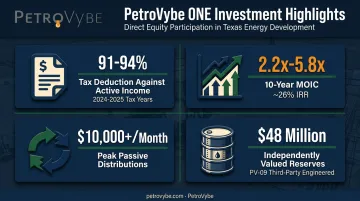
- Received a 91-94% tax deduction against active income in 2024 and 2025, driven largely by IDC deductions
- Target a 10-year MOIC of roughly 2.2x-5.8x and an IRR near 26%
- Project monthly passive distributions to peak above $10,000/month during production
- Value reserves independently at $48 million (PV-09), per a licensed third-party engineering firm
The company's Chief Geophysicist brings a 75.2% career success rate on well selection, nearly double the industry average below 40%, a factor that directly affects long-term project economics.
None of this replaces personal financial judgment. Good stewardship means matching any investment vehicle, including alternative assets like these, to your own goals, risk tolerance, and accredited investor status.
A minimum investment of $100,000 and SEC accreditation are required to participate in offerings like PetroVybe ONE. Talk with a financial or tax advisor before pursuing alternative investments of any kind.
Frequently Asked Questions
What is financial stewardship?
Financial stewardship is the responsible, purposeful management of money and resources to meet both present needs and long-term goals. It treats resources as entrusted, not owned outright.
What is biblical financial stewardship?
Biblical stewardship views God as the ultimate owner of all resources, with individuals acting as accountable managers. It calls for wisely multiplying and deploying what's been given, not hoarding it out of fear.
How to be a good financial steward?
Track spending, set written goals, save and invest consistently, give generously, and plan ahead through insurance and estate planning. Consistency matters more than intensity.
What's the difference between financial stewardship and financial management?
Financial management focuses on day-to-day tasks like budgeting and bill-paying. Stewardship adds a layer of accountability and purpose, asking what the money is ultimately for.
Why is financial stewardship important today?
Rising costs, heavier tax burdens, and economic uncertainty make careless money habits more costly than ever. Intentional stewardship helps build resilience against those pressures.
Can investing be considered a form of financial stewardship?
Yes. Deploying capital into productive, income-generating assets, rather than letting it sit idle, reflects the Parable of the Talents: multiplying what's been entrusted to you. Direct investments in real assets, such as PetroVybe's natural gas development projects, put that principle into practice.