
The concept sounds straightforward: put money into a well, collect a share of production. In practice, outcomes swing wildly based on operator selection, deal structure, geology, and whether you even qualify to invest in the first place.
This guide walks through the exact steps, requirements, return-driving factors, and mistakes to avoid before you commit capital to a Texas oil well.
TL;DR: Key Takeaways
- Direct investing requires accredited investor status via a working interest or joint venture.
- First-year IDC deductions can offset a large share of your investment against active income.
- Returns depend on operator track record, well geology, and deal terms, not oil prices alone.
- RRC filings and third-party engineering reports separate legitimate operators from the rest.
- Expect illiquidity. Plan to hold capital for 5+ years.
How to Invest in Oil Wells in Texas: Step-by-Step
Step 1: Confirm Your Accredited Investor Status
Most Texas oil well joint ventures are unregistered securities offerings, sold under SEC Regulation D. That means accreditation isn't a nice-to-have. It's the gate.
The SEC's thresholds, per its 2023 review of the accredited investor definition, require one of the following:
- Net worth above $1 million, excluding your primary residence
- Income above $200,000 individually (or $300,000 jointly) in each of the prior two years, with the same expected this year
- Certain professional licenses, such as Series 7, 65, or 82
Under Rule 506(c) offerings, self-certification isn't enough. Issuers must verify your status. Expect to provide tax returns, W-2s, bank or brokerage statements, or a third-party verification letter from a CPA, tax attorney, or licensed financial advisor. That letter is generally valid for five years if your circumstances haven't changed.
Step 2: Research and Vet the Operator and Well Location
This step matters more than any other. An operator's track record predicts outcomes far better than a slick pitch deck.
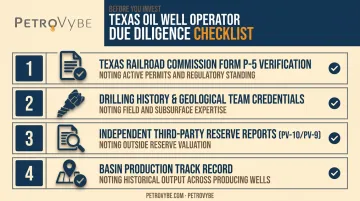
Before committing capital, check:
- Texas Railroad Commission standing: confirm an active Form P-5 Organization Report through the RRC's Organization Query tool, updated nightly
- Drilling history and geological credentials of the team making location decisions
- Independent, third-party reserve reports (like a PV-10 or PV-9 report) rather than operator-only projections
- Basin history — target areas like the Eagle Ford or Gulf Coast Basin should show a documented record of productive wells
Operator skill in site selection varies enormously. PetroVybe, for example, pairs its Chief Geophysicist's 48-year career record with independent, third-party reserve validation across its South Texas and Gulf Coast Basin projects, the type of layered diligence every operator should provide.
The Eagle Ford alone averaged 1.2 million barrels per day in 2025, roughly 9% of total U.S. crude production, according to 2025 EIA production data. A basin with that kind of documented output gives you something concrete to compare an operator's claims against.
Step 3: Review the Deal Structure, Offering Documents, and Tax Projections
Not all oil and gas investments work the same way. Know the difference:
| Structure | What you own | Cost exposure |
|---|---|---|
| Working interest | Direct share of production under the lease | Proportionate drilling and operating costs |
| Royalty interest | Share of revenue only | Generally no development or operating cost burden |
| Pooled fund/JV | Interest in an entity holding multiple wells | Governed by offering and operating agreements |
Once you know the structure, dig into the Private Placement Memorandum (PPM). Look for cost breakdowns, how costs are split between intangible drilling costs (IDCs) and tangible equipment, and projected MOIC/IRR.
Have a CPA or tax advisor review the projected first-year deduction percentage before you sign anything. Actual IDC allocations vary by project, so don't take a marketing number at face value.
Step 4: Fund the Investment and Monitor Production and Tax Reporting
Once diligence checks out, you'll sign a subscription agreement and wire funds to close your position.
After that, reputable operators keep you in the loop with:
- Regular production and distribution reports
- An investor portal for on-demand account access
- An annual Schedule K-1 for tax filing, which is also how you claim IDC deductions
- Direct access to a partner relations contact for questions
If an operator can't tell you when your next distribution statement or K-1 is coming, that's a red flag worth taking seriously.
When Should You Invest in Oil Wells in Texas?
Direct oil well investing isn't a fit for every accredited investor. It depends on your income profile, liquidity needs, and appetite for commodity risk.
Good candidates typically include:
- High-income W-2 earners looking to offset active income through IDC deductions
- Investors with recent capital gains seeking a tax-efficient place to redeploy proceeds
- Those with a 10-year hold period and no near-term need for the capital
This is likely the wrong fit if you:
- Need liquidity within the next few years
- Can't stomach oil and gas price swings without losing sleep
- Haven't yet consulted a tax professional about how deductions apply to your situation
Investors who want oil and gas exposure without the illiquidity or accreditation hurdle should look at public ETFs or stocks first. Direct working interests, like PetroVybe's $100,000-minimum units in South Texas production assets, suit investors who want tax leverage and asset ownership, not quick liquidity.
What You Need Before Investing in Texas Oil Wells
Preparation isn't just paperwork. It directly affects which opportunities you can access and how much downside protection you have going in.
Capital requirements:
- Private oil and gas placements commonly set minimums in the tens of thousands of dollars, with programs like PetroVybe requiring $100,000 in liquidity
- This figure represents accessible capital, not net worth tied up in other assets
- Operators want proof you can move quickly, often within 7-21 days of clearing diligence
Professional relationships:
- A CPA who understands depletion allowances, IDC deductions, and K-1 reporting is non-negotiable
- A tax attorney or licensed advisor may also be needed to issue your accreditation verification letter
Skipping this prep work is one of the fastest ways to miss a deal window or misjudge your actual tax benefit.
Key Factors That Affect Your Returns
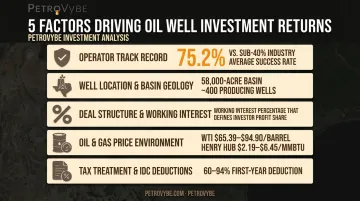
Unlike a stock index fund, direct oil well returns hinge on variables you can actually research before you invest. Five factors deserve close attention:
Operator track record and geological expertise: Well success rates hinge on an operator's skill in picking drilling locations. PetroVybe's Chief Geophysicist has posted a 75.2% career success rate across 48 years, against an industry peer average commonly cited below 40%, a gap worth verifying for any operator you consider.
Well location and basin geology: Proximity to proven, productive formations reduces dry-hole risk. A project inside a 58,000-acre basin with roughly 400 producing wells carries a very different risk profile than a speculative wildcat play with no comparable production history nearby.
Deal structure and working interest percentage: A higher working interest means a bigger share of both costs and revenue, but net revenue interest terms determine your actual payout per unit after royalties and burdens are deducted. Two deals with identical working interest can still produce markedly different investor economics.
Oil and gas price environment: Revenue ties directly to per-barrel and per-mcf pricing at the time of sale. Between 2021 and 2025, prices swung widely enough to affect monthly distributions and payback timelines:
| Benchmark | 2021–2025 Range |
|---|---|
| WTI Crude Oil | $65.39 to $94.90/barrel |
| Henry Hub Natural Gas | $2.19 to $6.45/MMBtu |
- Tax treatment and deduction structure: The split between deductible intangible costs and depreciable tangible costs determines your first-year tax benefit. IDC deductions commonly run 60-80% of invested capital in new drilling projects, with some structures delivering first-year deductions in the 91-94% range against active income. Confirm actual AFE cost breakdowns rather than relying on a promotional percentage.
Common Mistakes and Risks to Avoid
Most investor losses in this space trace back to a handful of avoidable errors:
- Skipping independent due diligence. Relying solely on operator-provided projections instead of third-party engineering reports leaves you blind to inflated reserve estimates.
- Underestimating illiquidity. Capital in private oil and gas placements is often locked up for 5-7+ years, and the SEC cautions that some private offerings may require an indefinite holding period.
- Assuming tax benefits automatically apply. IDC and depletion deductions depend on your specific structure and liability exposure — never assume without a CPA's confirmation.
- Concentrating capital in a single well. Spreading investment across multiple wells or a development program reduces the impact of any one dry hole or underperformer.
Frequently Asked Questions
What would the returns be if I invested $1,000 a month in oil drilling for 5 years?
Returns depend on well performance, operator success rate, and oil prices at time of sale, so there's no fixed number. Consistent investing builds exposure over time, but it compounds risk and reward rather than guaranteeing a set return.
Can you invest in oil drilling?
Yes, accredited investors can invest directly through working interests or joint ventures. Non-accredited investors typically access oil and gas exposure through public stocks, ETFs, or mutual funds instead.
Are oil rigs a good investment?
Oil and gas investments can offer strong tax benefits and meaningful income potential, but they also carry commodity price risk, illiquidity, and outcomes tied heavily to operator skill. Due diligence isn't optional here.
Do I need to be an accredited investor to invest in Texas oil wells?
Most direct working interest or joint venture opportunities require accredited investor status under SEC net worth or income thresholds. Non-accredited investors generally can't access these private offerings.
How much money do I need to start investing in oil wells in Texas?
Minimums vary by operator and program, often starting in the tens of thousands of dollars. Some pooled programs offer lower entry points than single-well working interests, though $100,000+ in liquidity is common for private placements.
What tax benefits come with investing in oil wells?
IDC deductions can offset a significant portion of your investment against active income, including W-2 wages, in the first year. Depletion allowances add further tax efficiency, though exact percentages depend on your specific deal structure.