

This guide covers the core legal concepts — definitions, interest types, co-tenant rights, key lease clauses, and tax implications — framed for investors and mineral owners who need practical clarity, not just legal theory.
Key Takeaways
- An undivided interest means co-ownership of the entire property as a fraction, not a physically separated parcel
- Oil and gas interests take several distinct forms — mineral, royalty, working, overriding royalty — each with different rights and cost obligations
- Co-tenants in a working interest share production revenues and development costs proportionally
- The lesser interest clause protects lessees when a grantor owns less than the full interest represented in a lease
- Working interest owners can access IDC deductions under IRC §263(c), a benefit royalty interest holders cannot claim
What Is Undivided Interest in Oil and Gas?
An undivided interest is a co-ownership structure where each party owns a fractional percentage of the entire property — not a physically defined portion of the land or reservoir. Compare that to a divided (partitioned) interest, where ownership is assigned to a specific geographic section of a tract.
The distinction matters practically: owning an undivided 25% means you own 25% of every acre and every barrel. Owning the divided northwest quarter means you own that specific quadrant exclusively. Neither party in the undivided scenario can point to "their" piece of ground.
How Co-Tenancy Works in Practice
Multiple parties can simultaneously hold undivided shares of the same mineral estate, each with legal rights to explore, develop, or lease their proportional share. In Texas — a critical jurisdiction for oil and gas — the mineral estate can be severed entirely from the surface estate, creating separate ownership chains for the land above and the resources below. The Texas Railroad Commission explains that severance occurs when an owner sells the surface while retaining minerals, or vice versa.
Undivided interests are created through:
- Inheritance — heirs dividing a mineral estate among themselves
- Conveyance — selling a fractional share via deed
- Reservation — granting land while retaining a percentage of mineral rights
Each successive transaction layers on top of prior ones. A tract can accumulate dozens of co-owners across multiple generations, which is why title examination is essential before leasing, drilling, or selling.
Net Revenue Interest vs. Working Interest
Net revenue interest (NRI) is not the same as working interest (WI). A working interest owner may hold 100% of the WI in a lease while receiving far less of actual production revenues, because royalties come off the top first.
| Term | What It Represents | Example |
|---|---|---|
| Working Interest (WI) | Cost-bearing ownership share | 100% WI = pays 100% of drilling costs |
| Landowner Royalty | Lease burden paid before costs | 25% royalty reserved by surface owner |
| Net Revenue Interest (NRI) | Revenue received after lease burdens | 100% WI − 25% royalty = 75% NRI |
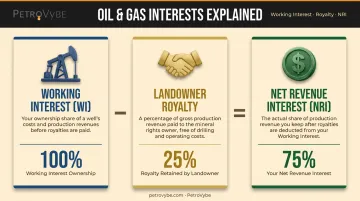
The WI percentage determines who pays development costs; the NRI percentage determines who receives what's left after royalties are satisfied. Both figures appear on every division order and are critical to evaluating any interest before you acquire it.
Types of Undivided Interests: A Breakdown for Investors
Oil and gas ownership isn't a single category. Each interest type carries distinct rights, obligations, and economic exposure. The Texas Supreme Court has identified five severable rights that together comprise the mineral estate — and each can be separately conveyed, creating a layered ownership structure.
Mineral Interest
The foundational ownership layer. The mineral interest holder owns the right to explore, develop, lease, and receive income from the minerals beneath a tract. The five severable rights within the mineral estate are:
- Right to develop — including necessary surface access
- Right to lease (the executive right)
- Right to receive bonus payments from lessees
- Right to receive delay rentals
- Right to receive royalty from production
Each stick can be separately conveyed. A mineral owner might transfer the executive right to one party while retaining royalty rights, creating sub-interests with entirely different economic profiles.
Working Interest (WI)
The lessee's operating interest under an oil and gas lease. Working interest holders bear all costs of drilling, completion, and production. In exchange, they receive the Net Revenue Interest (NRI) — their share of production revenue after royalty burdens are paid out.
Working interest can be co-owned among multiple parties who share costs and revenues proportionally. For active investors and development operators, this is the primary interest at play. PetroVybe's South Texas projects operate through leasehold working interests, with royalties paid to the underlying mineral owners in each developed tract.
Royalty Interests: Landowner's and Non-Participating
The landowner's royalty is the fraction of production reserved by the mineral owner when granting a lease — for example, 25% of gross production, free of costs. The lessee bears all development and operating expenses; the royalty owner simply receives their share of production revenue.
A Non-Participating Royalty Interest (NPRI) is carved from the mineral estate and entitles the holder to a share of royalties, but it conveys no executive right, no bonus, and no delay rentals. The NPRI owner has no say in leasing decisions.
A critical legal distinction: the difference between a "royalty fraction" and a "fraction of royalty":
| Language | Meaning | Example |
|---|---|---|
| "Undivided 1/16 royalty interest" | Fixed fraction of gross production | Always 1/16, regardless of lease royalty rate |
| "1/16 of royalty" | Fraction of whatever royalty is in the lease | If lease is 1/8, owner gets 1/128 of production |
These small wording differences produce dramatically different economic outcomes. Texas courts have long wrestled with this exact ambiguity — the Texas Supreme Court's ruling in Luckel v. White, 819 S.W.2d 459 (Tex. 1991) remains a foundational reference — making precise deed drafting essential in any conveyance.
Overriding Royalty Interest (ORRI)
An ORRI is carved out of the working interest, not the mineral estate. It entitles the holder to a share of production free of costs, but only for the duration of the underlying lease.
When the lease expires, the ORRI expires with it — a key distinction from interests rooted in the mineral estate.
ORRIs are commonly granted to geologists, landmen, and other professionals who helped assemble a prospect, serving as compensation in place of upfront cash.
Rights and Obligations of Co-Tenants
Development Without Unanimous Consent
Under Texas law, any mineral co-tenant has the right to explore and produce from the property without obtaining permission from other co-tenants. However, producing co-tenants must account to non-participating co-tenants — meaning after recovering reasonable and necessary development and production costs, the non-participating co-tenants receive their proportional share of revenues. Texas A&M's institutional review of mineral co-tenancy rules summarizes these rights and obligations in detail.
That default framework applies absent any contract. Where multiple working interest owners share a lease, they typically formalize arrangements through a Joint Operating Agreement (JOA).
Joint Operating Agreements
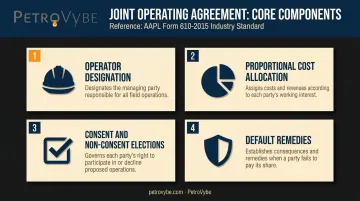
When multiple working interest owners co-own a lease, they typically execute a JOA. The AAPL Form 610-2015 is the industry's model operating agreement. A JOA:
- Designates one party as Operator responsible for conducting joint operations
- Allocates costs proportionally based on ownership shares
- Establishes consent and non-consent election procedures
- Addresses default remedies for unpaid obligations
PetroVybe OpCo LLC holds the operator's license under the Texas Railroad Commission for its South Texas wells, operating under a limited partnership structure where investor partners participate passively — not as active co-tenants with operational voting rights.
Non-Consent Provisions
When a working interest owner elects not to participate in a new well or operation, consenting parties drill at their own risk. They then recoup an additional penalty percentage of the non-consenting party's share before that party regains full participation rights. The exact penalty percentages are negotiated terms in each executed JOA — no universal range applies across all agreements.
Partition Rights
Co-tenants generally have the legal right to seek partition under Texas Property Code §23.001. However, physical partition of oil and gas producing properties is often impractical — reservoir geology doesn't respect property lines. Courts may order a sale when physical division isn't feasible. This risk is more common with inherited undivided mineral interests than with structured investment working interests.
Key Legal Provisions: Lesser Interest Clause and Deed Interpretation
The Lesser Interest Clause
Also called the proportionate reduction clause, this lease provision protects the lessee if the lessor doesn't actually own 100% of the mineral interest described. If a lessor claims full ownership but holds only 50%, the lessee's royalty obligations and acreage commitments reduce proportionately to match actual ownership.
The Texas Supreme Court applied this directly in Samson Exploration, LLC v. T.S. Reed Properties, Inc. (Tex. 2017), confirming that the proportionate-reduction clause adjusts payments to reflect the lessor's actual undivided interest. Without this clause, a lessee could overpay royalties to a partial owner while still being exposed to claims from other co-tenants.
Deed Language and Interpretation Risks
The "royalty fraction" vs. "fraction of royalty" distinction (described in the Types section above) has generated substantial Texas Supreme Court litigation. Key cases:
- Hysaw v. Dawkins (Tex. 2016): Established the whole-instrument interpretive approach; courts read deeds in their entirety rather than isolating double-fraction language
- U.S. Shale Energy II v. Laborde Properties (Tex. 2018): Court held the deed reserved a floating half-of-royalty interest, not a fixed 1/16 share
Title Examination and Curative Action
Undivided interests — especially those created through inheritance or decades of fractional conveyances — require thorough title examination to confirm actual ownership percentages. A title opinion identifies defects requiring curative action before interests can be safely leased, sold, or financed.
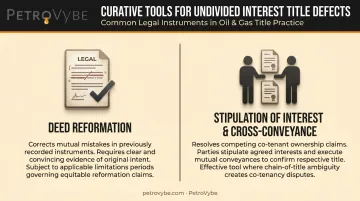
Common curative tools include:
- Deed reformation corrects mutual mistake in recorded instruments (subject to limitations periods per Cosgrove v. Cade, Tex. 2015)
- Stipulation of interest and cross-conveyance resolves competing ownership claims among co-tenants, as enforced in Concho Resources v. Ellison (Tex. 2021)
For investors evaluating oil and gas partnerships, this title examination process translates directly into due diligence. PetroVybe's Lavaca County lease agreements are publicly filed and verifiable through mineralrecords.com, and its operator license is accessible through the Texas Railroad Commission, giving accredited investors an independent baseline before committing capital.
Tax Benefits of Owning an Undivided Working Interest
Working interest ownership carries tax advantages that royalty interests simply don't match. These flow from the cost-bearing nature of the WI — you bear the expenses, and the tax code rewards that with deductions.
Intangible Drilling Cost (IDC) Deductions
Under IRC §263(c), working interest owners can elect to deduct qualifying intangible drilling costs in the year the well is drilled rather than capitalizing them. IDCs cover expenses with no salvage value — survey work, wages, fuel, drilling services, and similar costs.
Under IRC §469(c)(3), a working interest held directly or through an entity that does not limit liability is classified as nonpassive, removing the passive activity barrier that typically restricts deductions to passive income. This classification allows IDC deductions to potentially offset active income sources.
Other limitations still apply — basis, at-risk rules, excess business loss rules, and AMT — and should be evaluated with a qualified tax advisor before acting.
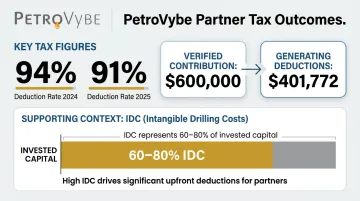
PetroVybe partners have documented results: 94% tax deduction against active income in 2024, and 91% in 2025. One verified investor example shows a $600,000 capital contribution generating $401,772 in deductions. IDCs typically represent 60–80% of invested capital in new drilling projects, so a $100,000 investment may generate $60,000–$80,000 in IDC deductions alone.
Depletion Allowances and Equipment Depreciation
Beyond IDCs, working interest owners benefit from:
- Percentage depletion at generally 15% of gross income from qualifying domestic production for independent producers under IRC §613A, subject to the depletable-quantity cap (1,000 barrels average daily production or equivalent), a 100% taxable income from property limit, and a 65% overall taxable income cap
- Tangible equipment depreciation: Physical wellhead and production equipment costs recovered through standard depreciation schedules
Royalty interest holders can claim depletion on their production income, but without access to IDC deductions or equipment depreciation, the overall tax efficiency of a royalty position falls well short of a working interest.
That efficiency gap matters most for accredited investors managing significant W2 income or capital gains. Direct working interest structures, such as those offered through PetroVybe ONE in South Texas natural gas development, can combine meaningful first-year deductions with monthly distributions projected to exceed $10,000 during peak production.
All tax outcomes should be reviewed with a qualified CPA before investing. Individual results vary based on income type, entity structure, and applicable limitations.
Frequently Asked Questions
What does an undivided interest in oil and gas mean?
An undivided interest means the owner holds a fractional share of the entire property rather than a physically separate portion. Multiple parties can co-own the same mineral estate or working interest simultaneously — each holding their percentage of every acre and every barrel.
What is the lesser interest clause in oil and gas?
The lesser interest clause (or proportionate reduction clause) protects the lessee by reducing royalty obligations and acreage commitments proportionately if the lessor's actual ownership is less than represented in the lease. It prevents a lessee from paying full royalties to a party who only owns a fraction of the mineral interest described.
What is the difference between a divided and an undivided oil and gas interest?
A divided (partitioned) interest assigns ownership to a physically specific portion of a tract. An undivided interest gives each co-owner a percentage of the whole — every acre, every barrel — with no physical lines separating their shares.
Can an undivided interest owner force a partition of oil and gas property?
Co-tenants generally have the legal right to seek partition under Texas Property Code §23.001. Courts may order a partition by sale where fair physical division isn't practicable — common with producing oil and gas properties where reservoir geology makes in-kind division technically infeasible.
How are revenues distributed among co-tenants with undivided working interests?
Revenues are distributed proportionally based on each co-tenant's net revenue interest (NRI) after royalties are paid. A producing co-tenant who develops without others' participation must account to non-participating co-tenants — meaning those owners receive their proportionate share after the producing party recovers development and production costs.
Are there tax advantages to owning a working interest versus a royalty interest in oil and gas?
Working interest owners can elect to deduct intangible drilling costs (IDCs) under IRC §263(c), and their interests may be classified as nonpassive under IRC §469(c)(3), allowing deductions against active income sources like W2 earnings and capital gains. Royalty interest holders can claim depletion but have no IDC or equipment deduction access — making working interests more tax-efficient for active-income earners.
Disclosure: PetroVybe and its team members are not licensed financial advisors, and nothing on this website constitutes financial or investment advice or a recommendation to buy, sell, or hold any investment. PetroVybe and its team members are not tax advisors, accountants, or tax strategists, and nothing on this website constitutes tax advice or a tax strategy. PetroVybe and its team members are not attorneys, and nothing on this website constitutes legal advice. All content is provided for general informational purposes only. You should consult your own independent financial advisor, tax professional, and legal counsel before making any decision.