
But here's the problem: most of them don't fully understand what they're holding. Terms like royalty interest, NRI, ORRI, and depletion get thrown around constantly, and the confusion costs owners real money. Some sell interests for pennies on the dollar. Others miss tax deductions they're entitled to.
This guide breaks down what royalties actually are, the different interest types, how payments get calculated, typical rates, how to acquire royalties, and how the IRS taxes them. We'll also cover how direct development investment, the model behind PetroVybe's approach to natural gas projects, stacks up against passive royalty ownership.
Key Takeaways
- Royalty owners collect a share of production revenue without paying a dime toward drilling or operating costs
- Average royalty rates run 12-25%, with premium basins and high-demand state acreage commanding the top end
- Schedule E reporting applies to royalty income, qualifying for a 15% percentage depletion deduction but excluding IDC write-offs
- Direct development investment offers deeper tax leverage, including IDC deductions against active W-2 and capital gains income
- These interests can be acquired through inheritance, land ownership, or purchase on the open market
What Exactly Are Oil and Gas Royalties?
A royalty payment is compensation paid to a mineral rights owner in exchange for letting an operator extract oil or gas from their property. It's typically calculated as a percentage of production revenue, though some agreements use a fixed per-unit amount instead.
The legal foundation starts with a lease. A landowner signs an oil and gas lease, handing operational control (the working interest) to an exploration and production company. In return, the landowner gets a lease bonus upfront and an ongoing royalty once the well produces.
Interest Owner vs. Non-Interest Owner
This distinction trips people up constantly. An interest owner holds rights tied to production decisions and operations. A non-interest owner only collects payment on what comes out of the ground and carries none of the exploration or development risk. The interest owner decides where to drill, pays for development costs, and bears the risk if a well underperforms. A non-interest owner skips all of that: no capital outlay, no operational headaches, just a contractual right to a share of production.
Royalty owners fall into the non-interest category. They get paid; they don't get a vote on where the next well goes.
Types of Royalty Payments a Mineral Owner May Receive
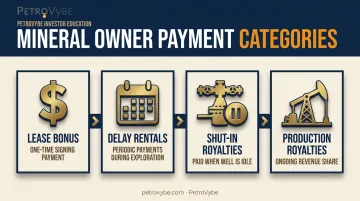
Not every check is the same kind of payment. Mineral owners typically encounter four:
- Lease bonus – a one-time payment for signing the lease, paid regardless of whether the well ever produces
- Delay rentals – periodic payments made during the exploration phase, before production begins
- Shut-in royalties – paid when a well is capable of producing but temporarily idle
- Production royalties – the ongoing percentage of revenue once oil or gas actually flows
The scale of this system is enormous. Federal onshore leases alone generated $7.191 billion in royalty revenue in fiscal year 2025, according to the Congressional Research Service. That figure covers federal lands only, and doesn't include the far larger volume of private and state royalty payments flowing across Texas, Oklahoma, and other producing states.
Types of Oil and Gas Royalty Interests
Labels matter here. The deed, lease, and state law all shape what you actually own, but four categories cover most situations.
Royalty Interest (RI)
This is the standard interest a landowner receives in exchange for leasing rights, generally landing between 12.5% and 25% of revenue. RI owners never pay production costs, and they retain ownership even after a well stops producing or the lease ends.
Overriding Royalty Interest (ORRI)
An ORRI is carved out of a working interest, usually by an operator or a third party rather than the mineral owner. It's non-possessory and bears no production costs, but there's a catch: it typically terminates when the underlying lease expires. If that lease gets surrendered, the ORRI can get "washed out" entirely.
Non-Participating Royalty Interest (NPRI)
An NPRI is granted by an RI owner and includes a share of production revenue, but nothing else. No right to negotiate new leases. No right to collect bonus payments. It's income only, with zero executive control.
Working Interest (WI)
Working interest owners bear all exploration and operating costs, drilling, completions, plugging, the works. In exchange, they keep full profits after expenses clear. This is the interest type behind direct development investment models like PetroVybe's, and it carries substantially different tax treatment than passive royalty ownership, a difference the tax section below breaks down in detail.
The core distinction across all four boils down to one trade-off:
| Interest Type | Bears Costs? | Revenue Rights |
|---|---|---|
| Royalty Interest (RI) | No | Share of gross production |
| Overriding Royalty (ORRI) | No | Share carved from WI, ends with lease |
| Non-Participating Royalty (NPRI) | No | Revenue only, no leasing control |
| Working Interest (WI) | Yes, fully | Full profit after costs, full control |
That cost-versus-revenue split also determines how each interest gets taxed and what happens when a lease ends, both covered next.
How Much Are Oil and Gas Royalty Payments?
Royalty math starts with Net Revenue Interest, or NRI. The formula is simple:
Share of Interest × Royalty Rate = NRI
Say you own a 25% interest in a tract with an 8% royalty rate, and the well produces $100,000 in monthly revenue. Your NRI would be 0.25 × 0.08 = 0.02, or 2% of gross revenue, meaning $2,000 that month before any deductions.
Average Royalty Rates by Region
Rates vary widely depending on location, lease terms, and negotiating leverage:
- Federal leases: Historically set at 12.5%, though rates have shifted with recent policy changes
- Private and state leases: Generally fall between 12% and 25%
- Premium state acreage: New Mexico's Permian trust lands cap jumped from 20% to 25% in 2025, and an August 2025 auction at that rate pulled in $256 million in bonus bids, per the New Mexico State Land Office
Five Factors That Influence Royalty Payment Amounts
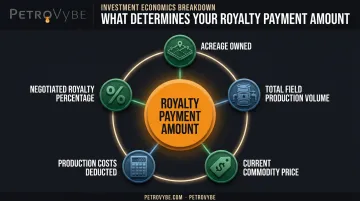
Your check size depends on:
- Acreage owned within the production unit
- Total field production volume
- Current commodity price
- Production costs deducted before net revenue is calculated
- The negotiated royalty percentage in your lease
These variables mean royalty income isn't a fixed-income investment. It swings monthly with commodity prices and follows the well's decline curve, making it an unpredictable long-term stream rather than a steady annuity.
Well lifespan matters too. Industry sources commonly cite productive lifespans in the 20-35 year range, though this varies enormously by well type.
The EPA notes that marginal conventional wells can operate for 25 years or more, while many modern tight-oil wells hit a sub-10% annual decline rate within just 8 to 10 years of first production. Translation: don't build a retirement plan around a single royalty check staying flat.
How to Get Oil and Gas Royalties
Three paths lead most people into royalty ownership:
- Inherit mineral rights through a will, trust, or intestacy, then establish clear title before requesting pay-status changes
- Own land with mineral rights and lease it to an operator for a bonus payment plus ongoing royalty
- Purchase existing royalty interests through a brokerage or private marketplace
Buying Royalties vs. Investing in Direct Development
Buying an existing royalty interest gets you passive income with limited tax benefit, just the depletion deduction, and zero say in operational or development decisions. You're along for whatever ride the operator takes you on.
Direct participation through a working interest is a different animal entirely. PetroVybe's model offers accredited investors direct entry into natural gas development across South Texas and the Gulf Coast Basin, where investors gain access to IDC deductions that typically represent 60-80% of invested capital.
In 2024, PetroVybe partners achieved a 94% tax deduction against active income, a benefit structurally unavailable to someone who simply bought a royalty check.
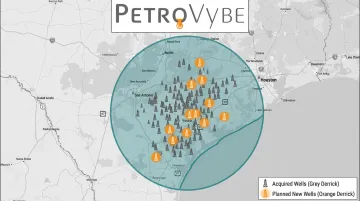
The difference comes down to control and compounding. A royalty buyer owns a slice of someone else's decline curve. A working interest partner in a project like PetroVybe ONE gets exposure to both legacy production stability and new drilling upside. The project operates roughly 400 acquired wells plus 57+ planned new wells across a 58,000-acre basin in Lavaca County, Texas.
Before acquiring either type of interest, verify:
- Mineral title and ownership chain
- Production history and current pay status
- The operator's technical track record and third-party engineering validation
That last point matters more than people realize. PetroVybe's reserves, for instance, carry a $48 million PV-09 valuation from a licensed third-party engineering firm, backed by a clean 2025 independent audit. That kind of outside verification is exactly what any investor, royalty or working interest, should demand before writing a check.
How Are Oil and Gas Royalties Taxed?
Royalty income counts as ordinary income, reported on Schedule E via Form 1099-MISC Box 2. The good news: passive royalty holders aren't subject to self-employment tax on that income.
The primary tax benefit for royalty owners is the percentage depletion deduction, set at 15% of gross royalty income. This deduction is available indefinitely, even after your original cost basis is fully recovered, though it's subject to statutory limits including a 65% of taxable income cap.
Working interest investment, by contrast, plays by different rules. IDC deductions can offset active W-2 income and capital gains in the very first year, something passive royalty holders simply can't access. This is the central reason some investors choose direct development participation over royalty ownership: the tax advantage isn't comparable.
A few practical notes for royalty recipients:
- No tax gets withheld at the source, so quarterly estimated payments are usually required
- Passive royalty income may also trigger the 3.8% Net Investment Income Tax for higher earners above the applicable AGI thresholds
- State severance and ad valorem taxes vary significantly, so check your specific state's treatment
Frequently Asked Questions
What are oil and gas royalties?
Royalties are payments made to a mineral rights owner for the right to extract oil or gas from their property, typically calculated as a percentage of production revenue.
What is the average oil and gas royalty payment?
Rates typically range from 12% to 25%, with premium basins and high-demand acreage in states like Texas and New Mexico commanding the higher end of that range.
How do I get oil and gas royalties?
Most owners get royalties through inheritance, by leasing land they already own to an operator, or by purchasing existing royalty interests through a broker or private marketplace.
What's the difference between a royalty interest and a working interest?
Royalty owners bear no operating costs but receive limited tax deductions. Working interest owners cover all drilling and operating costs but gain access to larger deductions like IDCs.
Are oil and gas royalties considered passive income for tax purposes?
Generally, yes. Royalty income is reported on Schedule E and isn't subject to self-employment tax, though it may still trigger the Net Investment Income Tax at higher income levels.
How long do oil and gas royalty payments last?
Payments continue as long as the well produces. Industry estimates commonly cite 20 to 35 years for productive lifespan, though this varies by well type and reservoir.