
This article is general education, not investment, tax, or legal advice. Open any oil and gas reserve report or offering memorandum, and you'll run into the acronym "PDP" within the first few pages. Most accredited investors nod along and keep reading. Few stop to ask what it actually verifies.
That's a problem. PDP, PDNP, and PUD reserve classifications aren't just industry jargon. They tell you how much of a project's projected income already exists versus how much depends on future drilling success. Misreading these categories means misjudging the entire risk profile of a direct working interest investment.
This guide breaks down what PDP means, how it stacks up against other reserve classes, and why the distinction matters before you commit capital to a natural gas development opportunity.
Key Takeaways
- PDP reserves are already drilled, completed, and generating revenue under current operating conditions
- Reserve classifications (PDP, PDNP, PUD) signal different risk and certainty levels, not interchangeable labels
- Independent third-party reserve reports (PV-10/PV-9 valuations) verify the claims sponsors make in offering documents
- Weigh PDP cash-flow stability against tax incentives like IDC deductions when evaluating a deal
What Is PDP in Oil and Gas?
PDP stands for Proved Developed Producing reserves. In plain terms: oil or gas already flowing from wells that are drilled, completed, and tied into existing infrastructure.
The SEC and SPE-PRMS frameworks require three conditions to be met simultaneously:
- Proved - economically producible with reasonable certainty under current prices and regulations
- Developed - recoverable through existing wells and equipment, or equipment costing relatively little compared to a new well
- Producing - completion intervals are open and actively generating output at the time of the estimate
SPE's Petroleum Resources Management System defines it clearly: developed producing reserves must come from completion intervals that are open and producing at the estimate date. Miss any one criterion, and the reserve drops into a different, riskier category.
Quick contrast:
- PDP: Drilled, completed, and flowing into a sales line
- PDNP: Drilled and completed, but shut-in waiting on a pipeline (more on that below)
"Proved" still isn't a guarantee. The SEC standard is reasonable certainty, not certainty—so execution, price, and mechanical risk remain in every barrel.
Understanding the Full Reserve Classification System
PDP sits at the top of a hierarchy built around two questions: how developed is the asset, and how certain is the recovery?
Proved Developed Non-Producing (PDNP) covers wells that are drilled and completed but not currently flowing. This usually means:
- Shut-in wells awaiting market access or pipeline connection
- Behind-pipe zones that need a recompletion before they'll produce
Proved Undeveloped (PUD) covers reserves that need new drilling or major capital investment before production can begin. SEC rules generally require an adopted development plan scheduling these locations within five years.
Comparing PDP vs. PUD Reserves
This contrast is central to risk assessment:
| Factor | PDP | PUD |
|---|---|---|
| Cash flow timing | Immediate | Delayed until drilled |
| Capital required | None | Significant |
| Risk level | Lower (decline, price risk remain) | Higher (execution, drilling, price risk) |
| Upside potential | Limited to existing production | Higher growth ceiling |
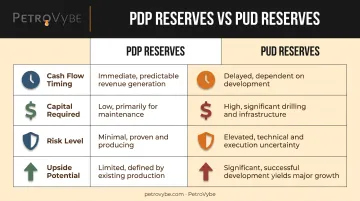
A well-structured oil and gas project typically blends both: PDP for near-term stability, PUD or exploratory upside for growth. Neither alone makes a complete picture.
Two more categories worth knowing, briefly: Probable and Possible reserves. These sit outside the "Proved" umbrella entirely. Probable reserves need at least a 50% chance of being recovered; possible reserves need only a 10% chance. Neither should be presented or mentally blended with PDP figures.
Why PDP Reserves Matter to Investors
PDP reserves represent the most bankable slice of an oil and gas asset. There's no guessing about whether a well will produce, because it already is. That's why lenders and sophisticated investors weight PDP far more heavily than other reserve classes.
The Office of the Comptroller of the Currency actually quantifies this. Its lending handbook directs banks to underwrite primarily on PDP reserves, with typical risk factors running 100% for seasoned PDP but dropping to just 25%-50% for PUD. That gap tells you everything about relative confidence levels.
Why this matters for distributions:
- PDP-heavy assets have actual production history, not projections
- Cash flow predictability improves when reserves are already flowing
- Independent reserve reports let investors verify PDP volumes instead of trusting a sponsor's forecast
This is where third-party validation earns its keep. PetroVybe's ONE project, for example, is backed by a $48 million PV-09 proved reserves determination from a licensed third-party engineering firm, not an internal projection.
The company's Chief Geophysicist, Michael Stamatedes, brings a 48-year track record identifying productive well locations, with a career hit rate reported around 75.2% against an industry average below 40%. Disclaimer: these results were achieved at prior companies. That experience helps separate an asset-backed opportunity from an optimistic pitch deck.

That same producing base is what makes tax mechanics useful in practice. Pairing PDP cash-flow visibility with Intangible Drilling Cost (IDC) deductions lets accredited investors combine predictable distributions with real tax efficiency—something MLP units or dividend stocks can't replicate. This treatment requires the investor to elect general partner status in the Subscription Agreement and may be limited in a given year by the excess business loss limitation under IRC §461(l).
How PDP Reserves Are Valued
Valuing PDP reserves starts with hard data: historical production volumes, current commodity prices, and operating costs projected into future net revenue.
The discount rate does the heavy lifting. A common convention, PV-10, discounts projected future net cash flows at 10% annually to arrive at present-day value. Some lenders use PV-09, prepared by Lee Keeling & Associates, Tulsa, March 2026, applying a 9% discount instead, typically as part of a reserve-based lending calculation under that lender's own price deck.
The SEC explicitly states that reserve estimates aren't intended to establish fair market value. PV-10 improves comparability across companies. It doesn't tell you what you should actually pay for an asset.
Who performs these valuations?
- Licensed, independent petroleum engineering firms conduct the work
- Objectivity matters, since sponsor-generated numbers carry obvious conflicts of interest
- Reports should disclose price deck, discount rate, effective date, and reserve classification breakdown
That's why PetroVybe relies on an independent engineering firm for its PV-09 figure rather than an in-house estimate. Third-party validation doesn't eliminate risk, but it removes one layer of "just trust us."

Risks and Considerations for PDP-Based Investments
PDP reserves reduce development risk. They don't eliminate financial risk.
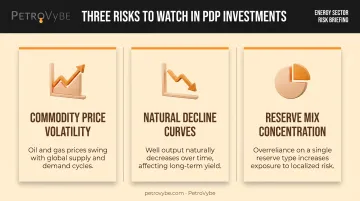
Three things to watch:
- Commodity price volatility. Reserve reports typically use a trailing 12-month average price. Actual realized cash flow can diverge sharply if prices move after the report's effective date.
- Natural decline curves. Every producing well slows down over time. PDP volumes shrink unless new drilling, workovers, or optimization projects replace what's been depleted.
- Reserve mix concentration. A project that's mostly PUD carries very different risk than one anchored in PDP. Before committing capital, ask what percentage of total reserves is PDP versus PDNP or PUD.
Decline rates vary widely by reservoir and completion type. There's no universal percentage that applies across every basin, so don't accept a generic decline assumption without well-level production history to back it up.
Questions worth asking any sponsor:
- When was the reserve report last updated, and by whom?
- What price deck and discount rate were used?
- What portion of reserves is PDP versus PDNP or PUD?
- How does the project plan to offset natural decline?
Projects that pair legacy PDP production with active reinvestment—workovers on existing wells plus new drilling—tend to hold up better over a 10-year hold than those that rely on either alone.
Frequently Asked Questions
What is a PDP in oil and gas?
PDP stands for Proved Developed Producing reserves: hydrocarbons already being extracted from existing, completed wells under current economic conditions. It is the most certain and immediate reserve classification.
What's the difference between PDP and PUD reserves?
PDP reserves are already producing, with minimal remaining development risk. PUD reserves need new drilling or major capital before they generate income, so they carry higher risk.
What are PDNP reserves?
PDNP means Proved Developed Non-Producing. These are wells that are drilled and completed but not currently flowing, often shut-in or awaiting pipeline connection or a recompletion.
How are PDP reserves valued?
Valuation combines historical production data, commodity price assumptions, and operating costs to project future net revenue. That revenue stream is then discounted, commonly at 10% for PV-10, to determine present value.
Are PDP reserves a safe investment?
PDP reserves carry lower risk than undeveloped oil and gas assets because production already exists. They are not risk-free: commodity price swings and natural decline curves still affect returns.
What is PV-10 and how does it relate to PDP?
PV-10 is the present value of estimated future revenue from proved reserves, discounted at 10% annually. It is widely used to compare PDP-heavy assets, but it is a benchmark—not a fair market value.
Informational requests only. PetroVybe projects are offered solely to verified accredited investors. Submitting this form does not create an investment or advisory relationship.