

This article is general education, not investment, tax, or legal advice. Accredited investors reviewing oil and gas offering documents run into two terms constantly: Working Interest (WI) and Net Revenue Interest (NRI). Confuse them, and you can misjudge what a deal actually pays.
Here's why this matters heading into 2026. WI determines what you pay and what you owe. NRI determines what actually lands in your bank account. The tax treatment differs between them too, and getting this wrong can mean overestimating returns by a wide margin.
This guide breaks down WI vs NRI with formulas, real examples, and how PetroVybe structures its natural gas development opportunities around these numbers.
Key Takeaways
- Working Interest (WI) is your ownership and cost share; Net Revenue Interest (NRI) is what you get paid after royalties
- Formula: NRI = WI × (1 − Total Royalty Rate)
- WI owners can claim IDC and depletion deductions that royalty-only holders cannot
- Identical WI positions can yield different NRI based on each lease’s royalty burden
- Always request both WI and NRI before committing capital to any development program
Working Interest vs Net Revenue Interest: Quick Comparison
| Factor | Working Interest | Net Revenue Interest |
|---|---|---|
| Cost responsibility | Pays proportional share of drilling, completion, and operating costs | No direct cost obligation; revenue share only, derived from WI |
| Revenue received | Gross share before royalty deductions | Actual share of production revenue after royalties |
| Tax treatment | May qualify for IDC deductions and depletion; can be nonpassive in specific cases | Feeds depletion and income calculations; not a standalone tax category |
| Risk exposure | Cost overruns, dry holes, operational risk | Commodity price and production volume risk |
| Control | May carry decision rights under joint operating agreements | Passive number, no control implications |
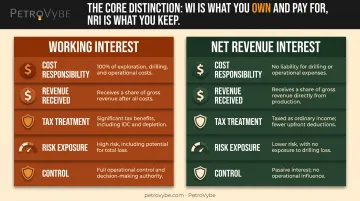
The core distinction: WI is what you own and pay for. NRI is what you get to keep.
What Is Working Interest?
Working Interest is the operating interest in a lease. It entitles the owner to a share of production while obligating them to pay a proportional share of drilling and operating costs. Simply put: no cost, no working interest.
That cost exposure is also what unlocks WI's main tax advantage:
- Share of production revenue in proportion to your WI percentage
- Obligation to pay the same percentage of drilling and operating costs
- Eligibility to expense qualifying intangible drilling costs (IDCs) under Regulation 1.612-4
An operator holding a working or operating interest may elect to expense qualifying IDCs rather than capitalize them. Qualifying IDCs include wages, fuel, repairs, hauling, and supplies incident to drilling. Equipment with salvage value, such as pipe and tanks, does not qualify.
Marketing materials often claim IDCs represent "a first-year deduction target of approximately 70–80% of invested capital of well costs." That range is an industry cost-composition figure, not an IRS-mandated deduction rate. The IRS does not prescribe a percentage. What matters is whether the qualifying costs on your specific well were correctly categorized and expensed. This treatment requires the investor to elect general partner status in the Subscription Agreement and may be limited in a given year by the excess business loss limitation under IRC §461(l).
Operated vs. Non-Operated Working Interest
Not all WI positions carry the same control:
- Operated WI: Holder (or their designated operator) makes drilling and operational decisions
- Non-operated WI: Holder shares costs and revenue but defers decisions to the operator under a joint operating agreement (JOA)
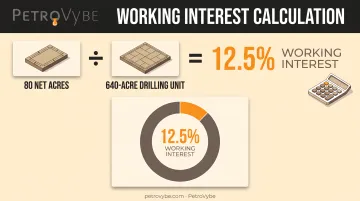
Your WI percentage typically derives from net mineral acres controlled divided by total acres in the drilling unit.
Example: If you control 80 net acres in a 640-acre drilling unit, your WI is 80 ÷ 640 = 12.5%.
How Investors Use Working Interest
Accredited investors use WI to participate directly in drilling economics—bearing costs in exchange for a larger share of production and the IDC election above. PetroVybe structures its South Texas and Lavaca County natural gas projects around this model so partners hold an entry-point working interest rather than only a royalty stream.
WI holders whose interest is not held through a liability-limiting entity may also qualify for nonpassive treatment under Section 469(c)(3), regardless of material participation. That differs from royalty income, which is typically portfolio income and sits outside passive-activity calculations entirely.
What Is Net Revenue Interest?
Net Revenue Interest is the percentage of production revenue an owner actually receives after royalty and overriding royalty burdens are subtracted from their working interest. SLB's Energy Glossary defines it this way: NRI is the production share remaining once all burdens are deducted from WI.
Here's the formula in practice:
NRI = WI × (1 − Total Royalty Burden)
This is an algebraic restatement of the standard industry definition, not a formula printed by the IRS or SPE. But it works reliably once you know your burden rate.
NRI drives your actual monthly cash flow. Two investors can hold identical WI percentages and still receive very different checks if their underlying leases carry different royalty burdens. Always request NRI alongside WI in any offering memorandum. The gap is rarely just a rounding difference.
How NRI Translates to Investor Cash Flow
Analysts use NRI to project cash distributions once a well reaches first production. The math below shows why a headline WI figure can overstate what you actually collect.
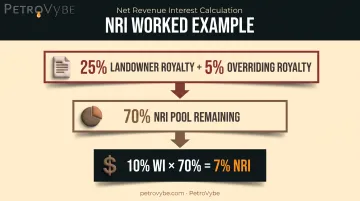
Worked example: A Texas lease carries a 25% landowner royalty and a 5% overriding royalty. That leaves a 70% NRI pool. A 10% WI position translates to:
10% × 70% = 7% NRI
That 7% is what actually shows up in distributions, not the 10% headline WI number.
Royalty burden ranges you should expect:
- Historical Texas standard: 12.5% (the traditional 1/8 royalty) (Texas A&M Real Estate Research Center)
- More recent Texas standard: approximately 20-25%
- Permian Basin average: 21.2%
- Eagle Ford average: 20.3%, based on 2014 acre-weighted lease data (Federal Reserve Bank of Kansas City)
These figures cover landowner lease royalties specifically. Overriding royalties and other burdens can push the total reduction higher, so always confirm the complete burden stack on your lease, not just the base royalty.
Which Matters More for Your Investment?
Neither number stands alone. WI defines your cost responsibility and tax exposure. NRI defines your actual income. You need both.
Prioritize NRI and royalty burden disclosures if:
- Modeling monthly cash flow projections
- Estimating check size once production starts
- Comparing two deals with different lease structures
Prioritize WI percentage and cost obligations if:
- Evaluating tax deduction potential
- Gauging exposure to cost overruns or dry holes
- Assessing operational risk under a JOA
A deal that leads with a big WI number and skips the NRI disclosure deserves a second look. That's often where royalty burdens get buried.
How PetroVybe Structures Working Interest for Accredited Investors
PetroVybe offers accredited investors direct working interest positions in natural gas development projects across South Texas and the Gulf Coast Basin. That's an entry-point position where value gets created, rather than a passive royalty check with no upside participation.
How this plays out for partners:
- IDC deductions pass through against active income, including W-2 earnings and capital gains. 2025 partner cohorts reported 94% first-year deductions against active income. This treatment requires the investor to elect general partner status in the Subscription Agreement and may be limited in a given year by the excess business loss limitation under IRC §461(l). Prior result; not a promise of any future deduction.
- Reserves are backed by third-party engineering validation, including a $48 million PV-09 proved-reserves valuation from a licensed independent firm, not PetroVybe's internal team. Prepared by Lee Keeling & Associates, Tulsa, March 2026.
- Focus on Natural Gas Liquids (NGLs), which the company positions as commanding premium pricing versus dry gas. Better realized pricing improves net revenue investors see after royalty burdens.
- Chief Geophysicist Michael Stamatedes brings a 48-year track record and a reported 75.2% hit rate on well-location selection, versus an industry average below 40%. Disclaimer: these results were achieved at prior companies. Stronger picks raise the odds wells meet underwritten production, which matters for the NRI that investors eventually receive.

PetroVybe's documentation does not publish a specific WI-to-NRI conversion formula or royalty burden range for its Lavaca County leases. Those figures live in the Private Placement Memorandum, Limited Partnership Agreement, and Subscription Agreement. Request them before wiring capital on any project, PetroVybe included.
Frequently Asked Questions
What is a net revenue interest?
Net revenue interest (NRI) is the share of production revenue you actually receive after royalties and other burdens come off working interest. That percentage is what drives real cash flow.
How do I calculate working interest for an oil and gas property?
Working interest is typically calculated by dividing your net mineral acres controlled by the total acres in the drilling unit. For example, 80 net acres in a 640-acre unit equals 12.5% WI.
What is the difference between working interest and mineral interest?
Mineral interest is ownership of subsurface rights that can be leased out. Working interest is the operating interest created once a lease is signed, carrying both production rights and cost obligations.
Can two investors with the same working interest have different net revenue interest?
Yes. Differing royalty burdens on each underlying lease can produce different NRI even when both investors hold identical WI percentages. Always check the specific lease terms.
Does working interest offer better tax benefits than royalty interest?
Yes. WI often qualifies for IDC deductions and may receive nonpassive treatment under Section 469. Royalty interest is usually portfolio income, limited mainly to percentage depletion at 15%, subject to limits.
Is working interest suitable for every accredited investor?
No. WI carries direct cost exposure and operational risk, so it fits investors who can tolerate those obligations and want tax-advantaged oil and gas upside—not every accredited investor.
Informational requests only. PetroVybe projects are offered solely to verified accredited investors. Submitting this form does not create an investment or advisory relationship.