

The One Big Beautiful Bill Act (OBBBA) reshaped brackets, deduction caps, and retirement contribution rules heading into 2026. Waiting until April to think about taxes means missing nearly every strategy that actually moves the needle.
High-income earners, business owners, and investors are feeling this most acutely. Rising effective tax rates, a new itemized deduction cap for top-bracket filers, and shifting SALT thresholds mean reactive filing costs real money. Proactive planning is no longer optional.
This guide covers seven actionable 2026 tax planning strategies, from retirement accounts to charitable bunching. It also covers one strategy most taxpayers overlook entirely: direct investment in natural gas development, which can generate deductions against active income that few other vehicles can match.
Key Takeaways
- Tax planning in 2026 demands year-round decisions, not December scrambling
- Retirement accounts, HSAs, and capital gains timing still count, but 2026 rules shifted
- IDC deductions from natural gas investments can offset W-2 wages and capital gains directly
- Your income mix, W-2, capital gains, or pass-through, determines which strategies matter most
- Coordinated planning beats chasing a single tactic in isolation
What Are the Pillars of Tax Planning?
Effective tax planning rests on five core pillars working together, not five separate checklists.
- Income timing — deciding when to recognize income or deductions based on your current and projected tax bracket
- Deduction and credit optimization — maximizing what you can legally claim, including itemized versus standard elections
- Tax-advantaged investment vehicles — retirement accounts, HSAs, and alternative assets like direct energy development investments that qualify for intangible drilling cost (IDC) deductions
- Entity and investment structure — how you hold assets or run a business affects your total tax exposure
- Estate and wealth transfer planning — positioning assets for the next generation with minimal tax drag

Most taxpayers focus almost exclusively on deductions. That's a mistake. Timing income and choosing the right investment vehicle often produces a **bigger swing in your final tax bill** than any single deduction.
These pillars aren't independent, either. Accelerating income into a lower-tax year can help you today, but push you into a higher bracket next year if you're not careful. A Roth conversion might reduce future taxes while triggering a Medicare premium surcharge two years from now. Coordinated planning matters more than any individual tactic.
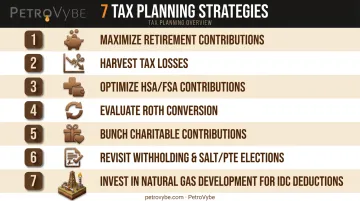
7 Tax Planning Strategies to Know in 2026
These seven strategies span retirement savings, investment timing, health accounts, charitable giving, and one increasingly popular deduction-heavy alternative asset class. Some apply to nearly everyone. Others fit a narrower profile, but deliver outsized value when they do.
Strategy 1: Maximize Contributions to Tax-Advantaged Retirement Accounts
Contribution limits jumped again for 2026. The 401(k) elective deferral limit rises to $24,500, with a $8,000 catch-up for those 50 and older, and an $11,250 catch-up for ages 60-63. IRA limits climb to $7,500, plus a $1,100 catch-up.
There's a new wrinkle for high earners: anyone who made more than $150,000 in FICA wages from their employer in 2025 must make their 2026 catch-up contributions as Roth, not pre-tax. This is a SECURE 2.0 requirement, not an OBBBA change, but it catches a lot of people off guard.
- Capture the full employer match first, always
- Decide Roth versus traditional based on whether you expect a higher or lower bracket in retirement
- Confirm your payroll system is applying the new Roth catch-up rule correctly
Strategy 2: Harvest Tax Losses and Manage Capital Gains Timing
Tax-loss harvesting offsets capital gains dollar-for-dollar, plus up to $3,000 of ordinary income annually ($1,500 if married filing separately). Unused losses carry forward indefinitely.
The wash-sale rule trips up plenty of investors. Selling a security at a loss and buying a substantially identical one within 30 days before or after the sale disallows the loss. That's a 61-day window to watch.
For large gains, consider:
- Spreading a sale across two tax years to avoid a bracket jump
- Timing the sale to coincide with a lower-income year (sabbatical, business loss, retirement transition)
- Pairing losses with gains realized earlier in the same year
Strategy 3: Optimize HSA and FSA Contributions
HSA limits for 2026 rise to $4,400 for self-only coverage and $8,750 for family coverage, with a $1,000 catch-up for those 55 and older. The triple tax benefit still stands out: contributions are deductible, growth is tax-free, and qualified withdrawals are tax-free.
Health FSAs get a bump too, to $3,400, with up to $680 in employer-permitted carryover. Remember, FSAs are generally "use it or lose it" unless your employer offers a carryover or grace period, not both.
Dependent care FSAs are underused. The 2026 exclusion rises to $7,500 per household, a meaningful deduction many working parents skip entirely.
Strategy 4: Evaluate a Roth IRA Conversion
Converting traditional IRA funds to Roth makes sense in specific windows: a temporarily low-income year, a market downturn (converting more shares for the same tax cost), or when you expect a higher tax bracket later.
The catch is Medicare. IRMAA surcharges use your tax return from two years prior, so a large 2026 conversion could raise your Medicare premiums in 2028. Convert only enough to stay under your target bracket ceiling, and check where you sit relative to IRMAA thresholds before pulling the trigger.
Strategy 5: Bunch Charitable Contributions and Consider a Donor-Advised Fund
With 2026 standard deductions rising to $16,100 (single) and $32,200 (married filing jointly), clearing the itemization threshold takes more giving than it used to. Bunching, combining two or three years of donations into one year, helps you itemize in that year and take the standard deduction in others.
There's a further complication for 2026: a new 2/37 limitation reduces the value of itemized deductions for top-bracket filers, effectively capping the federal benefit at roughly 35 cents per dollar instead of 37. This makes donating appreciated stock or other assets more valuable than writing a check, since you avoid capital gains tax on top of the deduction.
Two tactics can amplify the benefit: route bunched gifts through a donor-advised fund for flexibility on timing distributions, and donate appreciated securities held longer than a year rather than cash when possible.
Strategy 6: Revisit Withholding, Estimated Taxes, and SALT/PTE Elections
OBBBA changed enough brackets and deduction thresholds that your W-4 withholding from last year is probably wrong for 2026. Residents of high-tax states have an additional reason to check: the SALT cap rose to $40,400 for 2026, up from the old $10,000 ceiling, though it phases out starting at $505,000 in modified AGI.
Business owners with pass-through entities have a bigger lever: Pass-Through Entity (PTE) tax elections. These let the entity pay state tax and deduct it fully at the entity level, sidestepping the individual SALT cap altogether. Not every state offers this, so model it against your specific state's rules before year-end.
Strategy 7: Invest in Alternative Assets Like Natural Gas Development for Direct Deductions Against Active Income
Most tax-advantaged accounts shelter future income. Direct working-interest investments in oil and gas development do something different: they generate Intangible Drilling Cost (IDC) deductions that offset active income right now, including W-2 wages and capital gains.
This works because a working interest, held without limited liability, is excluded from passive-activity treatment under Section 469(c)(3). That's a meaningful distinction from most real estate syndications or fund investments, where losses typically stay trapped against passive income only.
This strategy isn't for everyone. It's generally reserved for accredited investors, and it requires real diligence: vetting the operator's track record, reviewing third-party reserve reports, and confirming the deduction percentage before committing capital.
Why Natural Gas Development Deductions Are a Standout 2026 Strategy
The mechanics here deserve a closer look because the numbers are unusual compared to most deductions taxpayers are used to.
Under Treasury Regulation 1.612-4, operators can elect to deduct intangible drilling costs, labor, chemicals, drilling fluids, and other non-salvageable expenses, in the year they're incurred rather than capitalizing them. In practice, this means IDC deductions can reach 60-80% of invested capital in the first year alone, with total deductions climbing toward 100% over time.
Partner results: Partners who joined in 2024 received a 94% total tax deduction against active income; 2025 partners saw that figure land at 91%. Both figures came through K-1 forms and applied directly against W-2 wages and capital gains, not just passive income.
The tax benefits are the entry point, not the whole story. PetroVybe's flagship offering, PetroVybe ONE, targets a 10-year MOIC of 2.2x to 5.8x and roughly 26% IRR. The deduction opens the door to a longer-term passive income and wealth-building position, not a one-time write-off.
Operator quality matters enormously here, and PetroVybe's leadership track record is part of the underwriting story:
| Role | Track Record |
|---|---|
| Chief Geophysicist | 75.2% well-success rate over a 48-year career, versus an industry peer average below 40% |
| President & COO | Scaled a $5 billion asset from zero to 35,000 BOEPD in 8 years |
| Proved reserves | $48MM PV-09 valuation from an independent, licensed engineering firm |

This strategy fits a specific investor profile:
- $100,000 or more in available liquidity
- High W-2 or capital gains tax burden
- Interest in diversifying beyond stocks, bonds, and traditional real estate
- Comfort with a multi-year hold before meaningful cash distributions begin
If that describes your situation, talk to your tax advisor about how IDC deductions would apply to your specific income mix. Then connect with PetroVybe to review current development opportunities in South Texas and the Gulf Coast Basin.
Common Tax Planning Mistakes to Avoid
- Waiting until December or April. Roth conversions, PTE elections, and alternative deductions require action months before year-end, not at filing time.
- Chasing one tactic in isolation. A move that lowers your income tax can quietly raise your Medicare premium or push you into a higher bracket elsewhere.
- Under-vetting alternative deductions. Confirm the working-interest structure, reserve reports, and operator credentials before claiming a large oil and gas deduction.
Frequently Asked Questions
What are some strategies to reduce taxes?
Top strategies include maximizing retirement and HSA contributions, harvesting capital losses, bunching charitable deductions, and exploring alternative deductions like oil and gas Intangible Drilling Cost (IDC) write-offs against active income.
What are the pillars of tax planning?
The core pillars are income timing, deduction and credit optimization, tax-advantaged investment vehicles, and estate or wealth transfer planning. They work together, not in isolation.
What is the difference between tax planning and tax preparation?
Tax preparation looks backward, filing an accurate return for a year that's already over. Tax planning looks forward, making proactive decisions throughout the year to reduce future liability.
Is investing in oil and gas a legitimate tax reduction strategy?
Yes. IRS-recognized IDC and depletion deductions make direct working-interest oil and gas investments an established strategy, though it's best suited for accredited investors after professional tax review.
What is the SALT deduction cap for 2026?
The OBBBA raised the itemized SALT cap to $40,400 for 2026, subject to phaseouts above $505,000 in modified AGI. Business owners can often work around individual caps through pass-through entity (PTE) elections.
When should I start tax planning for the year?
Start early in the year and review quarterly. Strategies like Roth conversions and alternative investments require action well before December, not scrambling at year-end.