
That process feels harder than ever right now. Grocery bills climb, rent keeps rising, and market headlines swing between euphoria and panic. Many people feel like they need more money than ever just to feel secure, and they're not wrong.
This guide breaks down what wealth actually means, the saving and investing steps that build it, and how diversifying beyond a standard 401(k) can accelerate the journey. No shortcuts, just the mechanics that actually work.
Key Takeaways
- Wealth follows a formula: Regular Investments + Time = Wealth, not a single lucky break
- Real wealth blends net worth with health, time, and relationships, not just dollars in the bank
- Paying down debt, automating savings, and using tax-advantaged accounts form the foundation
- Adding income-producing alternative assets can boost tax efficiency and inflation protection
What Does It Truly Mean to Build Wealth?
The dictionary defines wealth as an abundance of money or valuable possessions. Most people who've actually built some know it's more layered than that.
How Americans Define "Wealthy" Today
According to the 2025 Charles Schwab Modern Wealth Survey, Americans now associate "wealthy" with an average net worth of $2.3 million, down from $2.5 million in 2024. Meanwhile, "financially comfortable" now sits at $839,000, up from $778,000 the year before. Comfort got more expensive even as the wealth bar dropped slightly.
The same survey and related research found that respondents weigh happiness, health, relationships, and free time nearly as heavily as net worth when asked what wealth really means. Money matters, but it's not the whole scorecard.
How common is millionaire status? The Federal Reserve's 2022 Survey of Consumer Finances shows median family net worth at $192,900, with the 90th percentile crossing $1.94 million. Based on that data, somewhere between 10% and 25% of U.S. families have crossed the $1 million net worth mark, a range that's grown steadily over the past decade.

The Real Definition: Net Worth and Income-Producing Assets
Economists define wealth more precisely: net worth, meaning assets minus liabilities. They typically break assets into three buckets:
- Personal property (homes, vehicles, valuables)
- Monetary savings (cash, checking, savings accounts)
- Income-producing capital (stocks, real estate, business interests, natural resource investments)
That third category is where real wealth-building happens: accumulating assets that compound and produce income over time, not just chasing a bigger net worth number.
Master the Saving Fundamentals First
Before anyone touches an investment account, the savings side of the ledger needs attention. Skip this step and you're investing with one hand tied behind your back.
Kill High-Interest Debt Before You Invest
No investment reliably outearns credit card interest. The Federal Reserve's latest G.19 Consumer Credit report puts the average credit card APR at 20.94% across all accounts, and 22.15% among accounts carrying a balance. Even a strong stock market year rarely clears that hurdle.
Pay off high-interest debt first; every dollar of balance eliminated equals a guaranteed 20%+ return.
Build a Budget That Actually Makes Room to Save
With high-interest debt cleared, the next step is redirecting cash flow through a clear budget. Separating fixed bills (rent, insurance, loan payments) from discretionary spending shows exactly where that flexibility exists.
One frequent budget killer: oversized car loans. A $700 monthly payment on a truck can quietly cannibalize what would otherwise become investment capital. Keep vehicle payments modest and redirect the difference toward savings.
Automate an Emergency Fund
Set up automatic per-paycheck deposits into a dedicated emergency account. Fidelity recommends starting with $1,000, then building toward 3-6 months of essential expenses. A fully funded emergency fund means an unexpected car repair or medical bill doesn't force new debt or an early sale of long-term investments.
Invest Regularly: The Wealth-Building Formula
Once debt is under control and an emergency fund exists, the real wealth engine kicks in: Regular Investments + Time = Wealth.
Starting early is the single biggest lever an investor controls. Not stock picking, not market timing. Time in the market.
Commit a Fixed Percentage, Then Automate It
Common guidance suggests committing 5-10% of income every pay period at minimum, though Vanguard's research shows workers saving 12-15% of pay (including employer contributions) track well for retirement. Automating contributions removes emotion from the decision entirely. You never see the money, so you never talk yourself out of investing it.
Use Workplace Plans and IRAs as Your Starting Point
- 401(k) plans: Employer matching is effectively free money. Contribute at least enough to capture the full match.
- IRAs: Traditional and Roth accounts offer tax advantages on contributions or withdrawals, depending on the type.
- Target-date funds: A hands-off option that automatically shifts from growth-focused holdings toward conservative ones as retirement approaches.
Diversifying within these accounts, spreading money across many companies and sectors rather than a handful of stocks, reduces the odds that any single downturn derails years of progress.
What Compounding Actually Looks Like
Using the SEC's investor.gov compound interest calculator, a $200 monthly contribution over 25 years at a 7% estimated annual return grows to roughly $162,014. Of that total, only $60,000 came from actual contributions. The remaining $102,014 is growth generated by compounding alone, not new money out of your pocket.
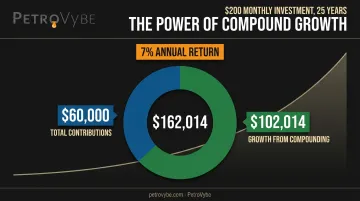
That's the formula in action. Small, consistent contributions, given enough time, do the heavy lifting.
Diversify Your Portfolio With Alternative Investments
Traditional saving and investing (401(k)s, IRAs, stocks, bonds) forms the essential base. It should come first, always. But sophisticated wealth-builders often extend further, adding assets designed to protect against inflation and reduce concentration in public markets.
High-net-worth investors and accredited investors increasingly allocate a portion of their portfolios to hard, income-producing assets: real estate, private equity, and natural resources.
Cerulli research found investors with $5 million or more in investable assets averaged 9.1% in alternatives in 2023, up from 7.7% in 2020.
An Example Worth Understanding: Natural Gas Development
This is where a company like PetroVybe fits the picture. PetroVybe is a private, Texas-based natural gas development company giving accredited investors direct access to early-stage development projects in Lavaca County and the Gulf Coast Basin.
The thesis is straightforward: AI infrastructure runs on electricity, and natural gas already supplies a large share of the U.S. grid. As data centers scale, that demand curve moves in one direction.
- Target structure: Minimum $100,000 liquidity per unit, accredited investors only
- Stated 10-year target MOIC: approximately 2.2x to 5.8x
- Stated target IRR: approximately 26%
- Tax benefit: PetroVybe's structure allows Intangible Drilling Cost deductions against active income, including W-2 wages and capital gains, not just passive income
These figures are PetroVybe's own stated goals, not guarantees. Oil and gas development carries real risk, including commodity price swings and drilling uncertainty.
A necessary caution: alternative investments typically require accredited investor status, carry higher risk, and are far less liquid than public stocks. Always consult a tax professional and financial advisor before committing capital. Pairing steady traditional investing with carefully chosen alternative allocations builds a more resilient, long-term wealth strategy.
Protect Your Wealth: Avoid Fraud and Costly Mistakes
Building wealth over decades means protecting it just as diligently. Fraudsters target investors precisely because patience and trust are valuable currencies.
Classic red flags to watch for:
- Guaranteed high returns with "no risk" attached
- Pressure to invest immediately, often through group chats or social media
- Unlicensed or unregistered professionals making pitches
- Vague or evasive answers about how returns are actually generated
Before committing capital to any investment professional, verify their license and background through FINRA's BrokerCheck or the SEC's Investment Adviser Public Disclosure database. It takes ten minutes and can save a lifetime of savings.
Frequent trading also steadily erodes wealth. A landmark Barber and Odean study of 66,465 brokerage households found the most active traders earned 11.4% annually, compared to 17.9% for the overall market.
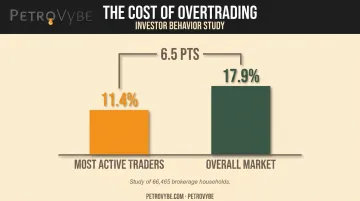
Part of that gap comes from short-term capital gains taxes. These apply to assets held one year or less and get taxed at ordinary income rates rather than the lower long-term capital gains rates.
This patience delivers a measurable financial edge over active traders.
Frequently Asked Questions
What percentage of Americans have $1,000,000 net worth?
Based on Federal Reserve Survey of Consumer Finances data, roughly 10% to 25% of U.S. households have crossed the $1 million net worth threshold. It's a small but steadily growing share.
What is the true meaning of wealth?
Wealth combines financial net worth with health, relationships, time, and purpose. Financial planners increasingly describe true wealth as this broader mix rather than a single net worth figure.
How much money do I need to start investing?
Many brokerages allow fractional share purchases starting from just a few dollars. Consistent small contributions matter far more than a large lump sum upfront.
What is the difference between saving and investing?
Saving is low-risk and liquid, meant for short-term needs and emergencies. Investing carries more risk but offers greater growth potential over a longer time horizon.
Are alternative investments a good way to diversify my portfolio?
They can add diversification and tax benefits for accredited investors, but they carry higher risk and less liquidity than public markets. Professional guidance is essential before committing capital.
How can high-income earners reduce their tax burden while building wealth?
Maxing out tax-advantaged accounts like 401(k)s and IRAs is the first step. Some also explore direct investments in natural gas development, where Intangible Drilling Cost (IDC) deductions can offset up to 90% or more of active income for qualified accredited investors.