Demand is shifting too. AI data centers pushed US electricity use to roughly 176 TWh in 2023, and the IEA projects natural gas will supply more than 130 TWh of additional annual US data-center demand through 2030. That's a fuel-specific opportunity, not just a power-grid story.
Results, though, vary wildly. Two investors can put money into "oil and gas" and get completely different outcomes based on the vehicle, the operator, and how the deal is structured. This guide walks through the exact steps to get started, compares your options, and flags the mistakes that trip up first-time investors.
Key Takeaways
- Oil and gas investing spans liquid public stocks/ETFs to illiquid private working interests
- Private direct participation offers the largest tax deductions but requires accredited investor status
- Returns hinge on operator track record and deal structure, not commodity prices alone
- Match the vehicle to your goal, income, tax offset, or liquidity, over chasing "the best" option
How to Invest in Oil and Gas: Step-by-Step Process
Step 1: Define Your Investment Goals and Check Eligibility
Start by getting honest about what you actually want. Passive income? Capital appreciation? Or a deduction to offset a high-tax year? Each goal points toward a different vehicle.
Private placements — joint ventures, development partnerships, direct working interests — require accredited investor status under SEC Rule 501. That means:
- $200,000 individual annual income (or $300,000 joint) for the past two years, with reasonable expectation of the same this year
- Net worth exceeding $1 million, excluding your primary residence
- Or an active Series 7, 65, or 82 license
Public stocks, ETFs, and mutual funds carry no accreditation requirement at all — anyone can buy them through a standard brokerage account.
Step 2: Select the Right Investment Vehicle
Once your goals and eligibility are clear, match them to a vehicle. Want liquidity and simplicity? Public markets. Want maximum tax deductions and don't mind a multi-year hold? Private working interests or partnerships. The full comparison lives in the "Ways to Invest" section below — read that before committing to anything.
Step 3: Vet the Operator or Company Behind the Deal
This step separates good outcomes from bad ones. Before wiring a dollar, check:
- Analyze production and EBITDAX growth history to see if the operator grows assets or just acquires them.
- Verify the geological and engineering success rate, as a team's track record in picking productive well locations is critical.
- Confirm state operator licensing. In Texas, this means verifying an active Form P-5 with the Railroad Commission, where bonds range from $25,000 to $250,000.
- Seek out independent, verified reviews on platforms that confirm investor status, avoiding anonymous feedback.
A current P-5 alone doesn't prove economic performance. Pull permits, completions, and production records separately through the RRC's online query tools.
At PetroVybe, this is where the operator's technical bench matters. Chief Geophysicist Michael Stamatedes brings a 48-year track record with a reported 75.2% well-location success rate.
The company holds its RRC operator license under PetroVybe OpCo LLC—a detail any prospective investor can and should verify independently.
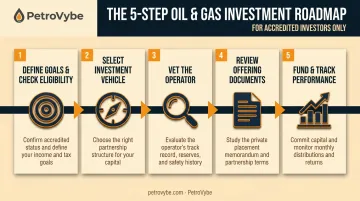
Step 4: Review Offering Documents Before Committing Capital
Every private placement memorandum (PPM) should spell out:
- Minimum investment required to participate
- Fee structure — management fees, carried interest, expense allocations
- Target MOIC and IRR over the hold period
- Expected first-year tax deduction percentage from Intangible Drilling Costs (IDCs)
Bring the numbers to a CPA before you sign anything. IDC expensing is elective and depends on how the interest is held. Losses are still subject to basis, at-risk, and AMT rules, so don't assume every partnership automatically produces a usable W-2 offset.
Some programs, including PetroVybe's, have targeted first-year deductions in the 70%+ range against active income, but your CPA must model this against your specific tax situation.
Step 5: Fund the Investment and Track Performance
Once you're comfortable, funding typically follows a capital call or subscription agreement process, with a wire transfer against signed documents. From there, a reputable operator should provide:
- Regular production and drilling updates
- Distribution statements and K-1 tax documents
- Access to an investor portal or direct point of contact for questions
Ask specifically how often you'll hear from the team and who your point of contact is before you commit — this detail separates transparent operators from ones that go quiet after closing.
Ways to Invest in Oil and Gas: Comparing Your Options
There's no universal "best" way to invest in oil and gas. The right choice depends on your available capital, risk tolerance, desired liquidity, and how hands-on you want to be.
Public Stocks and ETFs
This is the most liquid, lowest-barrier entry point. Buy shares of major integrated producers or sector-focused ETFs like IYE or XLE through any brokerage account.
The tradeoff: full correlation to public market volatility. IYE, for example, showed an 18.84% three-year standard deviation despite tight trading spreads. Liquidity doesn't guarantee stability. You also get minimal tax advantage compared to direct participation, and many energy ETFs are heavily concentrated in a handful of large-cap names.
Mineral Rights Ownership
Owning mineral rights entitles you to royalty income from production without paying drilling or operating costs. It's a cleaner, lower-effort form of exposure.
Valuation, though, depends entirely on:
- Reserve category and quality of the underlying estimate
- Decline curve assumptions
- Net revenue interest and lease burden terms
- Commodity price assumptions used in the valuation
There's no standard royalty multiple you can apply across deals; each property needs its own analysis.
Direct Working Interest in Wells
A working interest owner shares in both the profits and the costs, including drilling, operating expenses, and liabilities. This is where the largest tax deductions live, since IDCs can often be expensed against active income in year one.
But the risk and illiquidity are real. You're directly exposed to dry holes, cost overruns, and production shortfalls, and there's no secondary market to exit early if you need cash.
Private Oil and Gas Development Partnerships and Joint Ventures
This is how accredited investors get direct positions in early-stage development projects without operating anything themselves. A professional operator pools capital across investors to fund drilling and acquisitions, and you hold a partnership interest rather than a single well.
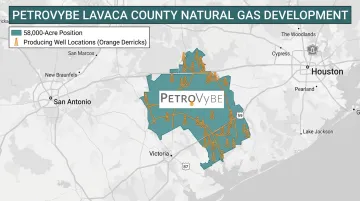
Firms like PetroVybe operate in this space, offering accredited investors direct partnership positions in South Texas and Gulf Coast Basin natural gas development. PetroVybe's current project includes:
- A 58,000-acre position in Lavaca County
- Roughly 400 producing wells plus 57+ planned new wells
- A third-party engineered $48 million reserve valuation
- A clean independent audit from Weaver
Treat these as a long-term hold. Private LLC or fund interests are typically not easily resold. Expect a 5-10 year commitment, with PetroVybe's structure targeting a 2-3 year gap before first distributions and a 10-year window for full MOIC realization.
Is Oil and Gas Investing Right for You?
This asset class tends to fit a specific profile:
- High-income W-2 earners looking to offset active income with legitimate deductions
- Investors with capital gains seeking tax-efficient placement of proceeds
- Those wanting inflation-resistant passive income and diversification beyond stocks, bonds, and real estate
It's a poor fit if you:
- Need near-term liquidity
- Don't meet accredited investor thresholds for private deals
- Get uncomfortable watching commodity prices swing
Beyond risk tolerance, capital and time horizons differ sharply by vehicle. Private development deals often carry $100,000+ minimums with multi-year holds — PetroVybe's minimum sits at $100,000 in liquidity, for instance. Public vehicles, by contrast, can be entered with a few hundred dollars and exited the same afternoon.
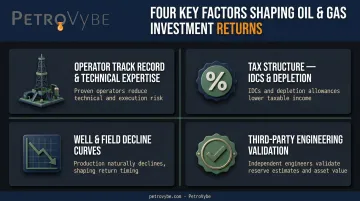
Key Factors That Affect Your Returns When Investing in Oil and Gas
Returns depend heavily on controllable due-diligence factors, not commodity price swings alone.
Operator Track Record and Technical Expertise
Why it matters: Geological and engineering expertise directly affects a project's well success rate. A skilled team identifies productive locations; a weak one drills expensive dry holes.
Impact: The EIA's last nationally reported combined drilling-success figure was 88.6% back in 2010, a figure that's dated and not broken out by exploration versus development. That's exactly why operator-specific records matter more than industry-wide averages. Compare permits, completions, and production data for the specific team you're evaluating, not a decade-old national number.
Tax Structure (IDCs and Depletion Deductions)
Why it matters: Intangible Drilling Costs can often be deducted against active income in the first year, a benefit most passive real estate or stock investments simply don't offer.
Impact: IDC classification depends on actual cost character, not a fixed percentage rule. There's no IRS-set standard share of total drilling cost that qualifies as IDC, so request the operator's actual cost schedule and tax opinion.
PetroVybe's investors, for example, have reported first-year deductions in the 91-94% range against active income in recent years. This figure varies by project, so confirm it against your own tax return with a CPA.
Well and Field Decline Curves
Why it matters: Production, and therefore royalty or working interest income, naturally declines over a well's productive life. Shale wells in particular often show high initial output followed by a steep early drop-off.
Impact: Accurately projected decline curves determine whether long-term cash flow projections hold up. A deal that only shows year-one numbers without a full decline model deserves extra scrutiny.
Third-Party Engineering Validation
Why it matters: Independent reserve valuations confirm a project's claimed asset value rather than relying solely on the operator's own projections.
Impact: SEC rules don't require an independent third party for reserve reporting, so its presence is a meaningful signal, not a formality. Deals backed by licensed third-party engineering, such as PetroVybe's $48 million third-party validated reserve report, reduce your reliance on unverified sponsor claims.
Common Mistakes to Avoid When Investing in Oil and Gas
Before committing capital, watch for these frequent missteps:
- Skipping operator due diligence: licensing status, production track record, and third-party reserve validation all need checking before capital moves
- Underestimating illiquidity: private working interests, LLC interests, and development funds are not quick-exit investments
- Ignoring tax structure details: never assume a specific deduction applies to your personal situation without a CPA review
- Chasing advertised returns: high headline numbers mean little without understanding decline curves, reinvestment risk, and commodity volatility behind them
Frequently Asked Questions
Is it a good idea to invest in oil and gas?
It can suit accredited or high-income investors seeking diversification, tax efficiency, and inflation-resistant income. Suitability depends heavily on your risk tolerance and which vehicle you choose.
What would happen if I invested $1,000 a month in oil and gas for 5 years?
The outcome depends on the vehicle: dollar-cost averaging into stocks or ETFs behaves very differently than a lump-sum private joint venture. Model projections against a target MOIC/IRR range, since commodity and production risk mean no outcome is guaranteed.
How much money do I need to invest in oil and gas?
Public stocks and ETFs can be entered with a few hundred dollars. Accredited private placements and joint ventures, like PetroVybe's, typically carry six-figure minimums starting around $100,000.
What are the tax benefits of oil and gas investing?
Intangible Drilling Cost deductions can offset active income in year one, and a percentage depletion allowance (typically 15% of gross property income) may apply afterward. Confirm specifics with a CPA before assuming they apply to you.
Can non-accredited investors invest in oil and gas?
Yes, through public stocks, ETFs, and mutual funds, which require no accreditation. Private placements and joint ventures are generally restricted to accredited investors under SEC rules.
Is investing in oil and gas riskier than stocks?
It depends on the vehicle. Direct working interests and private deals carry higher risk and illiquidity than diversified public energy stocks or ETFs, but the potential returns and tax benefits scale accordingly.