
Passive income offers that middle path. This guide covers 12 practical ideas, from low-effort investments to semi-passive side income, organized by how much capital and effort each one requires. The right fit depends on your risk tolerance, available cash, and how hands-on you want to be.
Key Takeaways
- Passive income usually fits three paths: investments, real estate or other assets, and semi-passive skill-based work
- Match your mix to available capital, risk tolerance, and how hands-on you want to stay
- Tax rules differ sharply by income type, so confirm treatment with a tax advisor before you commit funds
- Two or three income sources protect retirement cash flow better than a single stream
What Counts as Passive Income in Retirement
Passive income means money earned without regular active work: dividends, rental income, and royalties. Semi-passive income still needs occasional upkeep. Knowing the difference sets realistic expectations for how much time you'll actually spend.
Common examples:
- Passive: stock dividends, bond interest, royalty checks, limited partnership distributions
- Semi-passive: hosting an Airbnb, restocking an Etsy shop, light landlording
For Social Security recipients, the earnings test that reduces benefits only applies to wages and self-employment income. According to the Social Security Administration, pension payments, annuities, interest, and dividends don't count as "earnings" for this test. That said, this income can still affect how much of your benefit gets taxed—plan for the tax treatment, not just the earnings test.
Investment-Based Passive Income Ideas
Dividend-Paying Stocks and Bonds
Dividend stocks pay out a share of company profits regularly, often quarterly. The S&P 500's dividend yield sat at 1.24% at the end of 2024, dipping slightly to 1.15% by year-end 2025. Bonds tend to pay more: the 10-year Treasury averaged 4.29% in 2025.
- Dividend stocks offer growth potential plus income
- Bonds provide steadier, lower-risk payouts
- Blending both smooths out volatility

Annuities for Guaranteed Lifetime Income
An annuity converts a lump sum into guaranteed monthly checks for life. Payout rates rise with age, since insurers expect fewer payments from older buyers. On a $100,000 single-life annuity, approximate monthly payouts look like this:
- Age 65: around $630/month
- Age 75: roughly $823/month
Annuities work well as a guaranteed income floor, but they lock up capital, so don't put all your savings into one.
Real Estate Investment Trusts (REITs)
REITs let you earn real estate income without dealing with tenants or leaky roofs. By law, REITs must distribute at least 90% of taxable income to shareholders. Equity REITs yielded around 4.07% by year-end 2025, well above the S&P 500's dividend yield.
High-Yield Savings Accounts and CDs
For your cash reserve, high-yield savings accounts and CDs offer a no-risk parking spot. Rates fluctuate with the Federal Reserve's benchmark rate, so shop around at online banks, which typically beat traditional brick-and-mortar rates by a wide margin.
Alternative Investments: Natural Gas and Energy Development
Accredited investors looking beyond stocks, bonds, and REITs sometimes turn to direct participation in energy development. PetroVybe, a private Texas-based natural gas developer, offers accredited investors access to early-stage development assets in Lavaca County's Gulf Coast Basin.
How these deals differ from typical portfolio holdings:
- 2024 and 2025 partners received 91% to 94% tax deductions against active income, including W-2 earnings, via IDC and depletion allowances
- Monthly distributions are projected to peak above $10,000 during the production phase
- Targets a 10-year IRR near 26%, with MOIC (multiple on invested capital) forecasts from 2.2x to 5.8x
This isn't for everyone. It requires accredited investor status and roughly $100,000 in liquidity, and it fits best for retirees carrying a high tax burden who want diversification away from public markets. As with any private placement, these are forecasts, not guarantees, and full terms are set out in the offering's confidential documents.

Real Estate and Asset-Based Income Ideas
Rental Property Ownership
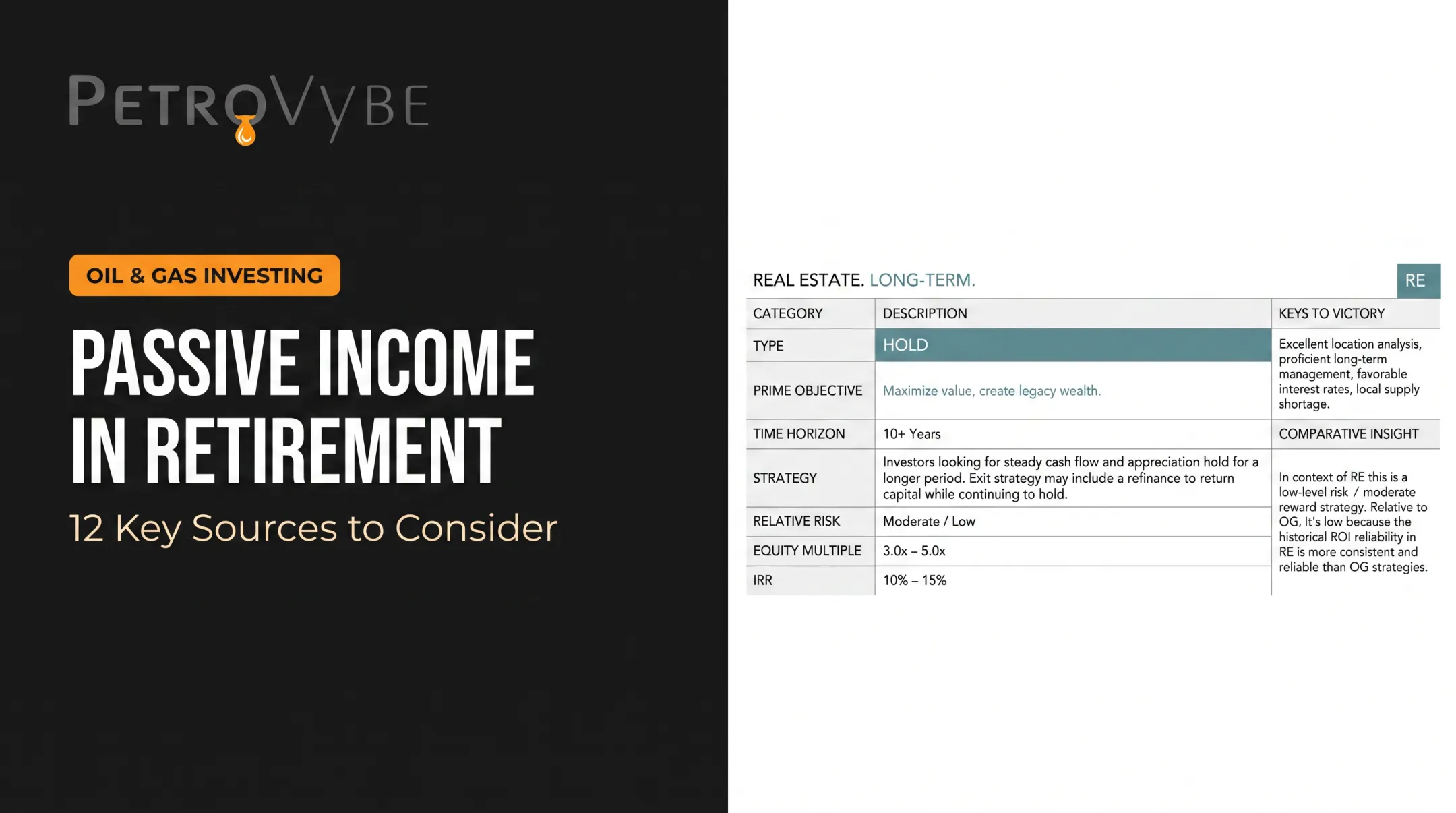
Owning a rental provides monthly cash flow plus long-term appreciation. Single-family rental cap rates ran around 6.7% in late 2024. The tradeoff: tenant screening, repairs, and vacancies demand real time and effort, even with a property manager handling day-to-day tasks.
Home Sharing and Short-Term Rentals
Renting a spare room, or listing your home while traveling, can generate real monthly income. The typical U.S. short-term rental host earned around $2,408 per month in gross revenue in 2025. That's revenue, not profit — cleaning, platform fees, and utilities eat into the total.
Renting Out Vehicles, RVs, or Tools
Underused assets can still earn money. Turo hosts averaged $906 per month in vehicle earnings, with about $634 landing in the host's pocket after the platform's share. RVs and tools work similarly through platforms like Outdoorsy and Fat Llama.
- Ideal if you already own a second vehicle, camper, or spare tools
- Low effort beyond scheduling and cleaning
- Factor insurance and wear-and-tear into your returns

Skill-Based and Semi-Passive Income Ideas
These options use skills you already have. Most need some setup work up front, then taper into lighter ongoing effort.
Royalties from Writing an E-Book
Decades of career expertise can become a practical guide other people will pay for. Amazon's Kindle Direct Publishing offers 35% or 70% royalty tiers, depending on pricing and territory. Once published, the book keeps earning with no ongoing labor beyond occasional updates or marketing pushes.
Selling Stock Photos Online
Retirees who enjoy photography can license images through platforms like Shutterstock, which pays contributors 15% to 40% of licensing fees depending on volume tier. Income starts slowly, but a larger portfolio can build steadier licensing fees over time.
Freelance Consulting or Tutoring
Your career knowledge has market value. Tutoring platforms like Wyzant report typical rates of $35 to $60 per hour, with tutors setting their own schedules. Consulting works the same way: a few hours a week, on your schedule.
Peer-to-Peer Lending or Silent Partner Investing
Peer-to-peer platforms let you lend directly to borrowers and collect interest. Prosper reported an average historical return of 5.5% as of mid-2024, net of fees and losses. Silent partnerships in a local business can pay more, but carry higher risk. Returns are not guaranteed, and principal can be lost—only use money you can afford to put at risk.
How to Choose the Right Mix for Your Retirement
Build retirement income in layers:
- Guaranteed floor — Social Security, annuities
- Market-linked income — dividends, REITs, bonds
- Flexible semi-passive income — rentals, freelance work, royalties

Once those layers are clear, evaluate tax efficiency across account types before committing capital. A Roth IRA, traditional IRA, and taxable brokerage account each treat dividends, rental income, and capital gains differently.
Don't launch all 12 ideas at once. Pick one or two that match your skills, capital, and risk comfort. Build from there.
Frequently Asked Questions
What is the $1,000 a month rule for retirees?
It's a rule of thumb estimating how much invested capital generates $1,000 monthly without depleting principal. Using a 4% withdrawal rate, that's roughly $300,000 invested; at 5%, closer to $240,000.
Where should a 70-year-old put money?
Shorter time horizons favor lower-risk options: high-yield savings for cash reserves, dividend stocks for income with some growth, and annuities for guaranteed lifetime payments. A mix reduces risk from any single source.
How can a 70-year-old make money from home?
Remote-friendly options include online tutoring, freelance consulting, selling crafts or stock photos, and renting out a spare room. These require minimal physical effort and flexible hours.
What is the best passive income source for retirement?
There's no single best source. It depends on your capital and risk tolerance. Most retirees do well combining dividends, annuities, and rental income rather than relying on one stream.
Is rental income considered passive income for tax purposes?
Generally, yes. IRS Publication 925 treats rental activity as passive unless the owner qualifies and materially participates as a real estate professional.
Can you live off passive income in retirement without touching savings?
It's possible, but it requires substantial invested assets and a diversified strategy across dividends, annuities, and rental or alternative income sources. Few retirees achieve this from a single stream alone.