

The top federal bracket, 37%, kicks in above $626,350 for single filers and $751,600 for married couples filing jointly in 2025, according to the IRS federal income tax rate schedules. Layer on state tax, payroll tax, and the Net Investment Income Tax, and a six-figure earner can watch a real chunk of every additional dollar disappear before it reaches a bank account.
That's not a flaw in the tax code. It's usually a lack of proactive planning. This article breaks down how tax liability builds, what drives it, and the legal strategies — across decisions, management, and investments — that bring it back down. We'll also draw a hard line between legal avoidance and criminal evasion.
Key Takeaways
- Tax liability builds gradually across brackets and income types, not as a lump-sum surprise.
- Income source, entity structure, and timing drive your tax bill.
- Legal strategies span upfront choices, ongoing management, and investment timing.
- Direct energy investment yields major deductions against active income.
- Avoidance is legal and disclosed; evasion is a felony that hides income.
How Tax Liability Typically Builds Up
Tax liability doesn't show up as a single visible charge. It accumulates progressively as income, bonuses, and capital gains stack across brackets throughout the year.
Sometimes this build-up is gradual: a salary that grows 5% annually eventually pushes into a higher bracket without anyone noticing. Other times it's episodic: a stock sale, business exit, or unusually large bonus year triggers a sudden spike in liability that catches taxpayers off guard.
Some of the liability is visible upfront through paycheck withholding, but a much larger portion often stays hidden until year-end filing, when:
- Missing deductions that surface too late to claim
- Losing credits that phase out once income crosses a threshold
- Facing underpayment penalties when estimated payments fall short
This is why reactive tax prep, just filing what happened, rarely minimizes liability. Planning has to happen before the income is earned, not after.
Key Drivers of Your Tax Bill
Three factors do most of the work in determining what you actually owe.
Income source and classification matters more than most people realize. W-2 wages, 1099/self-employment income, capital gains, and passive income all face different rates and different deduction eligibility.
Self-employment income carries an extra 15.3% self-employment tax on top of ordinary income tax: 12.4% for Social Security and 2.9% for Medicare.
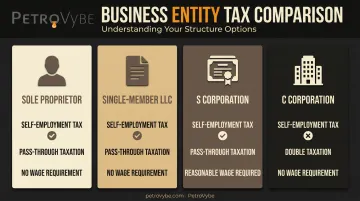
Business or entity structure determines how income flows through and what's deductible:
| Structure | Tax Treatment |
|---|---|
| Sole proprietor | Net earnings flow to Schedule SE; full self-employment tax applies |
| Single-member LLC | Disregarded entity by default; taxed like a sole proprietor |
| S corporation | Income passes through; shareholder-employees must take "reasonable" wages before nonwage distributions |
| C corporation | Taxed separately; dividends can face a second layer of tax at the shareholder level |
Timing is the third lever, and it plays out differently depending on your accounting method:
- Cash-method taxpayers recognize income when received and deductions when paid
- Accrual-method taxpayers recognize income once it's earned and determinable, regardless of when cash changes hands
Which method applies, and when you choose to accelerate or defer income, directly shapes a given year's liability.
These drivers apply differently depending on whether you're a W-2 earner, a business owner, or an investor sitting on capital gains. That's why the right strategy is never one-size-fits-all.
Legal Strategies to Reduce Your Taxes
The right combination of strategies depends on how your income is earned, how your business is structured, and where your capital is invested. Broadly, they fall into three categories.
Strategies That Change Financial Decisions
These are choices made before income is earned or a transaction closes.
- Choose the right entity structure. An S-corp election lets an owner split income between reasonable wages (subject to payroll tax) and distributions (not subject to self-employment tax). The wage must be genuinely reasonable, not artificially low just to dodge payroll tax.
- Structure sales for capital gains treatment. Proceeds taxed as long-term capital gains (0%, 15%, or 20% depending on income) beat ordinary income rates by a wide margin for most high earners.
- Max out retirement contributions. For 2025, the 401(k) employee deferral limit is $23,500 (plus a $7,500 catch-up at 50+), and the combined IRA limit is $7,000. Every dollar contributed pre-tax reduces current-year taxable income.
- Decide in advance whether to accelerate or defer. If you expect a lower bracket next year, deferring income or accelerating deductions into the current year can lock in more value.
Strategies That Change How Income and Expenses Are Managed
This bucket is about capturing what's already legally available through better tracking and documentation.
- Document deductible business expenses rigorously: home office, mileage, and travel, backed by receipts and logs that hold up under scrutiny.
- "Bunch" itemized deductions. With the 2025 standard deduction at $15,750 (single) and $31,500 (married filing jointly), concentrating multiple years of charitable giving into one tax year can push you above the threshold, followed by standard-deduction years in between.
- Use an HSA strategically. 2025 limits are $4,300 self-only and $8,550 family, with a $1,000 catch-up at 55+. Contributions are deductible, growth is tax-free, and qualified withdrawals are tax-free too, a rare triple benefit.
- Claim every available credit. The Child Tax Credit runs up to $2,200 per qualifying child in 2025, and the Qualified Business Income deduction can shield up to 20% of net income for eligible pass-through business owners.
Strategies That Change the Investment and Income Context
For many high earners, the biggest lever isn't finding another deduction. It's changing where and how income is generated in the first place.
- Municipal bonds generate interest that's generally excluded from federal taxable income, and sometimes state tax too if you buy bonds issued in your home state.
- Real estate depreciation and 1031 exchanges let investors deduct a portion of a property's value annually (27.5 years for residential, 39 for commercial) and defer capital gains by rolling proceeds into a like-kind replacement property.
- Direct investment in oil and gas development can offer one of the more significant deductions available against active income. Under IRC 263(c) and Treasury Regulation 1.612-4, operators and working-interest holders can elect to currently deduct Intangible Drilling Costs: wages, fuel, and other no-salvage-value drilling expenses.
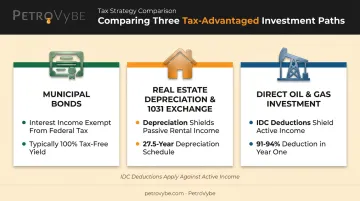
This is the exact mechanism PetroVybe structures its projects around. As a Texas-based natural gas developer working the Lavaca County section of the Gulf Coast Basin, PetroVybe reports that partners who joined its 2024 project received a 91% deduction against active income, including W-2 earnings and capital gains. That figure rose to 94% for 2025 partners.
This benefit applies to active income rather than only passive income because of how the working interest is held. It's a structural detail worth confirming with your CPA before committing capital, since limited-liability holding structures can change how the IRS treats the loss.
- Relocating geographically, whether to a lower-tax state or, for globally mobile earners, another jurisdiction entirely, is a longer-term structural lever worth modeling if your income is portable.
Tax Avoidance vs. Tax Evasion: Know the Legal Line
Tax avoidance is the legal use of deductions, credits, and structuring to minimize what you owe. The IRS itself defines it as action taken to lessen tax liability and maximize after-tax income. It reflects the tax code working exactly as written, not a hidden loophole.
Tax evasion is different in kind, not degree. It's the willful concealment of income, falsification of records, or deliberate failure to file — and the IRS actively prosecutes it.
| Aspect | Tax Avoidance | Tax Evasion |
|---|---|---|
| Definition | Legal reduction via deductions, credits, and structuring | Willful concealment, falsification, or failure to file |
| IRS Stance | Codified and encouraged | Prosecuted as a felony |
The penalties aren't close:
- Evasion under IRC 7201 is a felony carrying up to 5 years in prison, plus fines up to $100,000 for individuals or $500,000 for corporations
- Avoidance carries no penalty at all, provided the deductions are real and properly documented
- The dividing line is fabrication: inventing expenses that never happened or hiding income that did
Beyond that legal line, audit risk scales with income, not aggressiveness alone. The FY2025 IRS Data Book shows examination rates for tax year 2021 returns rose from 0.9% for incomes between $1 million and $5 million to 6.6% for incomes above $10 million.

Large deductions relative to income can draw a second look, but legitimate, well-documented ones remain entirely legal and shouldn't be avoided out of fear.
Given the stakes, working with a qualified CPA or tax attorney before executing aggressive strategies isn't optional. It's how you keep "aggressive but legal" from becoming "aggressive and audited."
Conclusion
Reducing your tax bill legally starts with understanding where your liability actually comes from — the type of income you earn, how your business is structured, or where your investments sit. Not a generic checklist of deductions.
The strategies that move the needle most for a W-2 earner look different than those for a business owner or someone sitting on capital gains.
For accredited investors carrying a heavy active-income tax load, direct energy development is one of the few vehicles that combines a substantial upfront deduction with a long production runway.
PetroVybe's structure is built around new-well drilling in its Lavaca County acreage. The goal: cut this year's tax bill while building monthly passive income as wells move into production.
Frequently Asked Questions
How do I legally pay the least amount of taxes?
Combine deductions, credits, tax-advantaged accounts, the right entity structure, and strategic investments. A tax professional ensures you're maximizing savings without crossing into non-compliance.
Which is worse, tax evasion or avoidance?
Evasion is far worse. It's a federal crime punishable by fines and imprisonment. Avoidance is fully legal and simply uses the tax code the way it was written.
What's the difference between tax avoidance and tax evasion?
Avoidance uses legal deductions and credits transparently. Evasion involves deliberately concealing or misrepresenting income, and it's a criminal offense.
Can claiming too many deductions trigger an IRS audit?
Large or unusual deductions relative to income can raise flags, but legitimate, well-documented deductions are legal. Don't skip a deduction you're entitled to out of audit anxiety.
What are the best legal tax strategies for high-income earners?
Consider maximizing retirement accounts, structuring the right entity, timing income and deductions strategically, and exploring alternative investments like energy development that offer substantial deductions against active income.
Is investing in oil and gas a legitimate tax strategy?
Yes. IRC 263(c) and Treasury Regulation 1.612-4 recognize IDC deductions for qualifying drilling costs, letting investors deduct a significant share against active income in the same tax year.