

For high-net-worth individuals, an unplanned estate faces four real threats: federal estate taxes at up to 40%, state-level estate and inheritance taxes, probate delays that can stretch for years, and family conflict that no amount of money can easily fix. According to a 2025 Caring/YouGov survey, 56% of Americans have neither a will nor a living trust — a striking gap given the stakes involved.
This guide covers what serious estate planning actually looks like at scale: the documents you need, the tax minimization strategies that work, how trusts function at this level, and how your investment portfolio fits into the broader picture.
Key Takeaways
- Estate planning for high-net-worth individuals goes well beyond a basic will — trusts, strategic gifting, and tax-minimization tools are essential.
- The federal estate and gift tax exemption is $13.99 million per individual in 2025, rising to a $15 million base in 2026 — early action locks in maximum protection before any legislative changes.
- Trusts are the cornerstone of high-net-worth estate planning, providing probate avoidance, tax efficiency, and multi-generational wealth protection.
- Oil and gas direct participation investments can generate 70–94% first-year tax deductions against active income, reducing the taxable wealth that drives estate tax exposure.
What Qualifies as High Net Worth for Estate Planning?
The Thresholds That Matter
The classification framework used by firms like Capgemini and Altrata sets the baseline for understanding your tax exposure:
- High Net Worth (HNW): $1 million or more in investable assets
- Very High Net Worth (VHNW): $5 million to $30 million
- Ultra High Net Worth (UHNW): $30 million or more

For federal estate tax purposes, the threshold that triggers real exposure is the exemption amount — currently $13.99 million per individual in 2025. Estates below that figure pass free of federal estate tax. Above it, the excess is taxed at up to 40%.
About 16 million U.S. families — slightly more than 12% — had a net worth of at least $1 million as of the most recent Federal Reserve Survey of Consumer Finances. A significant portion of those families still lack comprehensive estate plans — and for estates above $5 million, a basic will isn't enough to address what's actually at stake.
Why HNW Planning Is Fundamentally Different
Standard estate planning — a will, a beneficiary form, maybe a life insurance policy — doesn't account for the complexity that multi-asset, multi-generational wealth creates. HNW individuals typically deal with:
- Multiple asset types: businesses, real estate, concentrated stock, alternative investments
- Estate tax exposure that can reach tens of millions of dollars
- Multi-generational goals that require governance, not just distribution
- Asset protection needs that a basic will cannot address
The 2026 Inflection Point
P.L. 119-21 prevented the TCJA's original sunset and established a $15 million base exemption for 2026, indexed for inflation thereafter. While that's better than the pre-TCJA reversion that was previously anticipated, the exemption landscape is not static. For estates approaching or exceeding these thresholds, the window to lock in planning under current law — gifting strategies, trust structures, valuation discounts — is open now, not guaranteed later.
Core Estate Planning Documents Every High-Net-Worth Individual Needs
The Foundation: Will and Revocable Living Trust
A Last Will and Testament directs how individually owned assets are distributed after death. For a large estate, a will alone falls short — it must pass through probate, a process that is time-consuming, costly, and fully public record.
The Revocable Living Trust solves those problems. It:
- Avoids probate entirely for assets held inside it
- Keeps asset distribution private
- Allows seamless management if you become incapacitated
- Can hold assets across multiple states without multiple probate proceedings
A pour-over will works alongside the trust, capturing any assets not yet transferred in and directing them into the trust at death. Together, these two documents form the operational core of most HNW estate plans.
Asset distribution is only half the picture. The other half covers what happens while you're still alive but unable to act.
Incapacity Planning Documents
Three documents govern what happens if you're alive but unable to manage your own affairs:
- Durable Power of Attorney — Authorizes a designated agent to handle financial, legal, and property matters, including bank accounts, asset sales, and business interests.
- Healthcare Power of Attorney (HCPA) and HIPAA Release Agent — The HCPA authorizes a trusted person to make medical decisions on your behalf; the HIPAA agent can access your protected medical information. Together, they ensure your care reflects your wishes.
- Advance Directive / Living Will — Specifies end-of-life treatment preferences, preventing family conflict and avoiding costly court proceedings during a medical crisis.
Even with these documents in order, one overlooked detail can unravel the entire plan.
Beneficiary Designations: The Hidden Override
Retirement accounts, life insurance policies, and transfer-on-death accounts all pass by beneficiary designation — completely outside your will. A designation that names an ex-spouse or a deceased relative overrides everything else in your estate plan.
Review and update beneficiary designations every time your plan changes. An outdated designation can redirect hundreds of thousands of dollars to the wrong person — no court intervention can reverse it after death.
Minimizing Estate and Gift Taxes for Large Estates
Understanding the Unified System
The federal estate and gift tax system is unified — the same $13.99 million exemption covers both lifetime gifts and assets transferred at death. Married couples can potentially preserve $27.98 million combined in 2025, though portability (the mechanism that allows a surviving spouse to use a deceased spouse's unused exemption) requires a timely Form 706 election — it is not automatic.
Amounts above the available exemption are taxed at up to 40%.
Annual Gift Tax Exclusion Strategy
The annual gift tax exclusion allows transfers to any number of recipients without touching the lifetime exemption. In 2025, the per-recipient annual exclusion is $19,000. Spouses can "gift split," doubling this to $38,000 per recipient per year, subject to Form 709 filing requirements.
Annual gifting compounds in a way that's easy to underestimate. A couple gifting to three children and six grandchildren could transfer $342,000 per year tax-free — without touching a dollar of their lifetime exemption. Over a decade, that's $3.4 million shifted out of a taxable estate, entirely outside the unified credit.
Generation-Skipping Transfer (GST) Tax Planning
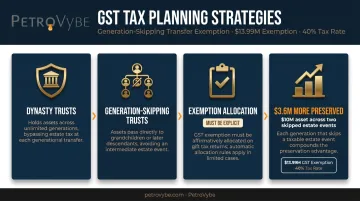
That annual gifting discipline intersects directly with GST planning when recipients include grandchildren or great-grandchildren. The GST tax applies whenever assets skip a generation — and its exemption mirrors the estate tax: $13.99 million per person in 2025, taxed at 40% above that threshold.
One critical distinction: the GST exemption is not portable between spouses. Each spouse must use their own allocation independently.
Key mechanics to understand:
- Dynasty trusts hold assets across multiple generations with GST exemption allocated at the outset
- Generation-skipping trusts direct assets to grandchildren while bypassing the children's taxable estates
- Exemption allocation must be explicit — automatic allocation rules apply in some cases but are not reliable for complex transfers
- Each generational estate tax event avoided compounds the benefit: a $10 million asset that skips two estate tax events at 40% preserves roughly $3.6 million more than a direct transfer would
Family Limited Partnerships and GRATs
Family Limited Partnerships (FLPs) and Family LLCs consolidate family assets under a single structure, enabling gradual ownership transfer to heirs. Two valuation discounts can apply:
- Minority interest discount — reflects limited ability to control distributions or management
- Lack of marketability discount — reflects the absence of a ready market for the interest
These discounts reduce the taxable value of gifts, allowing more wealth to transfer using less lifetime exemption. Note that courts have scrutinized FLP arrangements closely — the Estate of Fields (T.C. Memo. 2024-90) case resulted in full estate inclusion where the bona fide sale exception failed. Structure and substance matter here.
Grantor Retained Annuity Trusts (GRATs) are particularly effective for rapidly appreciating assets — including private equity positions, concentrated stock, or direct energy investments. The core mechanics:
- The grantor transfers assets into the GRAT and retains an annuity payment for a fixed term
- Any growth above the IRS Section 7520 hurdle rate (4.6% as of late 2025) passes to heirs gift-tax-free
- If the grantor outlives the GRAT term, the excess appreciation transfers at zero additional gift tax cost
- If assets underperform the hurdle rate, the GRAT "zeroes out" — no tax is owed, and the grantor simply tries again
Using Trusts to Protect and Transfer Wealth
Trusts are the most versatile tools in high-net-worth estate planning. A single trust structure can simultaneously avoid probate, cut estate taxes, and dictate exactly how heirs access wealth — often for generations. Most HNW individuals maintain multiple trusts, each serving a distinct purpose.
Revocable vs. Irrevocable Trusts
| Feature | Revocable Trust | Irrevocable Trust |
|---|---|---|
| Grantor control | Retained — can amend or revoke | Typically none after establishment |
| Asset inclusion in taxable estate | Yes | No (if structured correctly) |
| Probate avoidance | Yes | Yes |
| Estate tax reduction | No | Yes |
| Asset protection | Limited | Strong |
Irrevocable trusts remove assets — and all future appreciation — from the taxable estate. That permanence is the tradeoff for the tax and protection benefits they provide.
Irrevocable Life Insurance Trust (ILIT)
An ILIT owns a life insurance policy so that death proceeds fall outside the taxable estate. The policy still provides liquidity — cash heirs can use to pay estate taxes or equalize inheritances — without inflating the gross estate. This is especially valuable when an estate is concentrated in illiquid assets like real estate or a closely held business.
Dynasty Trusts
Dynasty trusts are designed to last for multiple generations. Some states allow perpetual trusts — South Dakota has no rule against perpetuities in force, Delaware allows indefinite duration for personal property, and Nevada provides a statutory period of 365 years. Assets inside are outside beneficiaries' taxable estates, protected from creditors and divorcing spouses, and governed by the grantor's distribution guidelines. Proper GST exemption allocation at funding is required.
Domestic Asset Protection Trusts (DAPTs)
DAPTs — available in 21 states as of August 2025, including South Dakota, Nevada, and Delaware — allow the grantor to remain a discretionary beneficiary while shielding trust assets from future creditors. Several critical constraints apply:
- Timing: Must be established before any known claim arises — proactive planning only
- Fraudulent transfer risk: Voidable transfer law still reaches transfers made with intent to hinder creditors
- State-specific rules: Each DAPT state has distinct limitations on duration, self-settled trust structures, and distribution standards
- Layered protection: Pair with LLC structures for asset segregation and umbrella liability coverage as the first line of defense
Building a Tax-Efficient Legacy: Investments, Business Succession, and Charitable Giving
Alternative Investments and Portfolio-Level Tax Reduction
HNW estate plans must account for the full asset portfolio — and how the portfolio is structured affects taxable estate accumulation, not just distribution.
Direct participation in oil and gas development carries unique tax advantages that most alternative investments don't. Under IRC 263(c), qualifying Intangible Drilling Costs (IDC) are deductible in the year they're incurred. For accredited investors in a direct participation program (DPP) like PetroVybe — a Texas-based natural gas development company — this deduction can represent a significant portion of the invested capital.
What distinguishes IDC deductions from real estate depreciation is their applicability to active income. The key differences:
- Real estate depreciation is typically limited to passive income unless the investor qualifies as a real estate professional
- IDC deductions can be applied directly against W-2 earnings and capital gains
- Deductibility timing occurs in the year costs are incurred — not spread across a depreciation schedule
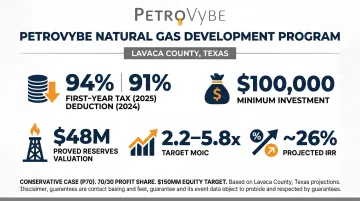
PetroVybe's 2024 partners received a 94% first-year tax deduction against active income; 2025 partners achieved 91%. The company structures investments as a private limited partnership with a minimum of $100,000 for verified accredited investors, operating in Lavaca County, Texas. The project carries a $48 million proved reserves valuation (PV-09) from an independent engineering firm, with a 10-year target MOIC of approximately 2.2–5.8x and a projected IRR of ~26%.
The working-interest exception under IRC 469(c)(3) — which permits IDC deductions against non-passive income — applies when the interest is held directly or through an entity that does not limit liability. Deduction treatment varies by participation structure and individual tax situation; consult a qualified tax advisor before investing.
For HNW individuals carrying significant W-2 income or capital gains, oil and gas direct participation can reduce current-year tax liability while contributing to long-term estate value — making it a natural complement to succession and charitable planning strategies.
Business Succession Planning
Family business owners must treat succession as an estate planning priority — one that shapes enterprise value long before a transfer event occurs. Key elements:
- Buy-sell agreements funded by life insurance provide liquidity and prevent forced sales at death or disability
- GRATs and FLPs can gradually transfer business value to heirs at reduced gift tax cost
- A formal written succession plan — clearly identifying who takes over and under what terms — reduces family conflict and protects enterprise value
Start early. A business without a succession plan is a liability, not just an asset, in an estate.
Charitable Giving Strategies
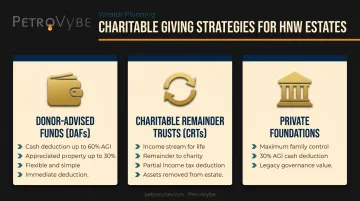
Assets transferred to qualifying charitable vehicles generally receive an estate tax deduction under IRC 2055. Three primary options:
- Donor-Advised Funds (DAFs) — Simple, flexible, immediate income tax deduction (cash up to 60% of AGI; appreciated property up to 30%). The sponsoring organization retains legal control; you retain grant-making recommendations.
- Charitable Remainder Trusts (CRTs) — You receive an income stream for life; the remainder passes to charity, removing assets from your estate while generating a partial income tax deduction for the present value of the charitable remainder.
- Private Foundations — Maximum family control and philanthropic involvement, with estate tax benefits. Income tax deductions are more limited (30% of AGI for cash to a nonoperating foundation), but the governance and legacy value is substantial.
Frequently Asked Questions
What is considered high net worth for estate planning?
Estates with at least $1 million in investable assets are generally considered high net worth. $5 million or more qualifies as very high net worth, and $30 million or more is ultra-high net worth. Federal estate tax only becomes a concern when the gross estate exceeds the current exemption threshold — $13.99 million per individual in 2025.
How many Americans have a net worth over $1,000,000?
About 16 million U.S. families — slightly more than 12% — had a net worth of at least $1 million as of the 2022 Federal Reserve Survey of Consumer Finances. Yet the 2025 Caring/YouGov survey found that 56% of Americans have no will or living trust, a planning gap that cuts across all wealth levels.
What is the best estate plan for a high-net-worth individual?
The optimal plan typically combines a revocable living trust for probate avoidance, irrevocable trusts for tax reduction and asset protection, strategic lifetime gifting, aligned beneficiary designations, and comprehensive incapacity documents. The right combination depends on asset complexity, family structure, and legacy goals.
How can I reduce estate taxes on a large estate?
The most effective strategies are maximizing annual and lifetime gift exclusions, using irrevocable trusts (ILITs, GRATs, dynasty trusts) to remove assets and future appreciation from the taxable estate, and leveraging FLP valuation discounts. Charitable vehicles — deductible under IRC 2055 — can reduce the taxable estate further.
How is estate planning different for high-net-worth individuals?
HNW estate planning is more complex in scale, tax exposure, and asset diversity. It requires advanced legal structures — multiple trusts, FLPs, charitable vehicles — greater emphasis on tax mitigation, business succession planning, asset protection across jurisdictions, and multi-generational governance that a simple will cannot provide.
How often should I update my estate plan if I have substantial wealth?
Review every 3–5 years and immediately after major life events: marriage, divorce, births, deaths of named trustees or beneficiaries, significant asset changes, or new tax legislation. With exemption amounts subject to future legislative adjustment, an immediate review is warranted for estates approaching or exceeding current thresholds.
Disclosure: PetroVybe and its team members are not licensed financial advisors, and nothing on this website constitutes financial or investment advice or a recommendation to buy, sell, or hold any investment. PetroVybe and its team members are not tax advisors, accountants, or tax strategists, and nothing on this website constitutes tax advice or a tax strategy. PetroVybe and its team members are not attorneys, and nothing on this website constitutes legal advice. All content is provided for general informational purposes only. You should consult your own independent financial advisor, tax professional, and legal counsel before making any decision.