
This article is general education, not investment, tax, or legal advice. When private companies want to raise capital without a traditional IPO, two SEC exemptions dominate the landscape: Regulation D and Regulation A. Both let businesses skip full public registration, but they serve very different purposes.
Many investors struggle to understand what separates them, and that confusion matters. The choice between Reg D and Reg A determines who can invest, how much disclosure they'll see, and how liquid the investment will be.
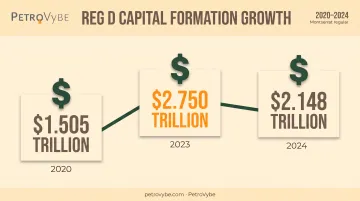
Reg D raised $2.148 trillion in 2024 alone through Form D filings, dwarfing the roughly $182 billion (excluding pooled funds) raised through registered offerings in the same period. Reg A, meanwhile, remains a smaller but growing path for companies courting retail investors.
This article breaks down both regulations side-by-side, then looks at where accredited-investor-only opportunities, like PetroVybe's natural gas development offerings, fit into the Reg D landscape.
Key Takeaways
- Reg D targets accredited investors with no dollar cap, using either restricted marketing (506(b)) or mandatory verification (506(c))
- Reg A allows non-accredited investors, caps raises at $20M (Tier 1) or $75M (Tier 2), and requires SEC review
- Faster, lower-cost launches make Reg D common for oil and gas development partnerships
- Choose based on capital needs, target investor pool, and how much compliance you're willing to take on
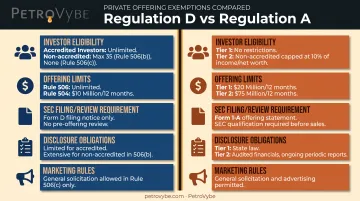
Reg D vs Reg A: Quick Comparison
| Dimension | Reg D | Reg A |
|---|---|---|
| Investor Eligibility | Primarily accredited investors (up to 35 non-accredited under 506(b)) | Both accredited and non-accredited investors |
| Offering Limits | Unlimited (506(b)/506(c)); $10M for Rule 504 | $20M (Tier 1); $75M (Tier 2) |
| SEC Filing & Review | Form D notice, filed within 15 days after first sale, no SEC review | Form 1-A requires SEC qualification before any sale |
| Disclosure/Reporting | Minimal; more required if non-accredited investors participate under 506(b) | Offering circular required; Tier 2 mandates audited financials and ongoing reports |
| Marketing/Solicitation | 506(b) bans general solicitation; 506(c) allows it with verification | Testing the waters and general solicitation permitted before qualification |
What Is Regulation D?
Regulation D is an SEC exemption that lets private companies raise capital without registering securities for public sale. It's built primarily for accredited investors, meaning people with either $200,000+ in annual income (or $300,000+ jointly) or $1 million+ in net worth excluding their primary residence.
Two rules dominate Reg D offerings:
- Rule 506(b): No general solicitation allowed. Companies can accept up to 35 sophisticated non-accredited investors alongside unlimited accredited investors.
- Rule 506(c): General solicitation and advertising are permitted, but every single investor must be verified as accredited through documentation like tax returns or a letter from a CPA, attorney, or licensed advisor.
Companies filing under Reg D only need to submit a Form D notice within 15 days after their first sale, with no SEC review required. This is a major reason Reg D moves faster and costs less than Reg A.
Restricted Securities, Long-Term Structures
Securities sold under Reg D are "restricted," meaning they can't be freely resold on public markets. That illiquidity fits long-term, buy-and-hold structures—real estate syndications and energy development partnerships—where investors aren't chasing quick exits.
PetroVybe is one example of this model in practice. The company structures its natural gas development projects under SEC Regulation D Rule 506(c), offering accredited investors direct equity participation in upstream energy assets rather than shares in a public fund.
Use Cases of Reg D
Reg D shows up constantly in:
- Venture capital and private equity fundraising
- Real estate syndications targeting passive income
- Energy development partnerships needing quick capital deployment
- Hedge funds and private credit vehicles
Energy partnerships in particular gravitate toward Reg D because investors in this space already accept illiquid, long-term holds, and the structure lets developers move fast on time-sensitive drilling or acquisition opportunities.
That speed shows up in the numbers. According to SEC data, Reg D capital formation grew from $1.505 trillion in 2020 to $2.750 trillion in 2023, before settling at $2.148 trillion in 2024—far larger than registered securities offerings over the same window.
What Is Regulation A?
Regulation A, sometimes called a "mini-IPO," is a scaled-down public offering exemption open to both accredited and non-accredited investors. It's a middle ground between a private placement and a full IPO.
Reg A splits into two tiers:
- Tier 1 allows raises up to $20M but requires state-by-state qualification, adding time and legal cost.
- Tier 2 allows raises up to $75M, requires audited financial statements, and comes with ongoing reporting obligations, including annual and semiannual reports.
Unlike Reg D, Reg A requires SEC review and qualification of Form 1-A before any sale can happen. This process typically extends launch timelines to several months rather than weeks.
Why Companies Choose Reg A
Reg A suits companies wanting broad public exposure, especially those planning a future exchange listing. Companies trade higher disclosure and cost for access to a much larger pool of potential investors.
Regulation A explicitly excludes issuers of fractional undivided interests in oil, gas, or similar mineral rights, according to SEC guidance for issuers. That exclusion is a key reason oil and gas development companies overwhelmingly favor Reg D instead.
Use Cases of Reg A
Common users of Reg A include:
- Consumer product and beverage brands
- Real estate crowdfunding platforms
- Startups seeking retail investor exposure ahead of a public listing
Elio Motors offers a documented example. The company's Form 1-A was qualified by the SEC in November 2015, and it closed its offering in February 2016—issuing 1,410,048 shares at $12 per share for roughly $15.8 million net of expenses.
Forbes reported the raise attracted around 6,600 investors, showing how Reg A can mobilize a broad retail base.
Reg D vs Reg A: Which Is Better?
Neither path is automatically better. The right choice depends on four factors:
- Capital amount needed: Reg D has no cap; Reg A tops out at $75M
- Target investor pool: Accredited only versus the general public
- Timeline: Reg D can launch almost immediately; Reg A takes months
- Compliance appetite: Reg A means audits and ongoing reporting; Reg D keeps paperwork minimal
Choose Reg D if you're targeting accredited investors seeking direct, tax-advantaged access to niche opportunities, like oil and gas development partnerships.
Choose Reg A if you want to raise from a broad retail audience (up to $75M) and value public marketing and transparency over speed.
Why Accredited Investors Often Prefer Reg D Opportunities
Reg D's accredited-only structure often supports specialized offerings with higher yield potential, because these deals don't need to appeal to a mass retail audience. Direct-participation programs in energy development are a prime example.
These deals frequently pair with meaningful tax advantages. Intangible Drilling Cost (IDC) deductions, for instance, appeal strongly to high-income W-2 earners and investors sitting on capital gains they want to offset. This treatment requires the investor to elect general partner status in the Subscription Agreement and may be limited in a given year by the excess business loss limitation under IRC §461(l).
PetroVybe's structure illustrates this pattern. The company reported a 94% tax deduction against active income for 2025 partners**, driven by IDC and depletion allowances. Prior result; not a promise of any future deduction. Because IDCs typically represent a first-year deduction target of approximately 70–80% of invested capital in new drilling projects, investors can generally claim a large first-year deduction. This treatment requires the investor to elect general partner status in the Subscription Agreement and may be limited in a given year by the excess business loss limitation under IRC §461(l).
PetroVybe ONE shows how that Reg D structure shows up in a live energy deal:
- 58,000 acres in Lavaca County, Texas
- Roughly 400 legacy wells plus 57+ planned new wells
- $48 million third-party-engineered proved reserves valuation (PV-09, prepared by Lee Keeling & Associates, Tulsa, March 2026)
- Clean 2025 independent audit

Offered under Rule 506(c) with third-party accredited-investor verification, it is a direct example of how Reg D gives qualified investors access to early-stage energy deals without a mass-retail raise.
Frequently Asked Questions
What is Regulation D in simple terms?
Reg D is an SEC rule that lets private companies raise money from accredited investors (and a limited number of non-accredited investors) without going through full public registration. It trades broad market access for speed and lower cost.
What is a Reg D violation?
Common violations include general solicitation under 506(b) when it isn't allowed, failing to verify accredited status under 506(c), or missing the Form D filing deadline within 15 days of the first sale.
What exemptions does Regulation D provide?
The three main paths are Rule 504 (small offerings up to $10M), Rule 506(b) (private placements with no general solicitation), and Rule 506(c) (general solicitation permitted with verified accredited investors).
Can non-accredited investors participate in Reg A offerings?
Yes. Both Tier 1 and Tier 2 Reg A offerings allow non-accredited investors, though Tier 2 caps their investment based on income or net worth unless the securities will be exchange-listed.
How long does a Reg A offering take compared to Reg D?
Reg D offerings can launch almost immediately after the first sale, with Form D due within 15 days. Reg A requires SEC qualification of Form 1-A first, a process that typically takes weeks to months.
Which regulation is better for real estate or energy development?
Reg D is generally preferred for accredited-investor energy and real estate partnerships due to speed, lower compliance costs, and no oil-and-gas issuer exclusions. Reg A suits companies pursuing broader retail capital raises instead.
Informational requests only. PetroVybe projects are offered solely to verified accredited investors. Submitting this form does not create an investment or advisory relationship.