That's not quite right. A working interest holder pays a proportional share of drilling and operating costs in exchange for a larger slice of revenue — real upside, but real liability too. The appeal is dual: outsized tax deductions against active income, plus monthly cash flow once wells start producing. Most investors underestimate the cost and risk side of that equation.
This guide breaks down how working interest actually works: the mechanics, the tax treatment, realistic return expectations, and how to vet an operator before wiring a dollar.
Key Takeaways
- A working interest is direct lease ownership, requiring cost participation for a larger revenue share
- IDC deductions can offset a significant portion of W-2 or capital gains income in year one
- Returns depend on well productivity, commodity prices, and operator execution — nothing is guaranteed
- Legitimacy comes from operator track record, third-party verification, and documented well economics, not marketing slides
What Is a Working Interest in Oil and Gas?
A working interest is a percentage ownership in the operating rights under an oil and gas lease. It's not the same as owning the minerals outright. Holding a working interest obligates you to pay your share of leasing, drilling, completion, and operating costs. In return, you receive a share of net revenue once the well produces.
That revenue share is called the net revenue interest (NRI), and it's smaller than your working interest percentage because royalty obligations come off the top first. The formula is straightforward:
Working interest % × (1 − royalty burden %) = NRI
For example, a 75% working interest with a 25% royalty burden nets:
0.75 × (1 − 0.25) = 56.25% NRI
That's the actual revenue percentage flowing to the investor, even though the "ownership" figure quoted is 75%. This distinction trips up a lot of first-time investors who assume their stated working interest percentage is what shows up on their check.
A working interest is also a contractual lease right, not permanent mineral ownership. It typically ends when the lease expires or production ceases, and it doesn't transfer with the land the way mineral rights do.
Operating vs. Non-Operating Working Interest
Not all working interest owners do the same job. The distinction matters for both control and liability. Operators manage daily drilling and production decisions, hold primary responsibility for well operations, and bill other owners for their share of costs through Joint Interest Billing (JIB) statements. Non-operators fund their proportional share of drilling and operating costs but rely on the operator for day-to-day decisions, while retaining voting and consent rights on major operational proposals under the joint operating agreement.
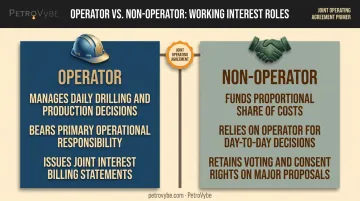
Most model-form operating agreements establish several liability among parties, not automatic joint-and-several liability, though tort, environmental, and entity-specific exposure still requires separate legal review.
Carried Working Interest
A carried working interest lets an investor contribute upfront capital without taking on daily operational duties. Another party, typically the operator or a partner, covers the contract-specified drilling or completion costs on the investor's behalf, often until casing point or first completion. Once the well begins producing, the carried investor starts receiving their negotiated revenue share.
How Working Interest Investments Generate Returns
Cash flow from a working interest follows the well's lifecycle: leasing and permitting, drilling, completion, first production, then decline. Most of the cash flow is front-loaded: horizontal wells typically produce at their highest rates in the first one to two years before tapering off.
The Paperwork Behind the Cash Flow
Investors interact with three recurring documents:
- Joint Interest Billing (JIB) statements: monthly invoices detailing each owner's share of costs
- Authority for Expenditure (AFE) approvals: cost estimates for proposed drilling or workover operations
- Cash calls: advance payment requests for the next month's estimated expenses, typically due within 30 days
What Returns Can I Expect?
Returns on working interest investments are usually expressed as MOIC (multiple on invested capital) and IRR (internal rate of return) over a multi-year hold. There's no single industry-wide benchmark for realized private working interest returns, but disclosed projections give a useful reference point.
One SEC-filed program, the ICON Oil & Gas Fund, projected a 20.0% IRR and 2.0x MOIC on invested capital, explicitly labeled as a projection, not an actual result.
PetroVybe states a 10-year target range of roughly 2.2x to 5.8x MOIC and ~26% IRR for its PetroVybe ONE program, reflecting a conservative-to-optimistic spread tied to commodity pricing and production reinvestment assumptions. Figures like these are targets, not promises. Treat any operator's projection the same way.
How Do You Value a Working Interest?
Valuation comes down to four inputs:
- Reserve estimates, often verified through a third-party PV-09 report
- Production decline curve assumptions, since output drops fast after peak
- Commodity price forecasts used to model future revenue
- Operating cost trends, which erode margin over the life of the well
Risks That Compress Real Returns
Two mechanics can compress projected returns far below what investors expect:
Non-consent penalties kick in if you decline to participate in an approved operation. Some agreements let other owners recover 200%–500% of your share of costs before your revenue resumes. North Dakota's statute, for instance, sets a 200% risk penalty in specific circumstances, but this isn't a nationwide default, and terms vary by contract.
Commodity price swings compound that risk. WTI crude has ranged from under $9/barrel in 2020 to over $123/barrel in 2022. That volatility is why stress-testing economics at a conservative price deck matters more than trusting a rosy forecast.
Tax Benefits of Working Interest Investments
The tax treatment is where working interest genuinely differs from most passive investments, and it's the biggest reason accredited investors pursue this asset class.
Intangible Drilling Costs (IDCs) typically represent 60% to 80% of total well costs, according to IRS audit guidance, and investors can often deduct up to 100% in the year incurred rather than capitalizing over time. That's a substantial first-year write-off relative to invested capital.
Even more notable: under IRC Section 469(c)(3), working interest losses can potentially offset active income, including W-2 wages and capital gains, when investors hold the interest directly or through an entity that doesn't limit their liability. This flips the usual rule, where passive investments trap losses against passive income only.
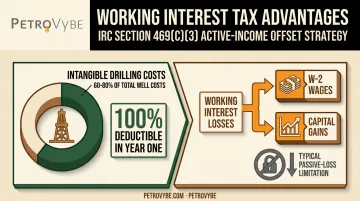
Structure matters here. Direct or general-partner interests qualify differently than limited-partner interests, so this treatment isn't automatic for every ownership arrangement.
Beyond IDCs, three additional layers shape your tax picture:
- Percentage depletion allowances let qualifying producers deduct a percentage of gross income from the well
- Tangible equipment depreciation (MACRS) covers physical drilling and production equipment
- Self-employment tax applies to most working interest income, which the IRS treats as active or self-employment income reported via K-1 or Schedule C, at the current 15.3% rate (12.4% Social Security plus 2.9% Medicare)
A Real-World Example
PetroVybe's own partners realized a 94% first-year tax deduction against ordinary income in 2024 and a 91% deduction in 2025, applied against active income including W-2 wages and capital gains. These figures illustrate what's achievable in practice, not a guarantee for every investor or every deal.
Consult a qualified CPA before relying on any projected deduction percentage. Individual tax treatment depends on your income structure, how the interest is held, and current tax law.
Working Interest vs. Royalty Interest: Key Differences
Royalty interest holders receive a smaller share of gross revenue but carry zero cost obligations. Working interest holders take on cost and liability in exchange for a larger revenue share. Overriding royalty interest (ORRI) sits in between — carved out of a working interest, but structured to be free of drilling and production costs like a royalty.
| Feature | Working Interest | Royalty Interest | Overriding Royalty Interest |
|---|---|---|---|
| Cost obligations | Pays share of drilling, completion, operating costs | None | None |
| Revenue share | Larger (NRI after burdens) | Smaller, lease-specified percentage | Carved from WI, contract-specific |
| Liability exposure | Several (contract) liability; fact-specific tort/environmental exposure | None from ownership alone | None under standard definition |
| Tax deduction eligibility | IDC, depletion, depreciation may apply | Depletion may apply; generally not SE tax | Instrument-specific; no automatic IDC treatment |
| Investor involvement | Active (operator) or consent-based (non-operator) | Fully passive | Fully passive |
Sophisticated investors often blend both structures across a portfolio. Working interest delivers leveraged upside and tax deductions, while royalty or ORRI positions provide steadier, cost-free income that smooths out the volatility.
PetroVybe's partnership units are structured as working interest positions, giving investors direct access to the same IDC deductions and depletion benefits reflected in the table above.
Risks, Legitimacy, and Due Diligence: What to Know Before You Invest
Every working interest investment carries some combination of these risk categories:
- Dry hole risk — exploratory wells historically failed at a 39% rate versus roughly 9% for development wells, per EIA data. Drilling in a proven basin with existing production history differs fundamentally from wildcat exploration.
- Cost overruns against the original AFE estimate
- Production decline that outpaces modeled assumptions
- Commodity price volatility that compresses margins regardless of how well the well performs
Operating working interest can carry significant liability exposure, though the exact scope depends on the joint operating agreement and applicable state law. Structures like limited partnerships can cap investor liability at the amount invested, a meaningful protection worth confirming before signing anything.
Is Investing in Oil and Gas Working Interests Legitimate?
Legitimacy doesn't come from the existence of tax benefits alone. Those are real, but they're not proof of a sound deal. It comes from operator transparency, documented well economics, and independent verification.
Veteran operators flag inflated per-well cost markups as a classic red flag, often signaling trouble before drilling even begins. Watch for vague projections without supporting reserve data, and be skeptical of any operator unwilling to share how their numbers were built.
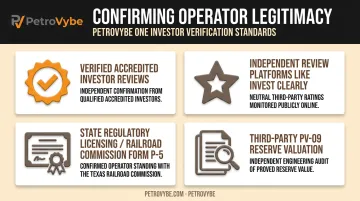
Look for these verification signals:
- Verified accredited investor review status: confirming testimonials come from a legally vetted, financially sophisticated investor pool
- Independent review platforms like Invest Clearly, where ratings can't be self-generated
- State regulatory licensing: Texas operators need an active Railroad Commission operator license (Form P-5); PetroVybe's OpCo entity holds one
- Third-party reserve valuation: a PV-09 report from a licensed engineering firm, not an operator's internal estimate
Due Diligence Checklist Before Committing Capital
Before wiring funds to any operator, ask:
- What's the track record? Compare well success rate against peer averages, not just the operator's own claims.
- How good is the geology? Request offset well performance data from nearby producing wells.
- Is the AFE transparent? Line-item costs should be traceable, not bundled into vague categories.
- What are the lease terms? Confirm primary term length and conditions that extend it into production.
- How does the model hold up under stress? Ask how projected IRR changes at a conservative commodity price deck, not the operator's base case.
Frequently Asked Questions
What is the working interest in oil and gas?
A working interest is a percentage ownership in an oil or gas lease's operating rights. It entitles the holder to a share of production revenue in exchange for paying a proportional share of drilling and operating costs.
What returns can I expect from oil and gas working interest investments?
Returns are typically framed as MOIC (multiple on invested capital) and IRR over a multi-year hold, varying with well productivity and commodity prices. Industry-wide 10-year targets often fall between roughly 2x and 6x MOIC with IRRs in the 20-30% range, though no return is guaranteed.
How do you value a working interest in an oil well?
Valuation relies on reserve estimates (often third-party verified via a PV-09 report), production decline curve assumptions, commodity price forecasts, and operating cost trends.
Is investing in oil and gas working interests legitimate?
Legitimate opportunities are backed by transparent operator track records, documented well economics, and independent verification. Be cautious of deals with inflated cost markups or vague, unsupported projections.
What is the difference between working interest and royalty interest?
Working interest owners pay drilling and operating costs in exchange for a larger revenue share. Royalty owners pay no costs but receive a smaller, more passive revenue share.
Are working interest investments tax deductible?
Intangible drilling costs, percentage depletion, and equipment depreciation can generate first-year deductions of 70% or more against active income, depending on deal structure. Treatment varies by ownership structure, so consult a qualified CPA for your specific situation.