One trades on an exchange in seconds. The other locks up capital for years, generates a K-1, and can wipe out most of your tax bill in a single filing season. Many investors treat "oil and gas" as a single asset class, then get blindsided when the tax treatment, liquidity, or risk profile doesn't match what they expected.
Outcomes here depend on far more than commodity direction. Capital committed, operator quality, deal structure, and the vehicle you choose all swing returns dramatically. This guide walks through the step-by-step process to invest, compares the major strategies, covers what you need before committing capital, and flags the mistakes that cost investors the most money.
Key Takeaways
- Oil and gas investing spans liquid public stocks to illiquid private working interests, each with distinct risk and tax outcomes
- Direct working interests unlock IDC deductions unavailable to public stockholders, but require accredited status
- Returns hinge on operator track record and deal structure, not commodity prices alone
- Line up accreditation paperwork, a liquidity runway, and a tax advisor before committing capital
How to Invest in Oil and Gas: Step-by-Step
Step 1: Assess Your Investment Goals and Risk Tolerance
Before picking a vehicle, get specific about what you actually want:
- Passive income to supplement cash flow
- Tax deduction against active income (W-2 earnings, capital gains)
- Long-term capital appreciation through asset growth
Your answer determines everything downstream. It also determines your liquidity needs. Private oil and gas partnerships commonly lock capital for 5 to 10 years, so this isn't money you want earmarked for a house down payment in 2027.
Price volatility matters too. Natural gas prices are historically brutal on nerves: the EIA measured Henry Hub natural gas volatility at 81% in the fourth quarter of 2024, easing to 69% by mid-2025, with a 30-day spike hitting 102% in early February 2025. That's not a typo. Set your risk expectations accordingly, especially if you're considering a vehicle tied directly to spot pricing.
Step 2: Confirm Accredited Investor Status and Capital Readiness
Most private oil and gas deals (working interests, development partnerships, direct participation programs) require accredited investor status under SEC Rule 501. You qualify if you meet any of these:
- Net worth over $1 million, excluding your primary residence (individually or with a spouse)
- Income over $200,000 individually or $300,000 jointly for the past two years, with the same expected this year
- Hold a Series 7, 65, or 82 license
Accreditation alone doesn't guarantee entry, though. Most private placements set minimum capital thresholds well above what public markets require. Public ETFs and stocks have no minimum beyond the share price. Private placements, by contrast, often start at $50,000 to $100,000 per unit.
PetroVybe, for example, requires $100,000 in accessible liquidity per unit. That capital must be wireable within a 7 to 21 day closing window, not simply sitting on a net worth statement. Gather your documentation early: tax returns, bank statements, or a third-party accreditation letter from a CPA or attorney. Verification delays are one of the most common reasons deals stall.
Step 3: Choose Your Investment Vehicle
This is where most of the decision-making weight sits. Public markets and private direct participation solve for different things entirely.
| Vehicle | Liquidity | Minimum Investment | IDC Deductions |
|---|---|---|---|
| Public stocks, ETFs, mutual funds | High | Share price only | Not available |
| Direct working interests, development partnerships | Low (5-10 year lock) | $50,000-$100,000+ | Full access |
Here's the part many investors miss: intangible drilling cost deductions are only available through direct working interest ownership. If you own shares in a C-corporation oil producer, the company can deduct its own IDCs, but that benefit stays at the corporate level. Shareholders of an ordinary C-corporation cannot deduct corporate losses on their personal returns.
Match your vehicle to your actual goal:
- Need liquidity? Public markets.
- Need a tax offset against active income this year? Direct working interest.
- Building long-term compounding wealth with a decade-long horizon? Private development partnership.
Don't pick based on a headline commodity price rally. Pick based on what you need capital to do for you.
Step 4: Conduct Due Diligence, Finalize, and Monitor the Investment
Once you've identified a private opportunity, the diligence phase separates investors who protect their capital from those who don't.
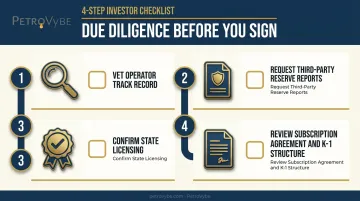
Before signing anything:
- Vet the operator's track record and geological team's historical well selection results
- Request independent third-party reserve validation reports (not just internal projections)
- Confirm the operator holds active state licensing. In Texas, that means checking the Railroad Commission (rrc.texas.gov) for the operator's license and API well numbers
- Review the subscription agreement, Private Placement Memorandum, and K-1 structure line by line
After you sign, monitor ongoing performance by requesting:
- Regular production volume reports
- Revenue and distribution statements
- Access to an investor portal for real-time account visibility
PetroVybe's ONE project, for instance, backs its diligence package with a $48 million PV-09 reserve valuation from a licensed third-party engineering firm and a clean 2025 audit from Weaver. That's the kind of independent verification that lets investors check the operator's claims against outside sources rather than taking marketing materials at face value.
Oil and Gas Investment Strategies Compared
No single strategy fits every investor. The right approach depends on your capital, timeline, and tax goals — here's how the major options stack up.
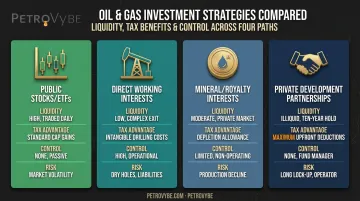
Publicly Traded Stocks, ETFs, and Mutual Funds
This is the most liquid, lowest-barrier entry point into the sector. You can buy shares during market hours with no accreditation requirement and no minimum beyond the share price.
The tradeoff: limited tax advantages, and your returns track broader stock market sentiment almost as much as they track oil prices. A 2016 Brookings analysis confirmed a measurable positive relationship between stock indices and oil prices, meaning your "oil exposure" often moves with equities generally, not independently of them.
Direct Participation Programs and Working Interests
Here, you own a direct stake in a well's production and its costs. This structure unlocks the largest tax benefit in the asset class: the IDC deduction. It typically covers 60% to 80% of invested capital in new drilling projects, deductible against active income including W-2 wages and capital gains.
The cost of that benefit is real exposure. You're on the hook for a proportional share of drilling costs, and a dry hole means a real loss, not a paper one.
Mineral Rights and Royalty Interests
Royalty owners collect production-based payments without paying drilling costs. It's a cleaner, more passive structure than a working interest.
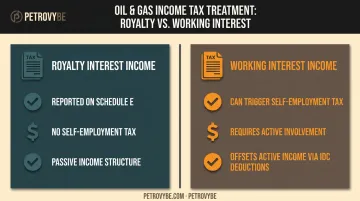
The tradeoff is control. Royalty owners have no say over drilling pace, well placement, or project timing; you're along for the ride the operator sets. IRS guidance also treats royalty income differently for tax purposes: it's generally reported on Schedule E and isn't subject to self-employment tax, unlike working-interest operating income.
Private Development Partnerships with Accredited Investors
This route combines direct working interest ownership with professional operator management, typically targeting a specific basin. PetroVybe, for example, structures accredited investor partnerships around its South Texas and Gulf Coast Basin assets. The model pairs sizable first-year IDC deductions with 10-year MOIC targets in the 2.2x to 5.8x range and roughly a 26% IRR benchmark.
This structure demands extra scrutiny before you commit capital:
- Verify the operator's technical team has proven geological expertise
- Confirm reserve estimates through independent, third-party validation, not self-reported figures
- Review transparency around fund structure, fees, and profit splits
What You Need Before Investing in Oil and Gas
Preparation directly shapes both your risk exposure and your net realized return. Skipping this stage is where most costly mistakes originate.
Financial and Eligibility Requirements
Beyond accreditation verification, know your minimum capital threshold going in: many private deals start at $50,000 to $100,000 per unit.
Just as critical: build a liquidity runway. Private oil and gas structures commonly lock capital for 5 to 10 years. Committing funds you might need within the next 3 to 5 years, whether for a home purchase, tuition, or emergency reserve, sets you up for a forced early exit at a discount. In many cases, an exit may not even be possible.
Tax and Advisory Readiness
Work with a CPA who has actual experience with:
- IDC deductions and timing elections
- Depletion allowances
- K-1 partnership filings
This matters because deduction treatment isn't uniform. Whether your IDC deduction offsets active or passive income depends on your level of involvement and how the entity is structured. A non-limited working interest is generally treated differently than a passive limited partnership interest for tax purposes. Get this wrong, and you could lose the deduction's full value.
Key Factors That Affect Oil and Gas Investment Returns
Outcomes hinge on a mix of factors you can diligence and factors you can't control at all.
Operator Track Record and Geological Expertise
Why it matters: Experienced geological teams identify higher-probability well locations and reduce dry-hole risk. This edge often becomes the single biggest driver of project-level returns.
Impact on results: PetroVybe's Chief Geophysicist, Michael Stamatedes, holds a documented 75.2% career hit rate on profitable well location selection across 48 years — compared to an industry peer average below 40%, according to company-reported data. That gap compounds across every well in a portfolio.
Commodity Price Environment
Why it matters: Oil and natural gas prices directly affect cash flow timing and how long it takes to recoup invested capital.
Impact on results: The EIA reported that upstream capital expenditure for its sample of public US oil companies averaged roughly $21 per barrel of oil equivalent in real terms since mid-2022. Capital efficiency, not just price direction, increasingly separates profitable operators from marginal ones.
Deal Structure and Tax Treatment
Why it matters: The share of costs classified as IDCs, the MOIC and IRR targets, and the distribution waterfall all shape what actually lands in your pocket.
Impact on results: Passive royalty income lands on Schedule E and typically avoids self-employment tax. Working interest income, by contrast, can trigger self-employment tax on net earnings, a meaningfully different net-return calculation depending on which structure you hold.
Common Mistakes to Avoid When Investing in Oil and Gas
The costliest errors in this asset class are almost always preventable:
- Skipping due diligence on operator history, well selection track record, and independent reserve reports
- Over-concentrating capital in a single well or basin instead of spreading exposure across multiple projects
- Misjudging liquidity needs, leading to forced early exits at a steep discount when lock-up terms don't match your real cash-flow timeline
- Failing to prepare tax documentation in advance, missing IDC deduction deadlines, or filing K-1 information incorrectly
Each of these is fixable with basic preparation. None require insider knowledge, just discipline before you wire funds.
Frequently Asked Questions
Is oil and gas investment legit?
Yes. It's a long-established asset class regulated under SEC private placement frameworks like Regulation D. That said, legitimacy of any specific deal depends entirely on operator transparency, third-party validation, and your own due diligence.
What is the best oil investment right now?
There's no single answer: it depends on your risk tolerance, tax situation, and liquidity needs. A public energy ETF offers liquidity with no tax perks, while a private working interest offers substantial IDC deductions in exchange for a multi-year lockup.
What is a capital investment?
A capital investment is money committed to acquire, develop, or expand an asset expected to generate returns over time. In oil and gas, that capital funds drilling, well completion, and production infrastructure.
Do I need to be an accredited investor to invest in oil and gas?
Public stocks and ETFs require no accreditation. Private placements, working interests, and development partnerships almost always require accredited investor status under SEC Rule 501.
What are intangible drilling costs (IDCs) and how do they reduce my taxes?
IDCs cover non-salvageable drilling expenses like labor, drilling mud, and chemicals. They're typically deductible against active income in the year incurred. Some development programs report first-year deductions of 90% or more of invested capital, making IDCs often the largest single tax benefit in oil and gas investing.
How risky is investing in oil and gas wells?
Risk varies sharply by vehicle. Diversified public funds carry lower, market-correlated risk, while a single-well direct working interest carries concentrated dry-hole and price risk, making operator due diligence essential before committing capital.