

That gap isn't a character flaw. It's a curriculum problem. Medical school and residency are built to produce excellent clinicians, not confident investors. This guide walks through where that blind spot comes from, what to do about it at each career stage, the tax trap that hits high W-2 earners especially hard, and how to know when you actually need professional help.
Key Takeaways
- Medical school skips financial literacy, leaving doctors years behind income peers.
- Optimal money moves shift across residency, early practice, mid-career, and retirement.
- High W-2 income creates a tax burden that standard retirement accounts alone rarely solve.
- Disability, life, and malpractice coverage should be locked in early, before net worth grows.
- Hiring a fiduciary advisor or physician-focused CPA can prevent six-figure mistakes.
Why Financial Education Gets Left Out of Medical Training
Between four years of medical school, three to seven years of residency, and sometimes a fellowship on top, physicians can lose more than a decade of peak compounding years. Someone entering the workforce at 22 with even modest savings has a 15-year head start on compound growth by the time a doctor finishes training.
That delay compounds a second problem: debt. Among the medical school Class of 2025, 70% graduated with education debt, and the average balance among borrowers hit $223,130, with 28% owing $300,000 or more. Then residency begins, and pay doesn't reflect the debt load at all.
- Residency stipends average $68,000-$70,000 nationally, roughly flat across PGY years despite mounting responsibility.
- That income barely covers rent, loan interest, and living expenses in many major metro areas.
- Saving and investing habits simply never get built during these years, because there's little left to save.
Then attending pay hits, sometimes overnight. A resident earning $65,000 can suddenly be earning $300,000-$600,000+ within a year. This is where lifestyle inflation takes hold: a nicer car, a bigger house, restaurant habits that scale with the new paycheck. Because no one taught the alternative, most doctors learn money lessons reactively, after a costly mistake, rather than proactively.
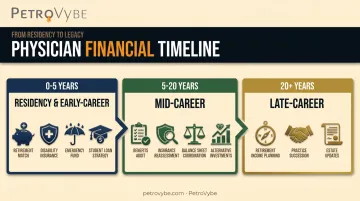
The Money Moves Doctors Should Make at Each Career Stage
Financial priorities aren't static. What matters in residency looks nothing like what matters at year 15. Treat this as a rough roadmap, not a rigid formula.
Residency & Early-Career (Years 0-5)
The sequence matters here more than the dollar amounts:
- Capture the employer retirement match — it's free money, full stop.
- Secure own-occupation disability insurance while young and healthy — premiums are lowest now, and future health issues could make you uninsurable later.
- Build a starter emergency fund — even $1,000-$2,000 prevents a credit card spiral.
- Decide on a student loan strategy — Public Service Loan Forgiveness, refinancing, or a hybrid approach, depending on employer type and loan mix.
Once attending income starts, keep living like a resident for 6-12 months. Redirect the difference toward debt payoff and savings before lifestyle creep locks in permanently.
This is also the ideal window to open a Roth IRA or execute a backdoor Roth, since residents typically sit in the lowest tax bracket they'll see in their career.
Mid-Career (Years 5-20)
This is where balance sheets get complicated fast. Income, family size, and net worth all grow at once, and lifestyle creep becomes a genuine risk rather than a hypothetical one.
- Audit benefits annually — mega backdoor Roth options, 457(b) plans, and defined benefit plans often go underused simply because no one revisits them.
- Reassess umbrella and malpractice coverage — the limits that felt adequate at year two of practice are rarely enough at year twelve, when assets and exposure have both grown.
- Coordinate a growing balance sheet — multiple accounts, 529 education funding, and entity planning for practice owners need to work together, not sit in silos.
- Explore tax-advantaged alternative investments — accredited-investor physicians facing high W2 tax bills increasingly look at options like oil and gas development partnerships (e.g., PetroVybe), which offer intangible drilling cost deductions against active income alongside long-term diversification.
Late-Career (Years 20+)
Late-career planning shifts from accumulation to distribution and legacy:
- Build a retirement income plan blending Social Security, retirement account withdrawals, and other assets, with a tax-efficient withdrawal order mapped out in advance.
- Start practice-sale or succession planning 3-5 years before an intended exit, working with a specialist CPA on entity structure and tax strategy well ahead of time.
- Update estate documents, beneficiary designations, and long-term care plans, since complexity and wealth typically peak at exactly this stage.
The Tax Blind Spot: Why High W2 Income Works Against Doctors
Here's the uncomfortable truth: because most physician income lands on a W-2, doctors have far fewer natural deductions than business owners with similar earnings.
A salary jump from residency to attending status can push marginal federal tax rates from roughly 22% straight into the 32-35%+ range, with none of the write-offs a business owner would use to soften that blow.
| Rate | Single Filer Taxable Income |
|---|---|
| 22% | $50,401-$105,700 |
| 24% | $105,701-$201,775 |
| 32% | $201,776-$256,225 |
| 35% | $256,226-$640,600 |
The standard toolkit helps, but it has limits:
- HSA, 401(k)/403(b)/457(b), and backdoor Roth contributions are the right first moves for every physician.
- Even maxed out, these accounts rarely offset the full tax exposure of a $300,000+ W-2 earner.
- Most real estate or fund-based deductions are passive-only, meaning they can't touch active W-2 income unless you qualify as a full-time real estate professional, which almost no practicing physician does.
This is the missing piece for most physicians: active-income-eligible deductions. Direct-participation programs in oil and gas development operate under a different section of the tax code than real estate. Intangible Drilling Cost (IDC) deductions, for accredited investors holding a working interest, aren't restricted to passive income the way most alternative investments are.
This is where PetroVybe's natural gas development model fits into the conversation, offering deductions tied directly to active income.
Consider the numbers:
- PetroVybe partners who invested in 2024 received a 94% deduction against active income, including W-2 wages and capital gains
- That figure was 91% in 2025
- On a $100,000 investment, the IDC deduction alone can represent $60,000-$80,000 of write-off, taken fully in Year 1 via K-1 or spread across five tax years, depending on what fits your situation
- The projects are backed by roughly 400 producing wells and 57+ planned new wells across a 58,000-acre basin in Lavaca County, Texas, diversifying beyond stocks, bonds, and real estate

That said, accredited status alone doesn't determine tax treatment, and structures that limit liability can fail the working-interest exception that makes this deduction possible against active income. Talk to a physician-focused CPA before pursuing any accredited-investor strategy to confirm eligibility, suitability, and fit with your broader tax and investment picture.
Protecting What You've Built: Insurance and Asset Protection Basics
A doctor's ability to earn is their single largest financial asset, larger than any home or investment account most will hold for years. Yet disability insurance is consistently the most overlooked policy in a physician's financial plan.
- Own-occupation disability insurance pays out if you can't perform your specialty's duties, even if you could work elsewhere. Premiums run 1%-4% of income and are cheapest when bought young and healthy, ideally during training.
- Term life insurance should scale to dependents, debt, and income replacement needs, not a generic multiple of salary.
- Malpractice insurance comes in two types: claims-made, which needs tail coverage if you leave or retire, and occurrence, which covers incidents regardless of filing date. Tail coverage can cost ~200% of your final annual premium, so clarify who pays it in your employment contract.
- Umbrella liability coverage is worth adding once net worth or income crosses a meaningful threshold. Policies start at $1 million and fill gaps that homeowners and auto policies leave open.
Knowing When (and How) to Bring In Professional Help
Not every career stage calls for the same kind of advisor. Early-career physicians often get more value from a one-time, flat-fee financial planning session than a long-term assets-under-management relationship.
Once 1099 or K-1 income enters the picture, or practice ownership adds complexity, a dedicated physician-focused CPA becomes worth the investment.
When vetting anyone who touches your money, ask directly:
- Will you confirm your fiduciary status in writing?
- How exactly is your fee structured, and what does it cost in real dollars?
- Do you have experience with physician-specific compensation, including RVUs and benefits stacking?
- How responsive are you, and how often do we actually communicate?
The advisor who's a great fit for a resident with a modest starter portfolio may not be the right match for a mid-career physician managing a seven-figure balance sheet. Expect this relationship to evolve, and don't be afraid to change advisors as your complexity grows.

Frequently Asked Questions
How much can doctors earn?
Physician earnings vary widely by specialty, location, and practice setting, ranging from roughly $270,000 to over $600,000 annually depending on field. Research current specialty-specific compensation benchmarks for an accurate range for your situation.
When should doctors work with a financial advisor?
Many benefit from a one-time planning session early in their attending career. Ongoing advisor relationships make more sense once income, family obligations, or investment complexity like 1099/K-1 income increases.
What is the biggest financial mistake doctors make?
Lifestyle inflation immediately after residency, paired with skipping foundational steps like disability insurance and employer retirement matches, tops the list of costly early errors.
Do doctors need a financial advisor during residency?
Most residents don't need a full advisor relationship yet. Still, capture any free employer match and consider opening a Roth IRA while your tax bracket is at its lowest.
How can doctors legally reduce their tax burden?
Start by maxing out tax-advantaged retirement accounts, then look into alternative investments such as oil and gas partnerships, which can offer active-income tax deductions for physicians who qualify as accredited investors.
What is the ideal order of investing priorities for physicians?
Employer match first, then HSA contributions, high-interest debt payoff, maxed retirement accounts, and finally taxable and alternative investments once those foundations are covered.