

Introduction
Concentrating wealth in a single asset class feels natural when markets are rising. Then inflation spikes, a sector implodes, or a rate cycle reverses — and concentrated portfolios absorb the full damage.
High-income investors and accredited investors face a particular version of this problem. When most of your wealth sits in stocks, bonds, or a single sector, you're exposed to two simultaneous risks: market volatility and the opportunity cost of not holding assets that perform differently under pressure.
Morningstar's Q1 2025 data illustrates this clearly. U.S. Technology fell 12.06% that quarter while energy gained 9.03%, healthcare gained 5.45%, and a diversified 60/40 benchmark lost just 0.8%. Same market, starkly different outcomes — depending entirely on allocation.
This guide covers what portfolio diversification is, how it works, the four primary strategies, which asset classes matter most, and how alternatives like private energy development fit into a well-structured portfolio.
Key Takeaways
- Portfolio diversification spreads capital across asset classes, sectors, and geographies to reduce concentration risk
- True diversification depends on low or negative correlation between holdings — owning 20 stocks in the same sector doesn't count
- The four primary diversification strategies are asset class, sector/industry, geographic, and time horizon diversification
- Alternative investments can reduce a portfolio's dependence on public market performance
- Rebalancing regularly is what keeps diversification intact — allocations drift as markets move
What Is Portfolio Diversification?
Portfolio diversification is the strategy of allocating capital across multiple asset types, industries, and geographies so that poor performance in any single investment doesn't significantly damage the overall portfolio.
The Correlation Principle
Diversification works because different asset classes respond differently to the same economic conditions. The relationship between assets is measured by the correlation coefficient, which ranges from -1 to +1:
- +1: Assets move in perfect lockstep
- 0: No linear relationship between movements
- -1: Assets move in exactly opposite directions
Investors seek assets closer to -1 or 0. When one holding drops while another holds steady or rises, the portfolio's overall volatility is smoothed. That's the logic behind diversification — correlation math, not wishful thinking.
Two Types of Risk
What diversification can and cannot do comes down to two distinct risk types:
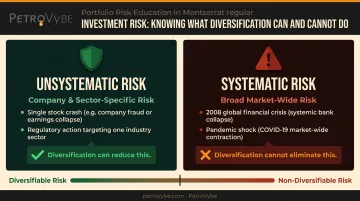
- Unsystematic risk — company- or sector-specific risk that diversification can substantially reduce (a single stock crashing, a regulatory action hitting one industry)
- Systematic risk — broad market or economic risk that affects all assets simultaneously and cannot be diversified away (a 2008-style financial crisis, a global pandemic shock)
A 2021 peer-reviewed review in the Journal of Risk and Financial Management found that 20 well-chosen stocks removed approximately 95% of diversifiable risk, with additional holdings delivering rapidly diminishing returns. Quality of diversification matters more than quantity of holdings.
That distinction carries a practical implication: not every multi-asset portfolio is actually diversified.
What Diversification Is Not
Owning ten tech stocks is not diversification. Holding gold, silver, and platinum simultaneously isn't either — precious metals show dynamic co-movement and often behave similarly under the same conditions. The real test isn't how many holdings you have. It's whether those holdings have meaningfully different correlations to one another.
How Does Portfolio Diversification Work?
A diversified portfolio stabilizes returns by ensuring that when one position loses value, low-correlated or negatively correlated holdings may offset those losses, reducing total drawdown during volatile periods.
A Practical Weighted Portfolio Example
Consider a blended allocation:
| Asset Class | Allocation | Anticipated Return |
|---|---|---|
| Equities | 40% | 8% |
| Bonds | 30% | 4% |
| Real Estate | 20% | 6% |
| Cash/Alternatives | 10% | 3% |
Expected blended return: (0.40 × 8%) + (0.30 × 4%) + (0.20 × 6%) + (0.10 × 3%) = 5.9%
That 5.9% comes with far less volatility than concentrating the full portfolio in equities targeting 8%. The blended return is lower, but the risk of a catastrophic drawdown drops substantially — a tradeoff most long-term investors are willing to make.
The Rebalancing Requirement
Over time, asset values shift. A portfolio designed as 60% stocks/40% bonds can drift to 75% stocks/25% bonds after a sustained equity bull run — exposing the investor to more risk than originally intended.
Vanguard's analysis of U.S. market data from 1926–2009 concluded that annual or semiannual monitoring with a 5% rebalancing threshold offered a reasonable balance between risk control and transaction costs. Morningstar similarly recommends rebalancing when any asset class drifts more than 5–10 percentage points from its target weight.
Rebalancing involves selling outperforming assets (trimming what grew) and adding to underperformers (buying what's cheaper) — a counterintuitive discipline that keeps the original risk profile intact.
Matching Structure to Goals
Knowing when and how to rebalance is only part of the equation. The right diversification structure depends on your risk tolerance and how long your money can stay invested:
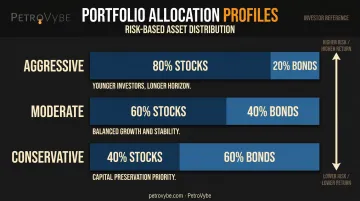
- Aggressive (80% stocks / 20% bonds): Younger investors, longer horizons, higher drawdown tolerance
- Moderate (60/40): Balanced growth and stability
- Conservative (40% stocks / 60% bonds): Approaching retirement, capital preservation priority
Your liquidity needs, tax situation, and income requirements will all shift the appropriate allocation beyond these starting points.
The 4 Types of Portfolio Diversification Strategies
Portfolio diversification can be applied across four distinct dimensions. Used together, they reinforce each other — reducing exposure in ways that no single strategy achieves alone.
Asset Class Diversification
Spreading capital across stocks, bonds, real estate, commodities, cash equivalents, and alternative assets is the foundational layer of diversification. Each asset class responds differently to economic conditions:
- Rising interest rates typically depress bond prices while commodity prices or real estate rents may rise
- Equities often outperform during economic expansion while bonds provide stability during contraction
- Cash equivalents sacrifice return for liquidity and capital preservation
Within each class, further layering is possible:
- Equities: mix large-cap, mid-cap, and small-cap
- Bonds: blend government, corporate, and municipal
- Alternatives: combine real assets, private equity, and energy investments
Sector and Industry Diversification
Even within a single asset class, concentration in one sector creates meaningful exposure. In Q1 2025, investors concentrated in U.S. Technology absorbed losses exceeding 12%. Those holding energy or healthcare simultaneously experienced gains in those same months.
Pairing sectors with low correlation — energy producers alongside consumer staples, or healthcare alongside technology — balances cyclical and defensive exposures within a portfolio.
Geographic Diversification
Investing across domestic and international markets (both developed and emerging) reduces exposure to country-specific downturns, policy shifts, and geopolitical events. Forces that depress the U.S. economy don't necessarily affect international markets identically — and vice versa.
One trade-off worth understanding: international diversification adds currency risk. A USD investor holding foreign assets will see returns amplified or dampened by foreign exchange movements, as the CFA Institute's currency management framework explains. Understanding that trade-off is what separates informed international allocation from naive geographic spreading.
Time Horizon and Maturity Diversification
Holding investments across different maturity lengths builds both liquidity flexibility and interest rate resilience. The spectrum runs from short-term T-bills and money market instruments through medium-term bonds to long-term equity positions or private assets.
Longer-maturity investments typically offer higher expected returns but greater rate sensitivity. Investors approaching retirement generally benefit from shifting toward shorter-maturity, more liquid holdings. That gradual transition is time horizon diversification in practice — and it's one of the most consistent applications of this principle across all investor profiles:
- Short-term (T-bills, money markets): maximum liquidity, minimal rate risk
- Medium-term (2–10 year bonds): income with moderate rate sensitivity
- Long-term (equities, private assets): highest growth potential, least liquidity
Key Asset Classes for a Well-Diversified Portfolio
A well-diversified portfolio for accredited investors typically draws from these primary asset classes:
| Asset Class | Risk/Return Profile | Key Consideration |
|---|---|---|
| U.S. Equities | Higher long-run return; high drawdown risk | Sector and mega-cap concentration risk |
| International Equities | Equity-like volatility plus FX risk | USD translation affects returns |
| Fixed Income | Lower volatility; income-generating | Duration and inflation risk |
| Real Estate / REITs | Income + real asset sensitivity | Public REITs can behave like equities in selloffs |
| Commodities | Inflation sensitivity; cyclical | Correlations vary sharply by market regime |
| Cash Equivalents | Lowest nominal volatility | Inflation and reinvestment risk |
| Alternative Investments | Structure-dependent returns | Illiquidity, longer hold periods |
The Evolution Beyond 60/40
The traditional 60% equities / 40% bonds portfolio served investors well for decades. Then 2022 happened. Stock-bond correlations moved above 0.5 from 2022 through 2024, and a standard 60/40 portfolio lost 17.5% in 2022 — demonstrating that when inflation drives both equity valuations and bond prices down simultaneously, the traditional two-asset framework offers less protection than expected.
That performance gap pushed institutional allocators toward a third bucket: alternatives. Major firms now model meaningful alternative allocations into their baseline frameworks:
- BlackRock: 20% alternatives in model portfolios
- J.P. Morgan Private Bank: 10% alternatives
- KKR: Replacing up to 30% of public assets with private markets
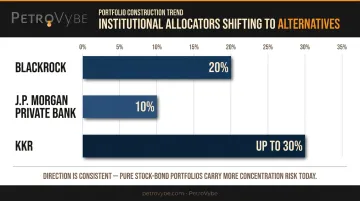
The specific percentages vary, but the direction is consistent — a pure stock-bond portfolio carries more concentration risk today than it did when the 60/40 model was built.
How Alternative Investments Strengthen Portfolio Diversification
The core diversification advantage of alternative investments: they operate outside public market mechanisms. When equity markets fall due to sentiment shifts or forced selling, many alternatives are protected from those same selling pressures. Valuations don't update daily. Income streams are tied to operational performance, not market price discovery.
This category includes any asset beyond publicly traded stocks, bonds, and cash: private equity, hedge funds, real estate, commodities, and energy development projects, among others.
Private Energy as a Diversification Tool
Energy production investments — specifically natural gas development — offer a specific set of characteristics for accredited investors:
- Tangible real asset: Producing wells with measurable, third-party-verified reserves
- Demand tied to structural growth: The IEA projects global data-center electricity use rising from roughly 415 TWh in 2024 to approximately 945 TWh by 2030 — approximately 15% annual growth — with natural gas as a primary fuel source
- Unique tax advantages: Oil and gas development partnerships structured as working interests may allow Intangible Drilling Cost (IDC) deductions to be applied against active income — including W-2 earnings and capital gains — under IRC 263(c), subject to eligibility conditions under IRC 469(c)(3)
PetroVybe, a private Texas-based natural gas development company, structures these opportunities specifically for accredited investors. Through their PetroVybe ONE partnership, investors achieved a 94% tax deduction against active income, with monthly passive distributions tied to natural gas liquids production in Lavaca County, Texas.
The project carries $48 million in proved reserves valuation (PV-09), independently verified by a licensed third-party engineering firm.
Key Trade-Offs to Understand
Alternative investments aren't appropriate for every investor or every allocation. Before considering them, weigh these factors:
- Illiquidity: PetroVybe ONE, for example, is structured around a 10-year hold period with no secondary market options — capital committed should not be needed for other purposes
- Higher minimums: Typically $100,000+ to participate in direct private placements
- Longer lead time on returns: Multi-year development timelines mean distributions may not begin for 2–3 years after investment

These trade-offs make alternatives best suited for accredited investors with sufficient liquidity, low cash flow urgency, and a long investment horizon.
Common Portfolio Diversification Mistakes to Avoid
Even well-intentioned portfolios can fail when these three mistakes go unaddressed.
Over-Diversification
Owning multiple large-cap U.S. equity ETFs often means holding the same top 10 stocks across several funds — the illusion of diversification without the reality. Morningstar's Stock Intersection tool exists precisely to reveal this overlap. More holdings don't equal lower risk if those holdings move together.
Ignoring Correlation
The relevant question isn't how many assets you own — it's how those assets relate to each other. Holdings that move in the same direction under the same market conditions offer no real protection, regardless of how many you hold. Consider what this looks like in practice:
- A portfolio of 30 stocks concentrated in tech and growth sectors
- Multiple bond funds that all react similarly to interest rate changes
- Real estate positions in the same geographic market
Two dozen holdings that all rise and fall together provide no more protection than a concentrated position.
Forgetting to Rebalance
Diversification isn't a one-time portfolio construction decision. Vanguard's verified historical data shows that an unrebalanced 60/40 portfolio started in December 1989 drifted to approximately 80% equity by December 2021 — exposing the investor to far more risk than originally intended. Maintaining your target allocation requires ongoing monitoring and discipline, not just an initial setup.
Frequently Asked Questions
What is portfolio diversification?
Portfolio diversification is the strategy of spreading investments across multiple asset classes, sectors, and geographies to reduce concentration risk. The goal is to ensure that poor performance in one area is offset by stability or gains elsewhere, producing more consistent returns across market cycles.
What are the 4 types of portfolio diversification strategies?
The four primary types are asset class diversification (stocks, bonds, real estate, and alternatives), sector diversification (investing across unrelated industries), geographic diversification (mixing domestic and international markets), and time horizon diversification — holding investments with varying maturity lengths to smooth exposure across different economic cycles.
What is the 70-20-10 rule in portfolio diversification?
The 70-20-10 rule is an allocation framework — not an industry standard — where roughly 70% goes to core lower-risk assets (such as index funds), 20% to medium-risk growth assets (such as real estate or sector funds), and 10% to higher-risk, higher-reward positions. Actual allocations should be tailored to individual risk tolerance and financial goals.
What is a 25/25/25/25 portfolio?
This equal-weight approach divides capital across four asset classes — typically stocks, bonds, gold, and cash or commodities — to maintain balance across different economic environments. Bridgewater's All Weather strategy inspired the concept, though Bridgewater's actual methodology targets risk balancing across economic regimes, not equal dollar allocation.
Does portfolio diversification guarantee against investment losses?
No. Diversification reduces unsystematic (asset-specific) risk but cannot protect against systematic risk — broad market downturns that affect all asset classes simultaneously. Its purpose is to reduce volatility and improve the consistency of returns over the long term, not to eliminate losses entirely.
How often should you rebalance a diversified portfolio?
Review allocation at least annually and rebalance whenever any asset class drifts more than 5–10% from its target weight. Major life events — retirement, a significant income change, or a large liquidity event — may also warrant an off-cycle strategic review.
Disclosure: PetroVybe and its team members are not licensed financial advisors, and nothing on this website constitutes financial or investment advice or a recommendation to buy, sell, or hold any investment. PetroVybe and its team members are not tax advisors, accountants, or tax strategists, and nothing on this website constitutes tax advice or a tax strategy. PetroVybe and its team members are not attorneys, and nothing on this website constitutes legal advice. All content is provided for general informational purposes only. You should consult your own independent financial advisor, tax professional, and legal counsel before making any decision.