This article is general education, not investment, tax, or legal advice. You've just been offered a stake in a natural gas development project. The pitch was compelling: tax deductions against your W-2 income, quarterly passive distributions, a decade-long runway toward real returns. This treatment requires the investor to elect general partner status in the Subscription Agreement and may be limited in a given year by the excess business loss limitation under IRC §461(l). Then comes the document stack.
Somewhere in that stack sits the subscription agreement, and it's easy to skim past it as another signature page. It isn't. This is the contract that legally binds you to the deal.
Many accredited investors misunderstand this document or treat it as boilerplate. It's not. This article breaks down what a subscription agreement actually is, its key components, and how it fits alongside the other documents in a private placement.
Key Takeaways
- A subscription agreement is the binding contract where an investor applies to buy a private placement interest and the issuer accepts.
- Core terms cover representations, capital commitments, accreditation confirmations, and indemnification clauses.
- The agreement sits alongside the PPM and partnership agreement, but stays legally distinct from both.
- Most private placements use SEC Regulation D exemptions, so investors certify accredited status in the agreement itself.
What Is a Subscription Agreement for a Private Placement?
A subscription agreement is a legally binding contract between an issuer and a prospective investor. It records the investor's offer to buy an interest in the offering and, once the issuer countersigns, the issuer's acceptance of that offer.
Investopedia describes it as the document that sets the terms for an investment in a limited partnership or private placement offering. Dentons frames it more precisely: it's a binding agreement among the fund, its general partner, and the investor that establishes the basis for admission.
The document locks in a two-way promise:
- The investor commits capital in a specific amount
- The issuer commits to issue units, shares, or partnership interests in exchange
There's a timing nuance most investors miss. Signing the subscription agreement doesn't mean you're in. It's an offer. The general partner or issuer must countersign to formally accept and admit you. Until that happens, you don't hold an interest in the deal.
In natural gas or oil development private placements specifically, this is the document that converts an interested accredited investor into an actual partner with economic rights in the project. Everything before it—the pitch deck, the calls, the PPM—is preparation. This is where the commitment becomes real.
Key Components of a Subscription Agreement
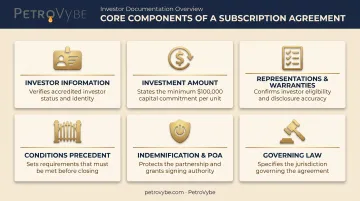
Every subscription agreement, regardless of industry, includes the same core building blocks:
- Investor information and eligibility: Legal name, entity type (individual, trust, LLC), and certification that you meet accredited investor standards
- Investment amount and terms: Capital commitment, purchase price, and units or interests acquired—in energy deals like PetroVybe's natural gas offerings. Participation begins at one unit of $100,000, with add-on subscriptions from $25,000
- Representations and warranties: Written confirmation you've reviewed the private placement memorandum (PPM), understand the risks, and meet suitability requirements
- Conditions precedent: Requirements that must clear before funds are accepted, such as a minimum raise threshold or regulatory sign-off
- Indemnification and power of attorney: Issuer protections if you misrepresent accreditation or authority, plus limited power to execute specific filings on your behalf
- Governing law and exemption references: The Regulation D exemption the offering relies on and the state law that governs the contract
One EDGAR-filed example folds these into a single workflow: capital commitment questionnaire, signature page, and issuer acceptance block, with indemnity and power-of-attorney language layered in. Issuers still customize the specifics, but the structure rarely changes.
Who Is Involved in a Subscription Agreement?
Two parties sit at the center of this contract, though the labels shift depending on the entity structure.
- The issuer or general partner (GP) — the company or fund sponsor offering the placement and deciding whether to accept subscriptions
- The investor or subscriber — the accredited individual or entity applying to invest, who becomes a limited partner or member only after acceptance
In many energy private placements, the investor is not a passive shareholder. They become a direct partner in project economics and share profits according to the partnership's split. That relationship differs sharply from buying stock in a public company.
Subscription Agreement vs. Other Private Placement Documents
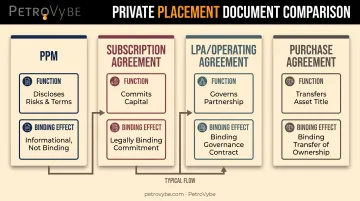
Investors frequently conflate the subscription agreement with other offering documents. Here's how they differ:
| Document | Function | Binding Effect |
|---|---|---|
| PPM | Discloses the opportunity, risks, and terms | Delivered, not signed as a commitment |
| Subscription Agreement | Records the investor's offer and issuer's acceptance | Binding once accepted |
| LPA/Operating Agreement | Governs ongoing partnership rules | Investor agrees to be bound via the subscription |
| Purchase Agreement | Transfers existing interests between parties | Used for secondary transactions, not new issuance |
The PPM tells you what you're buying and what could go wrong. The subscription agreement is you saying "I'm in" and the issuer saying "confirmed." The LPA or operating agreement then governs how the partnership actually runs, day-to-day, for the life of the investment.
Purchase agreements are a different animal entirely: they transfer existing interests between two parties, while subscription agreements involve interests newly issued directly from the issuer to you.
Regulatory Framework: Why Subscription Agreements Matter Under SEC Rules
Most private placements skip SEC registration by relying on Regulation D exemptions, specifically Rule 506(b) or Rule 506(c). The subscription agreement is the document that evidences your compliance with whichever exemption the issuer is using.
How the two rules differ:
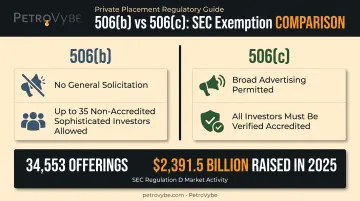
- Rule 506(b) prohibits general solicitation and allows up to 35 non-accredited but sophisticated investors
- Rule 506(c) permits broad advertising but requires every investor to be accredited, with the issuer taking reasonable steps to verify that status
The SEC's accredited investor thresholds are specific, not general wealth guidelines:
- Net worth over $1 million, excluding your primary residence
- Income over $200,000 individually or $300,000 jointly in each of the prior two years, with the same expectation for the current year
Since 2020, the SEC also recognizes Series 7, 65, or 82 license holders as accredited, regardless of income or net worth.
PetroVybe structures its natural gas development private placements under Rule 506(c). Every investor must verify accredited status through a qualified third party—such as a CPA, tax attorney, or financial advisor—before funds are accepted.
That verification step is documented in the subscription agreement, which is how the issuer shows it took the “reasonable steps” 506(c) requires.
For scale, the SEC reports 34,553 initial Regulation D offerings in 2025, raising $2,391.5 billion. Each of those raises depends on subscription agreements to record investor eligibility and keep the exemption intact.
What Investors Should Watch for Before Signing
Before you sign anything, slow down. This is a binding legal commitment, not a formality.
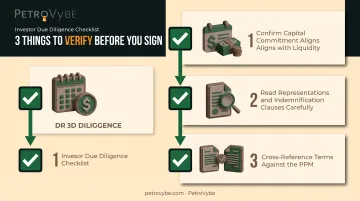
- Confirm the capital commitment aligns with your liquidity. Check the total amount, any capital call schedule, and whether the timeline matches your personal cash flow needs.
- Read the representations carefully. Pay close attention to indemnification and power of attorney clauses. If something's unclear, ask the issuer or your legal advisor before signing, not after.
- Cross-reference against the PPM. Confirm that projected returns, risk disclosures, and tax treatment match the PPM. On a deal like PetroVybe's, with a forecasted 10-year MOIC of roughly 2.2x to 5.8x, those figures and the related risk language should line up in both documents.
Remember: forecasted returns are targets, not guarantees. Any subscription package worth signing will say so explicitly, and any issuer worth investing with will encourage you to verify terms with your own counsel before wiring funds.
Frequently Asked Questions
What is a limited partner subscription agreement?
A limited partner subscription agreement is used when an investor is admitted as a limited partner in a fund or partnership. Once accepted, it binds the investor to the terms of the limited partnership agreement (LPA).
Is a subscription agreement necessary?
Yes. It is the primary document that records your investment commitment and the issuer's acceptance. It is also used to demonstrate regulatory compliance under Regulation D.
Can you provide an example of a subscription agreement?
A typical package includes an investor questionnaire, signature pages, and a capital commitment schedule. Public examples from actual private placements are available in SEC EDGAR filings.
What is a limited partnership agreement?
The LPA is the master governing document for the fund or partnership itself. It's separate from your individual subscription agreement, which is your personal application to join and be bound by the LPA's terms.
What is a private placement agreement?
This term generally refers to the full set of offering documents together: the PPM, the subscription agreement, and the LPA. Collectively, these govern a private securities sale to accredited investors.
Informational requests only. PetroVybe projects are offered solely to verified accredited investors. Submitting this form does not create an investment or advisory relationship.