
Many landowners and heirs face this exact confusion. They don't know whether their name is even attached to a producing well, what a division order is, or how the IRS will treat any money that shows up.
This guide walks through ownership types, how to verify what's yours, the buying/selling/leasing process, and tax treatment. We'll also cover a path most passive mineral owners never hear about: investing directly in oil and gas development as a working interest partner.
Key Takeaways
- Mineral rights are legally separate from surface rights and transfer independently
- Royalty, working, and leasehold interests differ in income, cost, and tax treatment
- Confirming ownership requires deeds, division orders, and county courthouse records
- Working interest investment offers upfront tax deductions against active income, unlike passive ownership
What Are Oil and Mineral Rights?
Mineral rights are the legal ownership of subsurface resources, oil, gas, and other minerals, separate from the land sitting above them. This is unusual by global standards. In most countries, the government owns everything beneath the ground. In the United States, private individuals and companies can own it outright.
Surface Estate vs. Mineral Estate (The "Split Estate")
When a single property is divided into a surface estate and a mineral estate, that's called severance. A landowner might sell the surface but keep the minerals, or sell both together, or sell the surface while reserving the minerals for their heirs.
Here's the part that surprises people: if a deed doesn't explicitly reserve or exclude minerals, they transfer automatically with the surface sale. Silence in a deed isn't neutral; it defaults to full conveyance.
In Texas, the mineral estate is legally considered "dominant." That means a mineral owner or their lessee generally has the right to use as much of the surface as is reasonably necessary to explore for and produce oil and gas.
This right isn't absolute, though. Under the accommodation doctrine, if drilling would substantially interfere with an existing surface use (like an irrigation system or specific pasture use) and a reasonable alternative exists, the operator may need to adjust its plans.
Who Owns Oil Rights in the USA?
Ownership splits three ways:
- Private individuals and families who hold mineral rights through purchase or inheritance
- Corporations and oil companies that acquire mineral or leasehold positions
- Federal and state governments, which manage mineral estates through agencies like the Department of the Interior
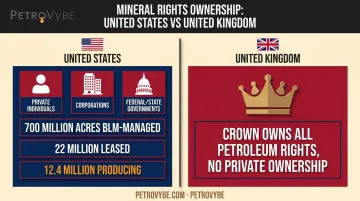
The scale of federal involvement is bigger than most people assume. The Bureau of Land Management manages roughly 700 million subsurface acres, about 30% of the entire United States, as federal onshore mineral estate. Of that, only about 22 million acres are actually leased for oil and gas, and 12.4 million are producing.
Compare that to the United Kingdom, where the Petroleum Act 1998 vests the Crown with the exclusive right to search for, bore for, and obtain petroleum throughout Great Britain and its territorial waters. There's no private oil and gas ownership model there. The American system, where a rancher's grandmother can own a producing mineral interest outright, simply doesn't exist in most of the world.
Types of Mineral Interests: Royalty vs. Working Interest vs. Leasehold
Not all mineral ownership looks the same. The interest you hold determines your income, your costs, and your control.
Mineral Rights Owner Entitled to lease the property, collect bonus and delay rental payments, and receive royalty income, all without paying a dime toward drilling or operating costs.
Royalty Interest (including NPRI) A carved-out right to a share of production revenue only. A Non-Participating Royalty Interest (NPRI) goes a step further, stripping out any say in leasing decisions. You get a check; you don't get a vote.
Working Interest This is the interest that funds drilling and operations. Working interest owners bear exploration, completion, and operating costs, along with the liabilities that come with them, in exchange for a much larger share of production revenue. Higher risk, but also higher reward.
Leasehold Interest What an operator obtains when a mineral owner signs a lease. It grants the right to explore and produce for a defined term, structured around a bonus payment, negotiated royalty, and a primary term.
Passive Mineral Ownership vs. Direct Working Interest Investment
Here's where most people's understanding stops, but it shouldn't.
Inherited or purchased mineral and royalty ownership generates passive income. It's modest, it's dependent on someone else drilling nearby, and it comes with no control over timing or terms.
Working interest participation is a different animal entirely. Instead of waiting for royalties from someone else's decisions, you're funding development at the point where value actually gets created. This is the model PetroVybe offers accredited investors through its Lavaca County, Texas projects.
The practical differences:
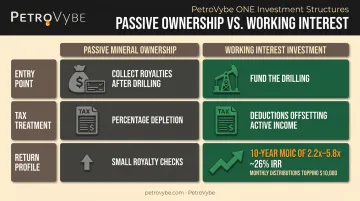
- Entry point: Passive owners collect royalties after a well is already drilled. Working interest partners fund the drilling itself.
- Tax treatment: Passive royalty income gets a percentage depletion deduction. Working interest deductions can offset active income directly, including W-2 wages and capital gains.
- Return profile: PetroVybe targets a 10-year MOIC of 2.2x to 5.8x and an IRR near 26%, with monthly distributions projected to top $10,000 at peak production.
It's not a fit for everyone. Working interest investment carries operational risk, requires a $100,000 minimum, and is limited to accredited investors. But for those who qualify, it's a materially different opportunity than sitting on a small royalty check.
How to Verify and Determine Your Mineral Rights Ownership
Before you can sell, lease, or even estimate the value of mineral rights, you need to confirm you actually own them.
Three documents matter most:
- The mineral deed - shows what was granted or reserved, and where. Filed at the county clerk's office where the land sits.
- Any existing lease - establishes whether the minerals are already committed to an operator, and on what terms.
- The division order - the payment instrument an operator uses to calculate your share of proceeds.
In Texas, a signed, statutorily compliant division order is generally required before an operator will issue royalty payments. But don't confuse it with proof of ownership.
A division order allocates payment; it doesn't establish or replace title. Reconcile it against your deeds and any probate records before signing anything.
Speaking of probate: fractionalized ownership is common. Mineral interests get split among heirs generation after generation, sometimes leaving dozens of people with tiny fractional shares in the same tract.
If your ownership traces through an estate, or you're unsure what you actually hold, a landman or title attorney can trace the chain through county records far faster than you can on your own.
Buying, Selling & Leasing Mineral Rights
Mineral rights values swing on a handful of factors:
- Historical and projected royalty income from the tract
- Regional drilling activity and nearby well performance
- Total acreage and mineral interest size
- Existing lease terms, including royalty rate and remaining primary term
Can you still buy mineral rights in Texas? Yes. Texas places no state restriction on private transfer of mineral or royalty interests. Transactions happen through direct sales, mineral rights brokers, and public auctions, provided the conveyance is in writing and properly executed.
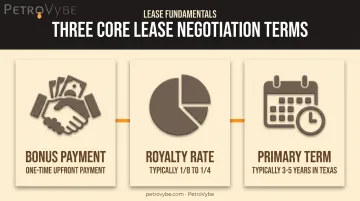
If you're leasing rather than selling, three terms drive the deal:
- Bonus payment - a one-time, upfront payment for signing
- Royalty rate - the negotiated share of production revenue you'll receive, commonly landing in the 1/8 to 1/4 range in private leases
- Primary term - the window in which the lessee must establish production, typically averaging 3-5 years in Texas
Get every term in writing. Verbal understandings about "we'll revisit the royalty rate later" don't hold up.
Options When You No Longer Want Your Mineral Rights
If you'd rather not hold onto mineral rights long-term, you generally have three paths:
- Sell to a buyer, broker, or at auction
- Donate to a qualifying nonprofit
- Gift the interest to a family member
One catch worth flagging: once you've leased your minerals, you can't lease that same interest to another party until the existing lease expires or terminates.
If a dispute arises over lease terms or royalty payments, the Texas Railroad Commission won't step in. Lease disputes are private contract matters, handled through attorneys and civil courts, not state regulators.
Tax Implications & Investment Considerations
Tax treatment is where passive mineral ownership and working interest investment diverge most sharply.
Royalty income is taxed as ordinary income, reported on Schedule E. Owners can typically apply a percentage depletion allowance, generally 15% of gross income from the property under IRC Section 613A, which shelters part of that income. It's a real benefit, but a limited one.
Working interest investment works differently. Intangible Drilling Costs (IDCs), which cover items like drilling labor, fuel, site preparation, and fracturing services, typically represent 60-80% of total invested capital in a new drilling project. Investors can elect to deduct these costs in the year incurred.
Here's the critical distinction: unlike passive royalty deductions, IDC deductions from a working interest can offset active income, including W-2 wages and capital gains, not just passive income. This is a direct result of how working interests are treated under the passive activity rules.
PetroVybe's own partner results illustrate the scale of this benefit:
| Year | Tax Deduction Against Active Income |
|---|---|
| 2024 | 94% |
| 2025 | 91% |
On a $100,000 investment, that translates to roughly $60,000-$80,000 in first-year IDC deductions alone, applied against whatever active income the investor already owes tax on.
A few things to keep in mind:
- Mineral rights value and royalty income both rise and fall with oil and gas prices, which affects resale value and long-term income projections
- Every investor's tax situation differs, and the rules around at-risk limits, basis, and passive activity exceptions are genuinely complex
- Talk to a CPA or tax attorney before leasing, selling, or investing, since these decisions carry lasting tax and financial consequences.
Frequently Asked Questions
Can you still buy mineral rights in Texas?
Yes. Buyers and sellers actively trade Texas mineral rights through private transactions, brokers, and auctions. No state law restricts private ownership transfer, as long as the conveyance is properly written and executed.
Who owns oil rights in the USA?
Private individuals, companies, and federal or state governments each hold portions of mineral ownership. The BLM alone manages roughly 700 million acres of federal subsurface mineral estate.
What are mineral rights for oil?
Mineral rights are the legal right to explore, extract, and profit from oil and other subsurface resources beneath a property. They exist separately from surface land ownership, and owners can sell or lease them independently.
What's the difference between mineral rights and royalty rights?
Mineral ownership includes the full bundle of rights, including the authority to lease and make development decisions. A royalty interest is income-only: you collect a share of production revenue with no leasing or development control.
Do I have to pay taxes on mineral rights income?
Yes. The IRS taxes royalty income as ordinary income, and owners typically report it on Schedule E. Owners may apply a percentage depletion deduction to shelter part of that income from tax.
How can I find out if I own mineral rights on my property?
Check your property deed and any recorded mineral deeds, review county courthouse records, and look for existing division orders tied to your name. If the paper trail is unclear, a landman or title company can trace the chain of ownership.