Congress responded the way it always does. Lawmakers reintroduced the Big Oil Windfall Profits Tax Act, along with a competing bill from Rep. Brad Sherman. It's a familiar pattern: oil shocks trigger tax proposals, from 1980's Crude Oil Windfall Profit Tax to Europe's 2022 windfall levies to today's 2026 bills.
This article breaks down what a windfall profits tax actually is, what history says about how these taxes perform, where the current debate stands, and what any of this means if you invest in oil and gas.
Key Takeaways
- Windfall taxes target unearned gains from price shocks, not added investment or effort
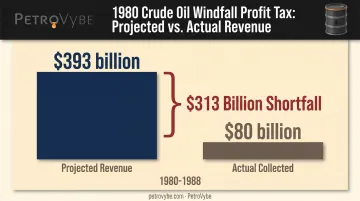
- The 1980 U.S. tax collected $80 billion versus a $393 billion projection, then was repealed by 1988
- The UK, Spain, and the EU have tried windfall taxes since 2022, largely with negative investment effects
- Current 2026 proposals target producers above 300,000 barrels per day, exempting most independents
- Percentage depletion and intangible drilling cost (IDC) deductions remain available to independent producers and investors today
What Is an Oil Windfall Profits Tax?
A windfall profits tax is a surtax on gains that come from a sudden, unearned event rather than from a company's own investment or effort. Think of a geopolitical shock, a supply disruption, or a government price decontrol — not a smarter drilling program or better technology.
The "oil windfall" concept usually gets triggered by:
- War or armed conflict disrupting supply routes (the 2026 Strait of Hormuz situation is a live example)
- Cartel action, such as OPEC production cuts
- Embargoes that restrict global supply
- Price decontrol, as happened when the U.S. lifted crude price caps in 1979-80
Here's the technical wrinkle most people miss: most "windfall profits taxes," including the 1980 U.S. law, aren't actually profits taxes. They're excise taxes on production.
The 1980 version taxed the per-barrel spread between market price and a statutory base price, not corporate accounting profit. That distinction matters: an excise tax hits every barrel produced, whether the company made money that quarter or not, while a true profits tax only applies when there's actual profit to tax.
Windfall Tax vs. the Corporate Income Tax
One argument worth taking seriously: the corporate income tax already functions like a windfall tax. It's proportional to profit, so when oil prices spike and profits rise, tax revenue rises automatically, with no new legislation required.
The Tax Foundation makes exactly this case, calling the existing corporate tax a windfall tax in all but name. A separate windfall levy, in this view, taxes the same gain twice.
A History Lesson: The 1980 Crude Oil Windfall Profit Tax
Origins and Structure
The 1980 tax wasn't punitive by design. It was a political compromise that let President Carter decontrol domestic oil prices without triggering a backlash over "unearned" producer gains.
The structure was tiered by well age and type:
- Tier I (mostly older oil from major producers): up to 70% for majors, 50% for qualifying independents
- Tier II (stripper and Naval Petroleum Reserve oil): up to 60%
- Tier III (newly discovered, heavy, and tertiary oil): generally 30%, with a lower 22.5% rate for new discoveries
Liability was capped at 90% of per-barrel net income, which sounds generous until you see what happened next.
Economic Fallout
The tax reshaped domestic production in ways its architects didn't intend. Congressional Research Service estimates put the damage at:
- Domestic oil production fell roughly 1.2% to 8% between 1980 and 1988
- Import dependence rose by an estimated 3% to 13% over the same period
The revenue numbers tell an even starker story. Original projections called for $393 billion in gross revenue. Actual collections landed around $80 billion, a shortfall of more than $300 billion, according to a Congressional Research Service analysis. Net revenue after income tax offsets was smaller still.
Why It Was Repealed
Three forces killed the tax before its scheduled 1991 sunset:
- Administrative burden: the GAO documented extensive compliance costs and called the tax exceptionally complex to administer
- Falling revenue: as oil prices collapsed in the mid-1980s, the inflation-adjusted base prices caught up, and receipts approached zero by 1987-88
- Industry contraction: roughly 130,000 oil and gas jobs disappeared between 1985 and 1986, though CRS attributes that mainly to the price collapse itself, not the tax alone
Congress repealed the tax in August 1988. It had raised a fraction of what was promised and left a permanent mark on how policymakers think about production-based levies.
The Global Windfall Tax Landscape: Lessons from Abroad
The U.S. isn't the only country that's tried this. The results elsewhere echo the same pattern: enact, then repeal or scale back.
United Kingdom. The Energy Profits Levy started at 25% in 2022 and climbed to 38% by late 2024, pushing the combined headline rate on North Sea producers to 78% through March 2030.
North Sea output has fallen roughly 75% since 1999. Analysts increasingly link the compounding decline to the tax squeeze on top of an already-maturing basin.
Spain. A 1.2% levy on energy company revenue (not profit) applies to firms with over €1 billion in turnover. The catch: many of these companies run both fossil fuel and renewable divisions.
Repsol has warned that extending the tax could redirect billions in planned clean energy investment elsewhere, an unintended consequence of taxing revenue broadly rather than targeting the actual windfall gain.
Other examples worth noting:
- The EU's solidarity contribution imposed a 33% levy on fossil-sector surplus profits above 120% of a 2018-2021 baseline
- Greece ran a 90% retroactive levy on electricity windfalls (outside the upstream oil sector)
- Mongolia repealed a mining windfall tax in 2009 after it discouraged investment
- The Netherlands layered a 33% solidarity contribution on top of proposed increases to gas-sale levies
The throughline across every jurisdiction: windfall taxes tend to get enacted in a hurry during a price spike, then walked back once the investment consequences show up.
Current U.S. Proposals and the 2026 Policy Debate
Two competing bills are sitting in Congress right now, and they work differently.
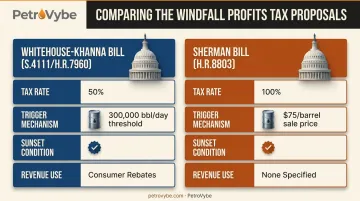
The Big Oil Windfall Profits Tax Act (Whitehouse-Khanna, S.4111/H.R.7960) would impose a 50% tax on the gap between a quarter's average crude price and the 2025 average price. It applies to producers and importers extracting or bringing in more than 300,000 barrels per day — a size threshold based on volume, not a formal "independent producer" carve-out.
Revenue would fund consumer rebates, phased out at 5% of adjusted gross income above $150,000 for joint filers.
Rep. Sherman's Iran War Oil Crisis Windfall Profits Tax Act (H.R.8803) takes a sharper approach: a 100% tax on crude sales above $75 per barrel. It only sunsets once Iran hostilities end, the Strait of Hormuz reopens, and WTI drops back below that $75 threshold.
A few things worth flagging for anyone tracking this closely:
- Neither bill has an official CBO/JCT revenue score as of this writing
- A 2022 predecessor bill was projected to raise roughly $45 billion annually at $120/bbl, but that's an old estimate on an old baseline, not a score of the current text
- The 300,000 b/d threshold in Whitehouse-Khanna leaves most smaller producers out of scope, since independents account for the large majority of U.S. oil and gas output according to industry trade groups
Both bills remain stuck at the introduced/referred-to-committee stage. That's the same spot most windfall tax proposals have occupied since 1980, minus the one that actually passed.
The Debate: Arguments For and Against Windfall Profits Taxes
Arguments in Favor
Supporters make a fairness case. Consumers absorb higher prices at the pump while producers collect gains they didn't earn through added investment; the argument goes that some of that money should flow back to consumers through rebates.
The IMF has weighed in with a more technical version of this argument. It favors permanent taxes on economic rent (profit above a normal return on investment) rather than temporary, retroactive levies. Done well, a rent tax theoretically avoids discouraging new supply because it only bites after investors recover their costs plus a reasonable return.
Arguments Against
Critics push back on both the design and the premise.
- Investment distortion: Even a "temporary" tax shapes how investors view long-term risk, since Congress could impose it again the next time prices spike.
- Output reduction from existing wells: A well-level study of the 1980 tax found it cut production from wells already pumping — not just deterred new drilling.
- Double taxation: Windfall profits already flow through the standard corporate income tax, so critics favor expanding full expensing over layering on a second tax.
Both sides agree on one thing: design matters more than intent. A poorly structured excise tax and a well-designed rent tax can produce very different outcomes, even if the headline goal is identical.
What This Means for Oil & Gas Investors
Here's the part that actually matters for anyone deploying capital into energy right now.
Scale determines exposure. Windfall tax proposals, including the 1980 law, have historically targeted large, publicly traded producers and importers.
The current 300,000 b/d threshold in Whitehouse-Khanna is a volume test, not a blanket independent-producer exemption. Still, the practical effect holds: most private developers fall well below that line and stay out of the crosshairs.
The depletion allowance is still alive. Percentage depletion remains available today for independent producers and royalty owners at a 15% rate. Major integrated companies lost this tool back in 1975.
Pair that with intangible drilling cost (IDC) deductions, and independent operators retain tax advantages that major producers simply don't have access to anymore.
This is one reason accredited investors increasingly look at direct participation in private natural gas development rather than shares of a major exposed to whatever Congress does next.
PetroVybe's projects in South Texas and the Gulf Coast Basin, for example, currently offer IDC deductions that apply against active income: W-2 earnings and capital gains, not just passive income. That's a meaningful distinction from most real estate deductions, which are boxed in by passive-income rules.
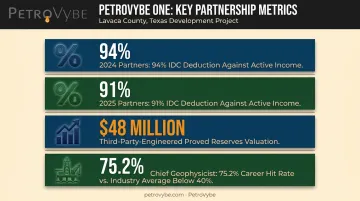
- PetroVybe partners who invested in 2024 saw a 94% deduction against active income
- Partners in 2025 saw that shift to 91%
- These figures came from a company with a $48 million third-party-engineered proved reserves valuation and a Chief Geophysicist carrying a 75.2% career hit rate against an industry average below 40%
Tax policy on oil and gas isn't static. It never has been, from 1980 through today's 2026 bills. That volatility is exactly why due diligence on any development partner should include their third-party engineering validation, operational track record, and how their structure holds up regardless of which way Washington swings next.
Frequently Asked Questions
What triggers windfall gains tax?
Sudden, unanticipated price spikes tied to events like war, supply shocks, or price decontrol typically trigger windfall taxes — not normal market cycles or gradual price growth.
What does "oil windfall" mean?
An oil windfall refers to unearned profit gains that come from external price increases, rather than from additional production effort, technology improvements, or new investment.
Is there still an oil depletion allowance?
Yes. Percentage depletion remains available for independent producers and royalty owners today, generally at a 15% rate. Congress eliminated it for major integrated companies in 1975.
Has the U.S. ever repealed a windfall profits tax before?
Yes. Congress repealed the 1980 Crude Oil Windfall Profit Tax in 1988 due to heavy administrative burden, collapsing revenue as oil prices fell, and its role in pushing up import dependence.
Do windfall taxes apply to small or independent oil producers?
Most historical and proposed windfall taxes exempt smaller producers below a production threshold. The current Whitehouse-Khanna bill sets that line at 300,000 barrels per day, well above most independents.
Could a new windfall profits tax pass in 2026?
Two bills have been reintroduced amid rising gas prices, but both remain stuck in committee. They face the same political and economic headwinds that have stalled nearly every windfall tax proposal since 1980.