

This article is general education, not investment, tax, or legal advice. Most investors assume every oil and gas check is "passive money." That assumption can cost you real deductions.
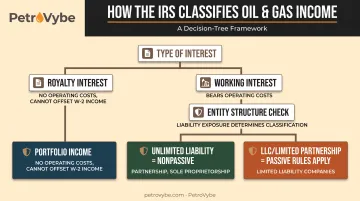
The IRS doesn't classify income based on how much work you put in day-to-day. It cares about what type of interest you hold and how it's structured. Royalty income and working interest income get treated completely differently under Section 469, and the difference determines whether you can use losses to offset your W-2 wages or capital gains. This treatment requires the investor to elect general partner status in the Subscription Agreement and may be limited in a given year by the excess business loss limitation under IRC §461(l).
This distinction matters more than most tax guides let on. Get it wrong, and you'll either overpay taxes or get blindsided by an IRS reclassification. Let's break down exactly how the IRS draws this line.
Key Takeaways
- Royalty income is generally portfolio income, not passive activity income (Schedule E, line 4)
- Working interests without liability protection get automatic nonpassive treatment under Section 469(c)(3)
- Only working interest losses (including IDCs) can offset ordinary W-2 income; royalty losses generally cannot
- Entity structure (LLC vs. direct/general partnership) determines which tax treatment applies. This treatment requires the investor to elect general partner status in the Subscription Agreement and may be limited in a given year by the excess business loss limitation under IRC §461(l).
What Is Passive Income vs Active Income?
Here's where most confusion starts: there are two completely different definitions of "passive income" floating around.
Everyday financial language treats passive income as any money you don't actively work for: rental checks, dividends, interest, and royalties, all lumped into one "hands-off cash flow" bucket.
Active income is the opposite. It is money you earn through material participation—wages, salaries, self-employment profits, and fees for services you perform.
The IRS Section 469 definition is stricter. It defines a passive activity as a trade or business where you don't materially participate, plus certain rental activities. That's it.
This distinction matters because IRS Publication 925 explicitly carves out portfolio income — interest, dividends, annuities, and royalties not tied to an ordinary trade or business — and excludes it from passive activity income entirely.
Why does this matter for your taxes?
- Passive activity losses can only offset passive activity income (with narrow exceptions)
- Portfolio income sits in its own bucket, separate from both passive and active/ordinary income
- Confusing "everyday passive" with "IRS passive" leads to bad tax assumptions
Is Royalty Income Passive or Active? The IRS Answer
Royalty income from mineral rights, intellectual property, or leasing arrangements is almost always taxed as ordinary income. But for Section 469 purposes, it's typically classified as portfolio income, not passive activity income.
Why Royalties Land in the Portfolio Bucket
The 2025 Schedule E instructions are direct on this point: oil, gas, and mineral royalties (other than operating interests) belong on line 4, and royalty income not derived in the ordinary course of a trade or business is generally not passive activity income.
Royalty owners typically:
- Don't manage drilling operations
- Don't cover development or operating costs
- Simply collect a fixed percentage of production revenue
That hands-off structure is why royalties often get called passive in everyday language. Portfolio income classification means something more specific: royalty losses generally cannot offset passive income from other sources. In practice there is rarely a loss to begin with, because royalty owners bear no operating costs.
The Trade-or-Business Exception
There's a narrow exception. In IRS Private Letter Ruling 202535011, released August 2025, the IRS found that a partnership actively engaged in owning, operating, and managing mineral interests, using full-time staff, generated royalties that arose in the ordinary course of a trade or business. That reclassified the income out of the portfolio bucket.
This ruling applies only to that taxpayer's facts. Most royalty owners cannot rely on it. It does illustrate the principle: if royalty generation is your actual business (not a passive holding), classification can shift.
Classification aside, royalty owners can still claim depletion deductions against the income they receive. Those deductions reduce taxable royalty income; they do not turn a pure royalty interest into a passive activity that shelters wages or other active income.
Royalty Interest vs. Working Interest: Why It Matters for Taxes
This is the distinction that actually changes your tax bill.
A royalty interest is a fixed share of production revenue with no drilling costs, no operating costs, and no liability. A working interest means you're directly on the hook for a share of drilling and operating expenses, and you participate in the well's economics.
The Section 469 Working Interest Exception
Here's the part most investors miss: Section 469(c)(3) creates a specific carve-out. A working interest held directly, or through an entity that doesn't limit your liability, is excluded from passive activity treatment automatically. No material participation test required. This treatment requires the investor to elect general partner status in the Subscription Agreement and may be limited in a given year by the excess business loss limitation under IRC §461(l).
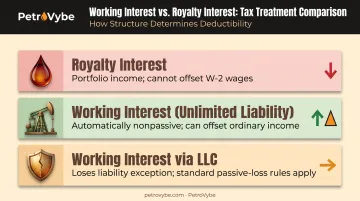
| Interest Type | Section 469 Treatment | Loss Offset Potential |
|---|---|---|
| Royalty interest (portfolio) | Not passive activity income | Cannot offset W-2/capital gains |
| Working interest, unlimited liability | Automatically nonpassive | Can offset ordinary income |
| Working interest via LLC/limited partnership | Loses the exception | Back to standard passive rules This treatment requires the investor to elect general partner status in the Subscription Agreement and may be limited in a given year by the excess business loss limitation under IRC §461(l). |
The Practical Deduction Difference
Working interest holders who qualify for operator status can elect to expense Intangible Drilling Costs (IDCs) in the year incurred. Royalty owners have no operating interest, so they don't get this election at all. They're limited to depletion.
A simplified comparison:
- Working interest investor: Deducts a large share of IDCs in year one against active income; loss (if any) can offset W-2 wages
- Royalty owner: Claims percentage or cost depletion (generally capped around 15% under Section 613A) against royalty income only, no offset to wages. This treatment requires the investor to elect general partner status in the Subscription Agreement and may be limited in a given year by the excess business loss limitation under IRC §461(l).
The Trade-Off: Self-Employment Tax
Working interest income treated as part of a trade or business can trigger self-employment tax exposure under Section 1402. Royalty income generally doesn't carry that exposure. Nothing comes free. Higher deduction potential comes with a different tax cost elsewhere.
Tax Benefits of Active Income Classification for Investors
Active classification is what makes working interests attractive versus royalty checks: upfront costs can offset W-2 wages, business income, and capital gains—not only passive income. This treatment requires the investor to elect general partner status in the Subscription Agreement and may be limited in a given year by the excess business loss limitation under IRC §461(l).
PetroVybe structures its natural gas development opportunities as direct working interest positions, so accredited investors can deduct a meaningful share of project costs, including intangible drilling costs (IDCs), against those active income sources. This treatment requires the investor to elect general partner status in the Subscription Agreement and may be limited in a given year by the excess business loss limitation under IRC §461(l).
What this has looked like for PetroVybe partners:
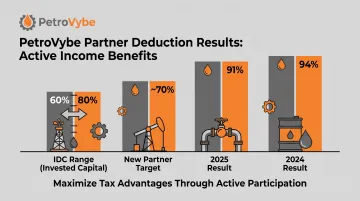
- 2025: partners reported a 94% deduction against active income. Prior result; not a promise of any future deduction.
- New partners: typically shown an ~70% first-year deduction target
- IDCs: generally a first-year deduction target of approximately 70–80% of invested capital of invested capital on new-drilling projects. This treatment requires the investor to elect general partner status in the Subscription Agreement and may be limited in a given year by the excess business loss limitation under IRC §461(l).
Why Entity Structure Can't Be an Afterthought
Those deduction results only hold if the working interest is held without liability limitation. Wrap costs and liability in a shield structure, and the Section 469(c)(3) exception disappears—standard passive-activity rules apply instead.
Before committing capital, diligence should confirm both the asset and the tax structure:
- Third-party engineering validation of reserves (PetroVybe’s PV-09 report: $48 million from a licensed independent firm, prepared by Lee Keeling & Associates, Tulsa, March 2026)
- Transparent reporting, including sample K-1s and pro forma financials
- Written documentation that the entity structure preserves active-income treatment
PetroVybe targets a 10-year MOIC of roughly 2.2x–5.8x and an approximate 26% IRR on its working interest offerings. Those figures sit alongside the tax structure as forecasts, not guarantees—actual results depend on well performance and market conditions.
Common Misconceptions About Royalty and Passive Income
Three myths still trip up oil and gas investors:
- "All oil and gas income is passive." Wrong. Working interests held without liability limitation get automatic nonpassive treatment regardless of participation level.
- "Passive losses can offset any income." Also wrong. Passive losses generally offset only passive activity income. Portfolio royalty income doesn't qualify as passive activity income, so it can't absorb those losses either.
- "My entity structure doesn't matter." It does. Moving a working interest into an LLC or limited partnership can strip away the Section 469(c)(3) exception. That pulls the investment back into ordinary passive-activity analysis—often the opposite of what investors intend.
Frequently Asked Questions
Do royalties count as passive income?
Royalties are generally treated as portfolio income under IRS rules, not passive activity income, and reported on Schedule E. This changes only if the royalty generation is part of an active trade or business.
What type of income is considered passive?
Under IRS Publication 925, passive income generally includes rental activities and income from businesses where you don't materially participate. Portfolio income, like most royalties, dividends, and interest, is a separate category.
Are working interests in oil and gas always active income?
Not always. The automatic nonpassive treatment under Section 469(c)(3) only applies if the working interest is held directly or through an entity that doesn't limit your liability. LLC ownership can remove this exception.
Can royalty losses offset my W-2 income?
Generally, no. Royalty losses fall under portfolio income rules, not passive activity rules, so they don't offset W-2 wages under Section 469.
Does the IRS ever reclassify royalty income as active?
Yes, in narrow cases. If royalty generation is part of an entity's ordinary trade or business, as seen in IRS Private Letter Ruling 202535011, the portfolio classification can shift.
Why do investors seek active income classification in oil and gas?
Active classification lets investors deduct drilling costs and losses, including IDCs, against ordinary income like W-2 wages and capital gains. Royalty income typically doesn't offer that benefit. This treatment requires the investor to elect general partner status in the Subscription Agreement and may be limited in a given year by the excess business loss limitation under IRC §461(l).
This article is for informational purposes only and does not constitute tax or investment advice. Consult a qualified tax professional before making investment decisions.
Informational requests only. PetroVybe projects are offered solely to verified accredited investors. Submitting this form does not create an investment or advisory relationship.