

Introduction
Many doctors, executives, and senior professionals earning $300,000 or more per year are surprised to discover they have little to show for it financially. A strong salary feels like security — until a job loss, market downturn, or early retirement ambition reveals the truth: income and wealth are not the same thing.
Income is what you earn. Wealth is what you keep, grow, and eventually live off. Most high earners spend decades confusing the two — trading time for money while taxes, spending, and inflation steadily drain what's left.
This matters most for high W2 earners, who face the highest marginal tax rates on earned income and often the steepest lifestyle inflation. Without a deliberate strategy to convert earnings into assets, even an impressive salary can leave someone financially fragile by retirement.
This article covers the definitions of income and wealth, the key differences between them, why high earners often end up with less than expected — and what a practical path from one to the other actually looks like.
Key Takeaways
- Income is a flow of money earned regularly; wealth is the accumulated stock of net worth — assets minus liabilities
- High income does not automatically create wealth; spending habits, tax efficiency, and asset accumulation determine net worth
- Wealth — not income — funds retirement, absorbs economic shocks, and creates generational legacy
- Disciplined saving, strategic investing, and minimizing tax drag are what convert income into lasting wealth
- Accredited investors can access direct energy investments that reduce income tax burden while building long-term tangible wealth
Wealth vs. Income at a Glance
Here's a side-by-side comparison across five key dimensions:
| Dimension | Income | Wealth |
|---|---|---|
| Nature | Recurring flow — stops when you stop working | Accumulated net worth — persists and compounds |
| Source | Wages, salaries, dividends, business profits | Savings, real estate, investments, business equity |
| Time Horizon | Short-term — measured weekly or annually | Long-term — built across decades, can span generations |
| Tax Sensitivity | High — W2 earnings face significant marginal rate drag | Structurable — tax-advantaged vehicles reduce exposure |
| Role in Freedom | Covers current expenses; requires continuous effort | Generates its own income; enables financial independence |
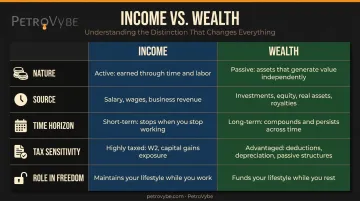
The table makes one thing clear: income is a function of your time and effort, while wealth works independently of both. The sections below unpack why that distinction matters — especially when it comes to taxes, compounding, and long-term financial independence.
What Is Income?
Income is the total money received from all sources during a specific period — typically measured monthly or annually. It represents inflow: earned, received, and generally spent or saved. Three main types matter for high earners:
- Earned income — wages, salaries, bonuses, and self-employment earnings. For most W2 employees, this is their primary source. It's directly tied to exchanging time and labor.
- Passive income — rental income, royalties, limited partnership distributions, and certain investment structures. Requires minimal ongoing effort and is the first real step toward wealth accumulation.
- Portfolio income — dividends, interest, and capital gains from stocks and bonds. Different tax treatment from earned income, with stronger compounding potential over time.
Two people with identical incomes but different saving and investing behaviors arrive at dramatically different net worth positions over time. Income is simply the raw material — what you do with it determines whether wealth ever follows.
The Income Trap for High Earners
Here's the uncomfortable reality for high W2 earners: you are among the most heavily taxed people in the country. According to IRS data for tax year 2022, the top 1% of income earners (those with AGI above $663,164) paid an average federal income tax rate of 26.09%. The top 5% paid 23.07%.
Add state income taxes — which ranged from 2.5% to 13.3% in 2025 — and a large share of every dollar earned disappears before it can be invested.
Without deliberate strategies to convert income into assets, even a $400,000 salary can produce limited net worth — especially when lifestyle inflation keeps pace with raises. A bigger paycheck that funds a bigger house, nicer cars, and higher monthly expenses leaves the same gap between income and wealth.
What Is Wealth?
Wealth is net worth: the total value of all assets you own minus all outstanding liabilities. It's a stock, not a flow. Once built, it compounds and can generate income without requiring your active labor.
Net Worth = Assets − Liabilities
Consider two professionals, both earning $250,000 per year:
- Person A has $800,000 in investments, a home with $300,000 in equity, and $50,000 in debt — net worth: ~$1,050,000
- Person B has a $50,000 savings account, a car loan, student debt, and a mortgage nearly equal to home value — net worth: ~$60,000
Same income. Radically different wealth. The difference is asset accumulation and liability management.
Components of Wealth
Wealth takes two forms. Liquid wealth — cash, stocks, bonds — is accessible on short notice. Illiquid wealth — real estate, private equity, oil and gas interests — takes longer to convert but tends to deliver higher returns and greater tax efficiency. Most serious wealth builders hold a deliberate mix of both.
The main wealth-building categories:
- Savings and cash reserves — the starting point; modest amounts invested consistently compound into meaningful net worth
- Investment assets — stocks, bonds, mutual funds, and alternatives; diversification across classes reduces risk while building long-term returns
- Real assets — property, land, and natural resources that hold intrinsic value, generate ongoing income, and act as inflation hedges
- Business and equity stakes — ownership in productive enterprises; among the highest-returning wealth categories, particularly through direct investment structures available to accredited investors
The 2022 Survey of Consumer Finances puts median net worth in the top income decile at $2.56 million — but the mean is $6.63 million, revealing massive dispersion within that group. High income does not guarantee high wealth.
From Income to Wealth: Why High Earners Often Fall Short
Here's the central paradox: many people earning $300,000, $500,000, or more have surprisingly low net worth. Income without asset accumulation creates no lasting wealth.
A 2024 Medscape survey of 7,000 physicians — professionals averaging $350,000 in annual earnings — found that only 60% had net worth above $1 million. More than a quarter carried credit card debt. High earnings and high wealth are not the same measure.
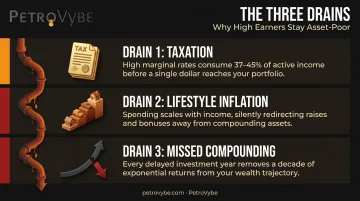
Three Drains That Block the Conversion
1. Taxation — High marginal rates consume a significant portion of active income before it can be deployed into assets. A top earner paying 37% federal plus 10%+ state tax sees nearly half of each marginal dollar disappear before investing.
2. Lifestyle inflation — Spending rises proportionally with income. The raise funds the second home and private school tuition rather than investment accounts. The wealth gap stays constant even as earnings grow.
3. Missed compounding — Years spent without investing mean lost decades of compound growth. Every year without invested capital is a year of compound growth permanently gone. No tax refund recovers it.
The Role of Tax Strategy
The most effective wealth builders treat tax reduction as a core investment decision, not a year-end formality. The goal is to redirect dollars that would otherwise go to the IRS into appreciating assets instead.
For accredited investors, direct positions in tangible assets — particularly oil and gas development projects — offer a dual benefit that standard stock portfolios typically cannot: substantial upfront tax deductions against active income (including W2 wages and capital gains) combined with long-term asset appreciation.
Under U.S. tax law, Intangible Drilling Costs (IDCs) — expenses incurred in drilling wells that have no salvage value — can be elected as current deductions. For investors holding direct working interests, those losses may be classified as nonpassive, allowing them to offset W2 wages and capital gains directly. That's a structural advantage real estate investments generally cannot match for passive investors.
PetroVybe's oil and gas development partnerships are structured around this principle. Partners in PetroVybe ONE received a 91% tax deduction against active income in 2024 and a 94% deduction in 2025 — applied against W2 earnings and capital gains, not restricted to passive income. One verified investor eliminated a $30,000 tax liability through this mechanism alone. The deduction can be taken in full in year one via the K-1, or spread equally across five tax years — whichever better aligns with the investor's tax position.
The result: tax dollars that would otherwise be lost are redirected into a direct equity position in a producing energy asset, with monthly passive distributions projected to peak above $10,000 per month during the production phase and a 10-year target MOIC of approximately 2.2x–5.8x.
A Simple Framework for When to Shift Focus
| Career Stage | Priority | Focus |
|---|---|---|
| Early career | Income-first | Maximize earnings, negotiate salary, build revenue |
| Mid-career | Transition | Begin asset accumulation alongside income growth |
| Established earner | Wealth-first | Tax-advantaged investing, passive income, accredited asset classes |
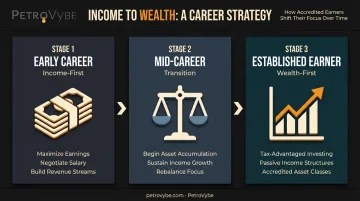
Once you reach accredited investor status — net worth above $1 million excluding your primary residence, or income above $200,000 individually / $300,000 jointly — the range of wealth-building tools expands significantly. That threshold is when the income-to-wealth conversion strategy should accelerate.
Conclusion
Income and wealth are not competing goals — but they're not the same thing either. What separates financially free individuals from high earners who stay stuck is how deliberately they convert what they earn into assets that generate returns without their time.
For high-income earners and accredited investors, that conversion requires more than a strong salary. It requires minimizing tax drag, maximizing asset accumulation, and building income-producing assets that keep compounding long after your working years.
If you're a high-income earner looking to redirect tax liability into tangible, income-producing assets — including potential IDC deductions against W2 income and capital gains — PetroVybe's direct oil and gas development partnerships are structured to do exactly that. You can reach the team at info@petrovybe.com or call 214.810.6207 to learn more about current investment opportunities.
Frequently Asked Questions
Is wealth the same as income?
No. Income is a regular flow of earnings — it arrives and, without deliberate action, gets spent. Wealth is the accumulated stock of net worth: assets minus liabilities. You can earn significant income without building meaningful wealth if spending, taxes, and debt consume everything you make.
Which is more important: income or wealth?
Both matter, but for different reasons. Income covers current expenses and is necessary for day-to-day living. Wealth provides long-term financial security, retirement funding, and freedom from a paycheck — most financial professionals treat it as the ultimate goal, with income as the tool to get there.
How much income is considered wealthy?
Income thresholds don't determine wealth — net worth does. The SEC defines accredited investors as individuals earning above $200,000 individually (or $300,000 jointly) or holding net worth above $1 million excluding their primary residence. But a high income number alone says nothing about actual financial security; net worth is the more meaningful measure.
What are the 4 types of wealth?
A widely used framework breaks wealth into four categories: financial wealth (money and investments), real asset wealth (property and tangibles), human capital wealth (skills and earning ability), and social wealth (relationships and networks). Most wealth-building strategies focus on the first two, as these are most directly accumulated and transferred.
Can you have high income and low wealth?
Yes, and it's more common than most people expect. High earners who spend beyond their means, carry significant debt, or fail to invest regularly can accumulate little net worth despite impressive salaries — a scenario sometimes called being "income-rich, asset-poor."
How do you convert income into wealth?
Spend less than you earn, reduce tax liability through strategic investments, and consistently allocate income into appreciating assets — real estate, equities, or alternative investments — so compound growth does the heavy lifting. For accredited investors with significant tax exposure, direct investment structures like oil and gas partnerships can accelerate that conversion by turning tax dollars into asset equity.
Disclosure: PetroVybe and its team members are not licensed financial advisors, and nothing on this website constitutes financial or investment advice or a recommendation to buy, sell, or hold any investment. PetroVybe and its team members are not tax advisors, accountants, or tax strategists, and nothing on this website constitutes tax advice or a tax strategy. PetroVybe and its team members are not attorneys, and nothing on this website constitutes legal advice. All content is provided for general informational purposes only. You should consult your own independent financial advisor, tax professional, and legal counsel before making any decision.