Publicly traded Master Limited Partnerships (MLPs) trade like stocks on the NYSE. Private oil and gas LPs are a different structure entirely, open only to accredited investors, offering direct working interests and deeper tax deductions. Confusing the two leads to bad due diligence and, sometimes, bad outcomes.
This article breaks down how both structures work, the well types behind them, how the tax benefits actually function, the real risks regulators warn about, and what separates a trustworthy sponsor from a red flag.
Key Takeaways
- Oil and gas LPs are either public MLPs or private, accredited-investor deals
- IDC and depletion deductions often offset most capital against active income
- Well type—income, development, or exploratory—shapes risk, return, and deductions
- Track record, reserve reports, and verified reviews separate durable partnerships from fraud
What Are Oil and Gas Limited Partnerships?
An oil and gas limited partnership is a business entity built around a simple division of labor. A General Partner (GP) manages drilling, operations, and day-to-day decisions. Limited Partners (LPs) contribute capital and receive a share of production revenue plus certain tax benefits, without taking on management duties themselves.
This division of roles doesn't change how the IRS taxes the partnership. Both public MLPs and private LPs must meet the same qualifying income rule to keep their pass-through tax treatment. At least 90% of gross income must come from sources tied to natural resource activities such as exploration, development, and production.
Miss that threshold, and the partnership gets taxed like a corporation instead, losing the advantage that makes this structure attractive.
General Partners vs. Limited Partners
The two roles carry very different risk profiles:
- General Partner: Manages drilling programs, operations, and vendor relationships; typically carries more liability, especially for tangible costs like equipment and infrastructure
- Limited Partner: A passive capital provider who receives production-based distributions, qualifies for IDC and depletion deductions, and keeps liability limited to the amount invested
This split protects LP investors from operational risk while still letting them capture the tax treatment tied to the underlying working interest.
Public MLPs vs. Private Oil & Gas Limited Partnerships
| Factor | Public MLP | Private Oil & Gas LP |
|---|---|---|
| Trading | Exchange-listed, liquid | Illiquid, transfer-restricted |
| Investor eligibility | Open to any investor | Accredited investors only (Reg D 506(c)) |
| Exposure | Partnership units, often midstream infrastructure | Direct working interest, often upstream drilling |
| Tax deduction potential | Lower, diluted across a large asset base | Higher, tied directly to drilling costs |
| Minimum investment | Cost of one share | Often $50,000-$100,000+ |
Private LPs like those offered by PetroVybe focus on direct, early-stage development projects rather than midstream pipelines or storage assets. That distinction matters for the tax math: capital going into new wells generates IDCs, while capital going into a pipeline mostly doesn't.
Types of Oil and Gas Well Investment Programs
Oil and gas LPs are generally categorized by the stage of the well being drilled, and that stage determines risk, return potential, and the size of the available tax deduction.
| Well Type | What It Is | Risk/Reward Profile |
|---|---|---|
| Income (stripper) wells | Investment in wells already producing, typically low-rate | Lowest risk, lowest IDCs, higher upfront mineral rights cost |
| Developmental (step-out) wells | Drilling near proven reserves to protect and expand legacy production | Moderate risk, moderate IDCs |
| Exploratory (wildcat) wells | Drilling in unproven territory with limited subsurface data | Highest risk, highest reward, highest IDC exposure |
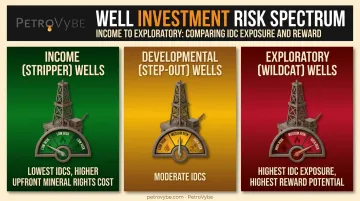
PetroVybe's own Lavaca County portfolio reflects this same split in strategy, even without breaking out an exact well-by-well count. The company runs two parallel plays:
- PROTECT: Optimizing roughly 400 already-acquired producing wells across a 58,000-acre basin for steady legacy cash flow
- SCALE: Drilling 57+ planned new wells identified through production data, grounded in proven geology rather than blind exploration
Well type and strategy explain part of the return equation, but they don't tell you how proceeds actually get divided once the well produces.
Revenue-Sharing Arrangements Worth Reading Closely
How revenue actually splits between GP and LP depends on the specific terms in the partnership agreement:
- Functional allocation: Investors fund IDCs (deductible) while the sponsor funds equipment costs (not deductible)
- Reversionary working interest: The GP shares no upfront costs but starts collecting a revenue share once investors recoup their capital
- Disproportionate sharing: The sponsor pays a lower percentage of costs but takes a higher percentage of revenue
- Overriding royalty interest (ORRI): A non-operating interest that collects a share of production without bearing drilling or operating costs
None of these labels tell you the real economics on their own. Read the payout definition, reversion trigger, and cost-sharing percentages in the partnership agreement before wiring capital.
How Are Oil and Gas Limited Partnerships Taxed?
The tax treatment is the main reason many investors look at oil and gas LPs in the first place, and it centers on two deductions.
Intangible Drilling Costs (IDCs)
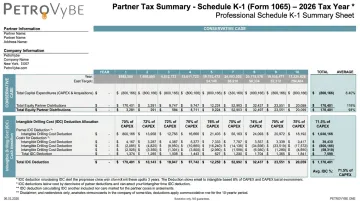
IDCs cover the non-salvageable costs of drilling a well: labor, fuel, drilling mud, and site preparation. Under IRC Section 263(c), investors can elect to expense these costs rather than capitalize them, and on a new-drilling program that election can cover a large share of the total investment in year one.
PetroVybe reports that its 2024 partners received a 94% tax deduction against active income, and 2025 partners received 91% — figures drawn from the company's own K-1 reporting, since deduction percentages vary by project, cost structure, and tax year.
What makes IDCs unusual compared to most alternative investments is where that deduction can be applied. A working interest held directly, or through an entity that doesn't limit the investor's liability, is excluded from the passive activity rules entirely under 26 U.S.C. § 469(c)(3).
In plain terms, the deduction can offset W-2 wages and capital gains, not just passive income from other investments. That's a meaningfully different position than real estate depreciation, which is generally boxed into passive income unless you qualify as a real estate professional.
Depletion Allowance
As a well produces, its reserves decline, and the depletion allowance accounts for that. Independent producers generally use a 15% percentage depletion rate, subject to a daily production cap and an overall limit tied to taxable income from the property. It works alongside IDCs to shelter income in later years, after most of the drilling deduction has already been taken.
K-1 Reporting
Both MLP unit holders and private LP investors receive a Schedule K-1 each year, reporting their share of income, deductions, and credits, including depletion figures under Box 20, Code T. Given how many moving parts are involved (at-risk rules, basis tracking, AMT exposure), working with a CPA who has actual oil and gas experience isn't optional.
Are Oil and Gas Limited Partnerships Still a Good Investment?
Key Risks to Understand
- Commodity price risk: Distributions rise and fall with oil and gas prices, which can swing widely within a single year
- Illiquidity: Private LP units generally can't be sold on a public market; expect multi-year holding periods
- Dry-hole risk: Exploratory wells can come up empty, and that loss isn't hypothetical
- Fraud risk: The SEC has flagged private oil and gas offerings as a recurring fraud category, warning that complaints about these programs rose sharply after 2007, often involving inflated reserve claims or unlicensed salespeople
If a sponsor promises guaranteed returns or pressures you to decide within days, that's a red flag, not an opportunity.
Current Outlook and Demand Drivers
Weighing these risks against the market backdrop matters just as much. Natural gas's role in the grid is shifting, largely because of AI infrastructure. S&P Global Ratings projects that data center growth could add 3-6 Bcf/d of incremental U.S. gas demand by 2030, a forecast rather than a signed contract, but a meaningful demand signal nonetheless.
PetroVybe has built its investment thesis around this shift, positioning its Lavaca County project to supply gas into a grid absorbing new electricity load from data centers. Natural gas already supplies close to half of U.S. electricity generation, and that share isn't shrinking.
None of this removes the underlying risk. What reduces it is diligence: independent reserve engineering, experienced technical leadership, and a sponsor willing to show its numbers rather than just its projections.
How to Choose a Trustworthy Oil and Gas LP Partner
Vetting a sponsor matters more in this asset class than almost any other, because the GP controls drilling decisions, cost reporting, and distribution timing. A few checkpoints separate a credible partner from a risky one.
- Track record: Look for documented production growth and EBITDAX performance, not just marketing claims. PetroVybe's leadership delivered a 5x EBITDAX turnaround and scaled an asset from zero to 35,000 BOEPD in eight years.
- State licensing: In Texas, confirm the operator holds a current Form P-5 with the Railroad Commission of Texas. PetroVybe operates through licensed entity PetroVybe OpCo LLC, with API numbers searchable at rrc.texas.gov.
- Independent reserve valuation: Reserve reports should come from a third-party engineering firm, not the sponsor itself. PetroVybe's Lavaca County reserves carry a $48 million PV-09 valuation from a licensed independent firm.
- Verified investor reviews: Confirm that platforms like Invest Clearly verify reviewers' accredited investor status. PetroVybe holds a 5.0 rating across 8 verified reviews, 100% five-star.
- Technical bench strength: Ask for a documented well-selection success rate. PetroVybe's Chief Geophysicist, Michael Stamatedes, carries a 75.2% hit rate versus an industry average below 40%.
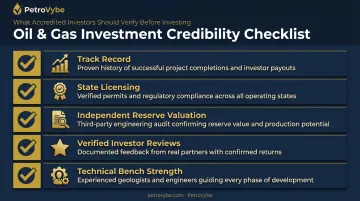
A sponsor who can produce all five of these without hesitation has already cleared a bar most private oil and gas programs never reach.
Frequently Asked Questions
Are oil and gas limited partnerships still a good investment?
Returns depend heavily on the sponsor's track record and current energy demand trends. Rising natural gas demand tied to AI and data center growth is renewing investor interest, but illiquidity and commodity price risk remain real constraints.
How are oil and gas limited partnerships taxed?
Intangible Drilling Costs and depletion allowances are the two primary deductions, and IDCs on a working interest can offset active income like W-2 wages and capital gains. Both MLPs and private LPs issue a Schedule K-1, so consult an experienced tax professional.
What is the difference between an MLP and a private oil and gas limited partnership?
Publicly traded MLPs are exchange-listed, liquid, and open to any investor, while private LPs are illiquid, accredited-investor-only vehicles offering direct working interests and typically larger tax deductions.
What is the minimum investment required for an oil and gas limited partnership?
Public MLP units can be purchased like any stock for the cost of a single share. Private LPs typically require $50,000 to $100,000 or more, along with verified accredited investor status.
Are oil and gas limited partnership distributions guaranteed?
No. Distributions fluctuate with production volumes, commodity prices, and operational performance, and no sponsor can legitimately guarantee them.
Who should consider investing in oil and gas limited partnerships?
The ideal investor is accredited, carries a significant tax burden, has a long investment horizon, and wants diversification plus passive income outside stocks, bonds, and real estate.