
This article is general education, not investment, tax, or legal advice. Selling a business is often the biggest liquidity event of your life. It's also where a huge chunk of what you built can quietly disappear into capital gains tax, Net Investment Income Tax (NIIT), and state levies.
Many owners spend months negotiating the sale price and days thinking about taxes. That's backwards. Asset allocation, entity structure, and deal terms often move your after-tax proceeds more than the headline number does.
This guide walks through federal capital gains rates on a business sale, how the IRS taxes different pieces of the deal, and strategies (including tax-advantaged reinvestment) to help you keep more of what you earned.
Key Takeaways
- The IRS taxes a business sale as separate assets, each under its own rules
- Long-term capital gains rates run 0%-20% federally, plus a possible 3.8% NIIT and state tax on top
- Asset sales and stock sales produce very different tax bills, especially for C corporations
- Installment sales, QSBS exclusions, and reinvestment strategies can reduce or defer your bill
- Planning years before a sale beats scrambling after signing a letter of intent
What Are the Capital Gains Tax Rates on the Sale of a Business?
Here's the part most sellers miss: the IRS doesn't tax a business sale as one lump event. It taxes each asset category separately, based on IRS Topic 409 guidance on capital gains.
Holding period determines the rate:
- Assets held more than one year qualify for long-term rates of 0%, 15%, or 20%, based on taxable income
- Assets held one year or less are taxed as ordinary income, at rates up to 37%
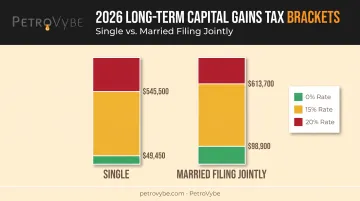
For tax year 2026, the long-term brackets look like this:
| Filing Status | 0% Rate | 15% Rate | 20% Rate Begins |
|---|---|---|---|
| Single | Up to $49,450 | $49,450–$545,500 | Above $545,500 |
| Married Filing Jointly | Up to $98,900 | $98,900–$613,700 | Above $613,700 |
Source: IRS Rev. Proc. 2025-32
The NIIT Layer
High earners face an additional 3.8% Net Investment Income Tax on the lesser of net investment income or the amount their modified adjusted gross income (MAGI) exceeds:
- $200,000 (single/head of household)
- $250,000 (married filing jointly)
- $125,000 (married filing separately)
These thresholds aren't inflation-adjusted, so they catch more sellers every year.
Which Assets Get Favorable Treatment?
Those stacked rates only apply to the portion of the sale that qualifies as capital gain. Not every asset does. Here's the split:
Capital gain treatment:
- Goodwill
- Real property under Section 1231
Ordinary income treatment:
- Inventory
- Accounts receivable
- Depreciation recapture (Section 1245 equipment)
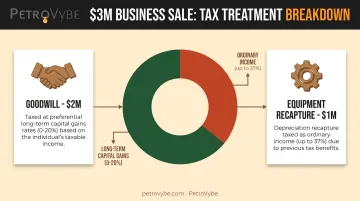
Say you sell for a $3 million gain: roughly $2 million goodwill and $1 million equipment recapture. The goodwill gets long-term capital gains treatment (0–20% federal). The equipment recapture is taxed as ordinary income, potentially at 37%.
That mix matters enormously — and it's negotiated, not fixed.
How Much Capital Gains Tax Will I Pay on a $100,000 Profit From Selling a Business?
There's no single answer here. It depends on your filing status, your total taxable income for the year, and how much of that $100,000 is capital gain versus ordinary income.
A simplified illustration: if the full $100,000 is your only taxable income and it's all long-term capital gain:
- Single filer: $49,450 falls in the 0% bracket, the remaining $50,550 gets taxed at 15% — roughly $7,583 in federal tax
- Married filing jointly: Nearly the entire $100,000 sits in the 0% bracket — roughly $165 in federal tax
That's a dramatic swing based purely on filing status and other income. Now stack on reality:
- Other income (salary, investments) pushes more of that $100,000 into higher brackets
- Depreciation recapture or inventory gain is taxed as ordinary income, regardless of holding period
- Modified adjusted gross income (MAGI) above Net Investment Income Tax (NIIT) thresholds adds another 3.8%
- State tax may apply again, with little or no federal offset under the SALT cap
Don't estimate your tax bill with one flat percentage. Get an asset-by-asset breakdown before you sign anything.
Asset Sale vs. Stock Sale: Why Deal Structure Changes What You Keep
This decision shapes your after-tax outcome more than almost anything else in the deal.
- Asset sale: The buyer purchases individual assets (equipment, inventory, goodwill, real estate) and gets a stepped-up basis in each.
- Stock sale: The buyer purchases ownership shares directly; the business entity itself remains intact.
Purchase Price Allocation Under Section 1060
In an asset sale, IRS Section 1060 requires both parties to allocate the purchase price across specific categories using Form 8594. The allocation determines:
- The buyer's basis in each asset going forward
- Your gain (or loss) and its character, asset by asset
Buyers typically want more allocated to equipment and other depreciable assets (faster write-offs). Sellers typically want more allocated to goodwill (capital gains rate) and less to recapture-heavy equipment. This is a real negotiation, and it happens before the letter of intent is signed — not after.
The C Corporation Double-Tax Problem
If your business is a C corporation, structure matters enormously:
| Structure | What Happens |
|---|---|
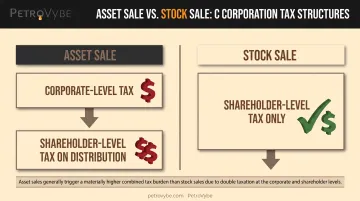
| Asset sale | Corporation pays tax on the gain, then shareholders pay tax again when proceeds are distributed |
| Stock sale | Shareholders generally recognize gain once, at the shareholder level |
That's two layers of tax versus one. On a $5 million sale, this difference can mean hundreds of thousands of dollars in additional tax under an asset sale structure, according to PKF O'Connor Davies' analysis of C corporation sale structures.
Pass-through entities are different. LLCs, partnerships, and S corporations generally don't face this double-taxation issue, since there's no separate entity-level tax to begin with. For these sellers, the asset-vs-stock decision still matters for allocation purposes, but the double-tax trap doesn't apply.
Is There a Capital Gains Tax Exemption for the Sale of Commercial Property?
No blanket exemption exists. Two mechanisms still matter for commercial real estate:
- Section 1231 treatment: Real or depreciable property held more than one year and used in your business gets favorable tax character. Net gains are typically long-term capital gain; net losses are ordinary loss.
- 1031 like-kind exchanges: Defer capital gains tax by reinvesting sale proceeds into another qualifying property within IRS timelines. Since 2018, this applies only to real property held for investment or business use — not equipment, goodwill, or other personal property.
Watch depreciation recapture: On commercial property it is still taxed at ordinary rates, even when the rest of the gain qualifies for capital treatment. A properly structured 1031 exchange can defer recapture as well.
What Is the 6-Year Rule for Capital Gains Tax on the Sale of a Business?
Short answer: There isn't one under U.S. federal tax law.
The "6-year rule" in online searches is an Australian Taxation Office provision. It lets a former primary residence keep its main-residence exemption for up to six years after the owner moves out.
It has nothing to do with selling a U.S. business. If you see the term tied to a U.S. business sale:
- Misapplied Australian housing rule, or mixed up with a state-specific concession
- No comparable federal "6-year rule" for business sale gains
- Confirm any online rule with a qualified U.S. tax advisor before relying on it
Strategies to Reduce or Defer Capital Gains Tax on a Business Sale
Several planning tools can lower or push back capital gains tax when you sell a business. Options range from simple payment structuring to specialized reinvestment strategies.
Installment Sales
Under Section 453, you can spread payments (and the associated gain) across multiple years instead of recognizing everything in the sale year. Benefits include:
- Keeping you in lower tax brackets across multiple years
- Reducing NIIT exposure in any single high-income year
- Spreading out state tax liability Caveat: inventory gain and depreciation recapture are still recognized fully in the sale year, regardless of when you actually receive payment.
QSBS Exclusion (Section 1202)
If your business is a qualifying C corporation and you've held the stock more than five years, you may exclude a significant portion of gain entirely:
- Stock issued after July 4, 2025 may qualify for partial exclusions after 3 years of holding, scaling up to 100% after 5 years
- Per-issuer exclusion caps have increased under recent law changes; confirm current limits with a tax advisor, since IRS guidance is still catching up
Pre-Sale Charitable Giving
Donating appreciated shares to a donor-advised fund before closing can remove that portion from your taxable gain entirely. The catch: it's irrevocable. You don't get the proceeds — the charity does. This only works for the portion you're genuinely willing to give away.
Reinvesting Into Tax-Advantaged Assets
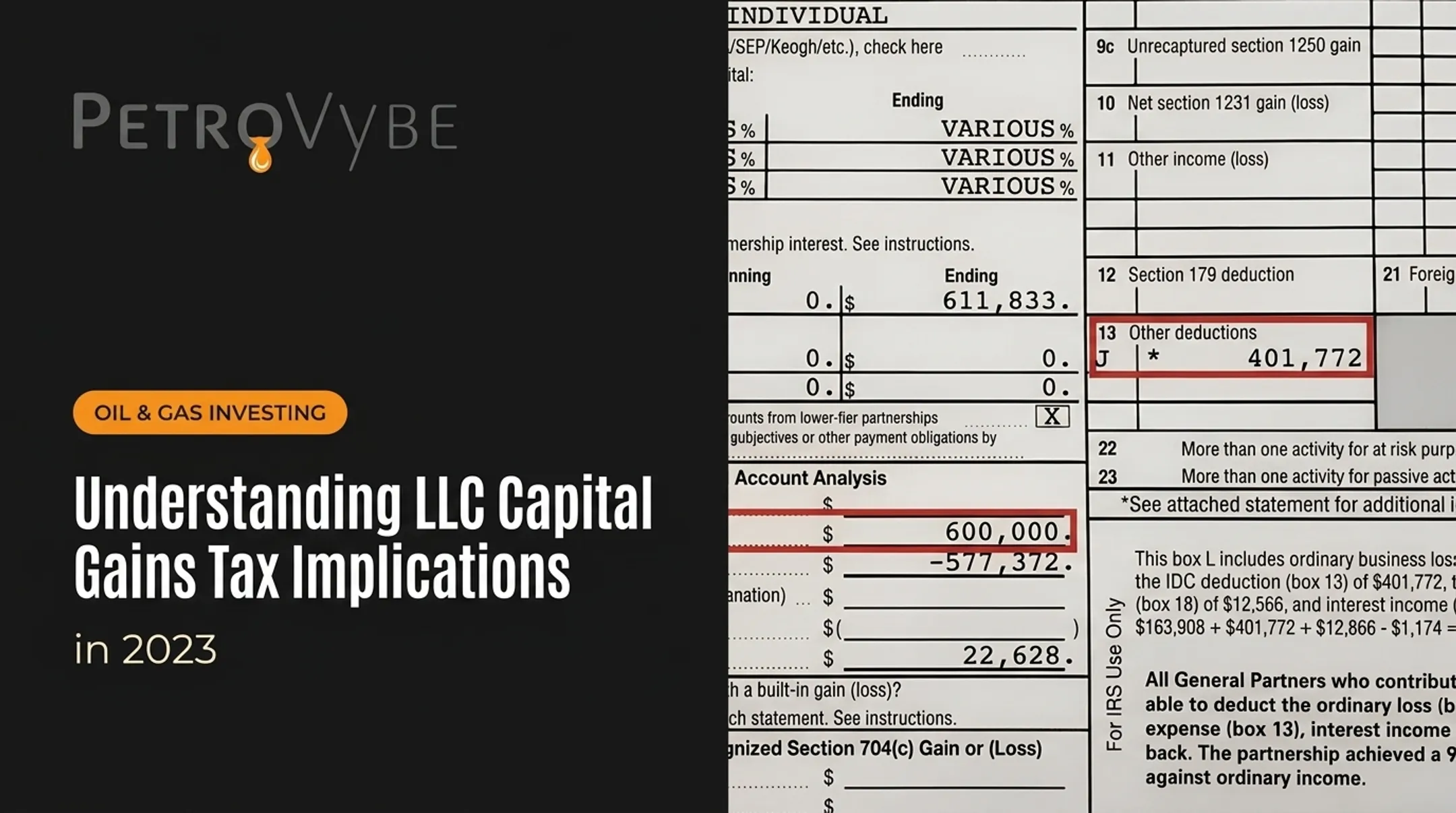
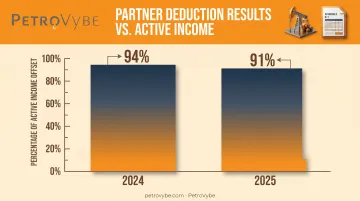
Instead of paying the full tax bill upfront, some sellers redirect a portion of proceeds into investments that generate their own deductions. Direct investments in natural gas development are one path. Companies like PetroVybe structure participation as direct working interests in drilling projects, which generate Intangible Drilling Cost (IDC) deductions. Unlike passive-only write-offs, IDC deductions tied to a working interest are not limited to passive income. They can offset active income, including W-2 earnings and capital gains. PetroVybe reports that partners achieved a 94% deduction against active income in 2025, documented on Schedule K-1. Prior result; not a promise of any future deduction. For a seller with a large capital gains bill, a same-year deduction of that size can change the tax math in a meaningful way. This structure is not automatic. It typically requires:. This treatment requires the investor to elect general partner status in the Subscription Agreement and may be limited in a given year by the excess business loss limitation under IRC §461(l).
- Accredited investor status
- A minimum liquidity commitment
- A clear view of project and commodity risk
Do not leave this decision for the final weeks before closing. It needs professional tax guidance and a real suitability review. It is not the right fit for every seller or risk tolerance.
Frequently Asked Questions
What are the capital gains tax rates on the sale of a business?
Long-term capital gains are taxed federally at 0%, 15%, or 20% by income, plus a possible 3.8% NIIT for higher earners. State tax may apply, and your rate also depends on how sale proceeds are classified by asset type.
How much capital gains tax will I pay on a $100,000 profit from selling a business?
It depends on your income bracket, holding period, and how much of the profit is capital gain versus ordinary income. On a fully long-term gain, federal tax can range from $0 to over $23,000 depending on filing status.
Is there a capital gains tax exemption for the sale of commercial property?
No outright exemption exists. Section 1231 treatment can favorably characterize the gain, and a 1031 exchange can defer tax if you reinvest in qualifying property within IRS timelines.
What is the 6-year rule for capital gains tax on the sale of a business?
There's no U.S. federal "6-year rule" for business sales. That phrase usually refers to an unrelated Australian real estate provision. Confirm any rule you've heard with a qualified U.S. tax professional.
Do I have to pay capital gains tax if I reinvest the proceeds from selling my business?
Reinvesting alone does not wipe out the tax. Tools such as 1031 exchanges, Qualified Opportunity Zone funds, or deduction-generating investments like direct working interests in natural gas development can defer or offset liability.
Should I hire a tax professional before selling my business?
Yes. Most tax-saving strategies, from purchase price allocation to installment sale structuring, require planning before you sign a letter of intent. Waiting until after closing eliminates most of your options.
Informational requests only. PetroVybe projects are offered solely to verified accredited investors. Submitting this form does not create an investment or advisory relationship.