

Introduction
Physicians earn some of the highest W-2 incomes in the country, yet many feel financially stuck. Long shifts, administrative burden, and a tax bill that eats into every raise leave little room to build wealth outside the clinic.
That frustration is pushing more doctors toward side income. Nearly 4 in 10 physicians now report having a side gig, according to Medscape's 2025 report, with three-quarters saying the work feels as fulfilling as practicing medicine.
This guide breaks down 15 proven passive income ideas for physicians, grouped into four categories, plus the tax strategy and decision-making framework that separates a sustainable income stream from a distraction.
Key Takeaways
- Physician passive income ranges from hands-off dividends and REITs to semi-passive real estate and digital products
- Time, capital, and risk tolerance should drive your choice, not just the advertised return
- Alternative investments like natural gas development can offer tax deductions of 90%+ against active income, well beyond typical real estate write-offs
- Diversified income protects against burnout, disability, and reimbursement cuts
- Starting with one or two streams beats spreading capital across five
Why Physicians Are Turning to Passive Income
Active income requires your direct time and labor, think clinical shifts, procedures, and patient visits. Passive income keeps paying you whether you're on call or on vacation. For physicians, that distinction matters more than for most professionals, since time is the scarcest resource in medicine.
A cardiologist working 60-hour weeks doesn't have the bandwidth to flip houses or run a side business that demands daily attention. This is why physicians gravitate toward income that requires heavy lifting upfront and minimal maintenance afterward.
Time constraints aren't the only driver. Burnout adds urgency to the search, with roughly 45% of physicians reporting at least one burnout symptom in the 2023 national survey published by the AMA. Passive income offers something beyond extra cash flow:
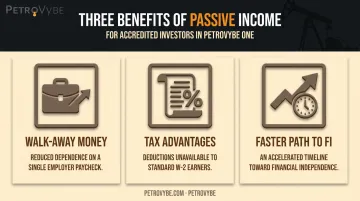
- "Walk-away money" that reduces dependence on a single employer or health system
- Tax advantages unavailable to pure W-2 earners
- A faster runway to financial independence, since diversified income helps high earners reach FI years sooner than salary alone
15 Proven Passive Income Ideas for Physicians
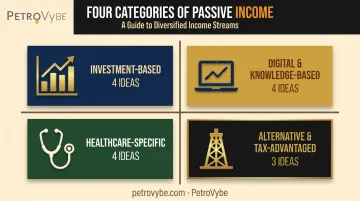
These ideas fall into four buckets based on the capital, effort, and expertise each requires. Pick the category that matches your current bandwidth, not the one with the flashiest headline return.
Investment-Based Passive Income
Real Estate Rentals – Cash-flowing rentals generate monthly income after expenses. Physicians typically screen deals using cash-on-cash return, and 8%-12% is a common industry benchmark range, though Rocket Mortgage notes there's no single "good" number.
Dividend-Paying Stocks – Dividend income arrives whether held in a taxable brokerage account or inside a retirement account, requiring almost no ongoing management once positions are set.
Index Fund Investing – Broad-market funds compound quietly over decades. The S&P 500 has delivered roughly a 10% annualized total return since 1957, though current dividend yields sit closer to 1%.
Bonds & Fixed-Income Instruments – Treasuries and investment-grade corporate bonds currently yield in the 4.5%-5.5% range, offering predictable income with far less volatility than stocks.
Digital & Knowledge-Based Income
Online Courses & Educational Content – Physicians package board-review material, procedural training, or wellness content into courses that sell repeatedly after a one-time build.
Medical Blogging & Affiliate Marketing – Ad revenue and affiliate commissions become low-lift income once an audience exists, though building that audience is the real work.
E-Books & Book Royalties – Amazon's KDP platform pays up to 70% royalties on qualifying titles, turning a single writing project into years of residual income.
Licensing Intellectual Property – A patented device, app, or clinical protocol can generate recurring royalty checks without you managing daily operations.
Healthcare-Specific Passive & Semi-Passive Income
Telemedicine Platform Royalties – Some platforms offer revenue-sharing beyond per-visit pay, especially for physicians who help build protocols or training content used across the platform.
Medical Consulting Retainers – Health-tech and pharma companies pay ongoing advisory fees for predictable access to physician expertise, often for a few hours a month.
Clinical Trial & Research Residuals – Ongoing trial involvement can include structured compensation tied to enrollment milestones and follow-up visits, paid at fair market value.
Expert Witness & Chart Review Work – These leverage knowledge you already have. Expert witness rates average $422/hour for review work and over $500/hour for testimony, per SEAK's fee survey, while chart review runs $85-$200/hour.
Alternative & Tax-Advantaged Investments
Real Estate Syndications & REITs – Pooling capital with other investors removes day-to-day management. Publicly traded REITs have posted an 8.94% annualized return over 30 years, per Nareit data.
Natural Gas & Oil Development Investments – Direct investment in gas development projects offers passive cash flow plus deductions that can offset active income directly, a rare feature since most passive investments limit write-offs to passive gains alone. PetroVybe, a private Texas-based natural gas development partnership, structures this specifically for accredited investors and high-income W-2 earners seeking that combination.
Private Equity & Venture Investing – Silent-partner stakes in businesses or startups offer a higher-risk, higher-reward passive option, typically requiring accredited status and a long hold period.
Tax Considerations & Advantages for Physician Investors
Not all "passive" income is taxed the same way, and this trips up more physicians than any other planning mistake.
Three different tax treatments apply, depending on the source:
- Active clinical income – taxed at ordinary rates, no special deductions
- Portfolio income (dividends, capital gains) – often taxed at preferential 0%, 15%, or 20% rates
- Passive activity income – subject to loss limitation rules under IRC Section 469, often trapping high earners who expect rental losses to offset salary
That last point matters. A physician actively participating in a rental property can deduct at most $25,000 against nonpassive income, and that allowance phases out entirely above $150,000 in modified adjusted gross income. Most physicians earn well past that threshold, meaning rental losses often just carry forward instead of reducing this year's tax bill.
Natural gas and oil development investments work differently. Under Section 469(c)(3), a working interest held without limited liability isn't classified as passive at all. That means Intangible Drilling Cost (IDC) deductions can offset active income, including W-2 wages and capital gains, something ordinary real estate losses generally cannot do.
PetroVybe's own partner results illustrate this in practice. Investors who joined in 2024 and 2025 received deductions ranging from 91% to 94% against active income, verified through an independent audit and third-party engineering review. Industry-wide, IDC deductions typically represent 60-80% of invested capital, so a $100,000 investment might generate a $60,000-$80,000 deduction alone.
Before committing capital to any tax-advantaged vehicle, work with a CPA who understands physician finances specifically. The rules around passive activity losses, at-risk limits, and material participation are unforgiving if applied incorrectly.
How to Choose the Right Passive Income Strategy
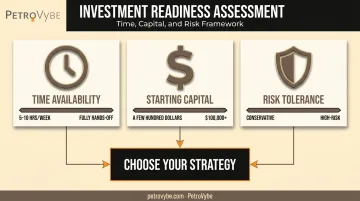
Chasing the highest advertised return is how physicians end up overcommitted to something that doesn't fit their life. Assess three things first:
- Time availability – Can you commit 5-10 hours a week for the next year, or do you need something fully hands-off from day one?
- Starting capital – Index funds require a few hundred dollars. Real estate syndications and natural gas partnerships, such as PetroVybe's accredited-investor program, often start at $100,000.
- Risk tolerance – Bonds and dividend funds carry different risk profiles than private equity or direct energy investment.
Once you've sized up time, capital, and risk, watch for the pitfalls that trip up even careful investors.
Common mistakes to avoid:
- Investing without reviewing offering documents or underlying performance data
- Overdiversifying into five income streams before mastering one
- Ignoring tax implications until filing season
- Underestimating how "semi-passive" most streams feel in year one
Start with one or two income streams. Track performance honestly for at least a year. Scale only what actually proves sustainable, not what sounded good at a conference.
Conclusion
There's no single perfect passive income stream for physicians. The goal is a diversified, tax-efficient portfolio built around your actual schedule, not someone else's success story.
Before committing capital anywhere, weigh scalability, time commitment, and tax efficiency side by side. A high return with a punishing tax bill often nets out worse than a modest return with strong deductions.
For physicians who qualify as accredited investors, one tax-advantaged option worth evaluating is PetroVybe's natural gas development opportunities. A $100,000 minimum investment pairs production income with deductions structured to offset active income directly.
Frequently Asked Questions
How can physicians make $100,000 a year in passive income?
This typically requires combining multiple streams, such as real estate, dividends, and alternative investments like natural gas development. These streams are built over several years with reinvested capital rather than relying on a single source.
Is passive income really "passive" for physicians?
Not initially. Most streams demand significant upfront effort or capital before becoming hands-off, as systems, managers, or partners eventually take over daily involvement.
What is the best passive income idea for busy physicians with little free time?
Fully passive options like dividend index funds, REITs, or partnership-structured investments such as natural gas development require the least ongoing time commitment.
How are physicians taxed on passive income?
Tax treatment varies by source. Dividends and capital gains are typically taxed favorably, while passive activity losses face IRS limitations that hit high earners hardest.
Can physicians use retirement accounts to build passive income?
Yes. Solo 401(k)s and SEP-IRAs can hold dividend and index fund investments, letting that income grow tax-deferred until withdrawal.
How much capital do physicians typically need to start generating passive income?
Entry points vary widely, from a few thousand dollars for index funds to $100,000 or more for real estate syndications or accredited investor opportunities like natural gas development.