In 2024, 918,481 U.S. oil and natural gas wells were in production, according to the Energy Information Administration. The overwhelming majority of those wells started as development wells, drilled after geologists already knew oil or gas was sitting underground.
Here's the problem: a lot of investors and industry newcomers lump development wells in with exploratory or appraisal wells. That mix-up can seriously distort how someone judges risk, timeline, or return potential on an oil and gas project.
This guide breaks down what a development well actually is, walks through how the process works stage by stage, and explains why the distinction matters if you're evaluating any drilling program or investment opportunity.
Key Takeaways
- Development wells are drilled in proven reserves, not speculative territory like exploratory wells
- Historical success rates for development wells have consistently topped 74-90%, far outpacing exploratory wells
- The process runs through site selection, drilling, completion, and ongoing production monitoring
- Upfront costs run higher for development wells, but they carry far less dry-hole risk
- This distinction gives you a clearer benchmark for evaluating risk across any oil and gas project
What Is a Development Well?
A development well is drilled within the proven boundaries of an oil or gas field, targeting a stratigraphic horizon already known to be productive. As Investopedia puts it, these are wells placed in areas already confirmed to hold recoverable hydrocarbons.
That's a different job than exploration. Exploratory and appraisal wells exist to answer a question: is there anything down here worth producing? Development wells answer a different question entirely: how do we get it out? They're the conversion point where confirmed reserves become actual cash flow.
Development Wells vs. Wildcat Wells
An exploratory well, sometimes called a wildcat well, is drilled into unproven territory with no guarantee of what's below. A development well skips that gamble.
The historical numbers make the gap obvious. In 2010, development wells posted a 90.8% success rate (31,515 successful out of 34,699 drilled), compared to just 61.0% for exploratory wells, based on EIA's Total Energy annual data.
Go back further and the gap widens: in 1950, development wells succeeded 79.5% of the time versus only 19.5% for exploratory wells.
Development wells aren't a single-purpose tool, either. Depending on the field's needs, a development well might be used for:
- Flowing production: natural reservoir pressure pushes hydrocarbons to the surface
- Artificial lift production: pumps or gas lift supplement reservoir pressure
- Water or gas injection: maintains reservoir pressure to support recovery
- Monitoring: tracks reservoir performance without primary production
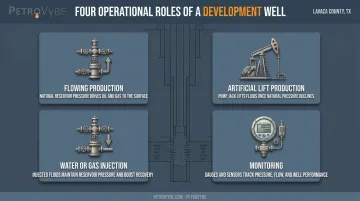
Those operational roles also carry a financial wrinkle worth knowing: under successful-efforts accounting, a dry development well's costs are still capitalized as an asset, while a dry exploratory well's costs get expensed immediately, according to PwC's oil and gas accounting guide.
That difference alone tells you how much less risky regulators and accountants consider development drilling.
How Does a Development Well Work?
Every development well moves through a defined sequence: planning, drilling, completion, and production, with each stage designed to reduce risk and squeeze more recovery out of the ground.
Site Selection & Spacing
Geologists choose well locations using existing reservoir data, seismic mapping, and offset well performance, not guesswork. This stage is entirely data-driven and geology-led, typically anchored by a geophysicist's read on reservoir boundaries and sweet spots.
Poor spacing decisions are one of the most common ways capital gets wasted in this business. Space wells too tight and you cannibalize each other's production; space them too wide and you leave recoverable reserves stranded. Getting spacing right requires combining geomechanics, petrophysics, and reservoir simulation instead of picking a number off a map.
Drilling & Completion
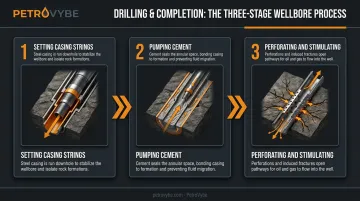
Once the location is locked, crews drill the wellbore to the target formation, then case and complete it. Completion involves perforating the casing, running tubing, and often stimulating the formation through hydraulic fracturing to get hydrocarbons flowing.
Physically, this looks like:
- Setting casing strings to the target depth
- Pumping cement to isolate productive zones from water-bearing or corrosive zones
- Perforating and stimulating the formation to open flow paths
Texas regulations under Statewide Rule 13 require cement isolation across productive zones and mandate pressure-testing casing before drillout, a safeguard against leaks and contamination. Development wells also tend to run larger diameter casing and more complex completions than exploratory wells, since they're built for sustained, high-volume production rather than a single test.
Production Monitoring & Control
Once flowing, a development well needs ongoing attention. Operators track pressure, watch for water breakthrough, and adjust artificial lift (sucker-rod pumps, ESPs, or gas lift) as reservoir energy naturally declines.
Skip this monitoring and wells can decline faster than expected or develop mechanical problems that erode recovery. Continuous surveillance using downhole gauges and production data separates a well that keeps compounding cash flow from one that underperforms.
Output & Production Result
The end result is a steady stream of oil, natural gas, or natural gas liquids feeding into gathering systems, pipelines, and processing infrastructure. Operators measure performance in BOEPD (barrels of oil equivalent per day), a metric that rolls oil and gas output into one comparable number using the standard conversion of 6,000 cubic feet of gas per barrel.
That BOEPD figure, tracked across an entire field, ultimately drives project economics, and it's the number investors should watch closely.
Development Well vs. Appraisal Well vs. Exploratory Well
Each well type answers a different question at a different stage of a field's life:
| Factor | Exploratory Well | Appraisal Well | Development Well |
|---|---|---|---|
| Purpose | Find or extend a reservoir | Size and test commerciality of a discovery | Produce from a proved target |
| Stage | Exploration | Discovery-to-development decision | Production buildout |
| 2010 Success Rate | 61.0% | Not separately reported | 90.8% |
| 2010 Avg. Depth | 7,671 ft | Not separately reported | 7,143 ft |
Exploratory wells actually averaged 528 feet deeper than development wells in 2010, so the assumption that development wells are always the deepest doesn't hold up. Development wells still hold one clear edge: they're dramatically less likely to come up dry.
These three well types also map onto the broader oil and gas lifecycle: exploration, appraisal, development, production, and eventually abandonment. Development marks the point where a field stops being a geological question and starts being a production business.
Where Development Wells Fit in an Oil & Gas Investment
For operators and investors alike, development wells are the primary engine for compounding production and cash flow across a field that's already proven out. This is where PetroVybe operates, developing natural gas and NGL assets across a 58,000-acre basin in Lavaca County, Texas, part of the broader South Texas and Gulf Coast Basin region.
That approach leans heavily on rigorous site selection. PetroVybe's Chief Geophysicist, Michael Stamatedes, brings a 48-year track record and a 75.2% career success rate on well location selection — nearly double the industry peer average, which sits below 40%. That kind of hit rate matters because location selection feeds directly into decline curve projections and, ultimately, project profitability.
PetroVybe's current portfolio reflects that approach:
- ~400 acquired producing wells plus 57+ planned new development wells
- A $48 million proved reserves valuation (PV-09), certified by an independent third-party engineering firm
- A clean 2025 audit from Weaver, an independent auditing firm
The company also passes along a specific tax advantage tied directly to new development drilling: Intangible Drilling Costs (IDCs). These deductions (covering survey work, drilling services, and completion costs) typically run 60-80% of invested capital.
That capital can be applied against active income like W-2 wages or capital gains, not just passive income. Partners who joined in 2024 received a 94% deduction against active income; that figure was 91% in 2025.
Participation requires $100,000 minimum investment and verified accredited investor status.
Conclusion
A development well is where proven reserves stop being a number on a report and start becoming actual production. That distinction, moving away from the riskier, unproven world of exploratory and appraisal wells, is exactly what separates a lower-risk drilling program from a speculative one.
Whether you're evaluating a drilling program operationally or weighing a passive stake in a development-stage project like the ones PetroVybe develops across South Texas, understanding this difference is the first real step toward judging risk correctly.
Frequently Asked Questions
What is a development well?
A development well is drilled within a proven oil or gas field to extract reserves already confirmed to exist. It's distinct from exploratory wells, which search for reserves in unproven territory.
What does developing a well involve?
The process runs through site selection using existing reservoir data, drilling and casing the wellbore, completion (including stimulation like hydraulic fracturing), and ongoing production monitoring to sustain output.
What is the difference between an appraisal well and a development well?
Appraisal wells measure the size and commercial viability of a discovery after exploration. Development wells come after that decision, extracting from reserves already confirmed as producible.
How successful are development wells compared to exploratory wells?
In 2010, development wells succeeded 90.8% of the time versus 61.0% for exploratory wells, according to the U.S. Energy Information Administration (EIA). That gap has held for decades because development locations rely on established geology rather than speculation.
Are development wells more expensive than exploratory wells?
Development wells are typically larger in diameter and built for sustained production, making them more capital-intensive upfront. However, their dramatically lower dry-hole risk usually offsets that added cost.
Can accredited investors participate in development well projects?
Yes. Companies like PetroVybe offer accredited investors direct access to development-stage natural gas projects, including Intangible Drilling Cost tax advantages applied against active income.