Whether you're negotiating a book contract, a patent license, or an oil and gas mineral lease, getting the royalty rate wrong is expensive. Misjudge it and you either leave money on the table as a licensor or overpay for rights as a licensee.
This guide breaks down what royalty rates mean, how they're calculated, what's typical across major industries, and what oil and gas investors specifically need to understand before committing capital.
Key Takeaways
- Royalty rates are typically a percentage of revenue or a flat per-unit fee, and rates vary widely by industry.
- Asset value, exclusivity, leverage, and market comparables set the rate, not a universal formula.
- Oil and gas royalties tie to mineral rights, not intellectual property, unlike IP royalties.
- Knowing how royalty structures work helps you judge whether a deal reflects fair market value.
What Are Royalty Rates?
A royalty rate is the percentage or fixed amount a licensee (or lessee) pays a licensor (or mineral owner) for the ongoing right to use an asset. That asset might be a patent, a trademark, a manuscript, or the minerals beneath a piece of land.
Two parties make every royalty deal work:
- The licensor — owns the asset and grants permission to use it
- The licensee — pays for that permission, typically tied to actual usage or sales
The World Intellectual Property Organization frames this well: a royalty always has two parts, a rate and a base. The base could be gross sales, net sales, units produced, or profit. Quote a percentage without naming its base, and you haven't said much at all.
Here's the part people often miss: royalty rates are mostly negotiated contract terms, benchmarked against market data. They are not fixed legal numbers, with a few exceptions. Federal mineral leases set regulatory floors. Certain music royalties fall under statutory rates set by Copyright Royalty Judges. Outside those specific cases, the rate on your contract came from negotiation, not law.
Types of Royalty Rates by Asset Class
Royalty structures diverge sharply depending on what's being licensed:
- IP and patent royalties — tied to technology use, often based on net sales
- Trademark and franchise royalties — recurring fees, almost always on gross sales
- Book and copyright royalties — based on retail price or publisher net receipts, depending on format
- Natural resource royalties — percentage of gross production value from oil, gas, or minerals
The payment basis matters as much as the percentage itself. A 5% royalty on gross sales pays very differently than a 5% royalty on net profit after deductions.
Factors That Influence Royalty Rates in Real-World Deals
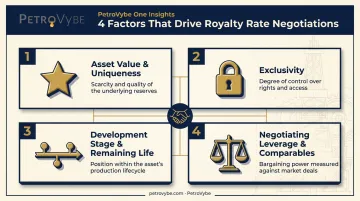
Four variables drive most negotiations:
- Asset value and uniqueness — a breakthrough patent commands more than an incremental improvement
- Exclusivity — worldwide exclusive rights cost more than limited, non-exclusive access
- Development stage and remaining useful life — an early-stage drug candidate prices differently than a launched product
- Negotiating leverage and comparables — availability of similar arm's-length deals shapes the final number
The spread is real. The Licensing Executives Society's 2021 High Tech Sector Royalty Rates survey found an overall mean of 4.82%, but that number hides massive variation: patent-only licenses averaged just 3.77%, while aerospace technology deals averaged 10.7%. Averages without context mislead more than they inform.
Range of Royalty Rates Across Industries
There's no such thing as a single "typical" royalty rate. What you'll find instead is a spectrum, shaped by industry norms, deal specifics, and how much risk each party is absorbing.
Common Industry Benchmarks
Book publishing royalties climb with format and sales volume:
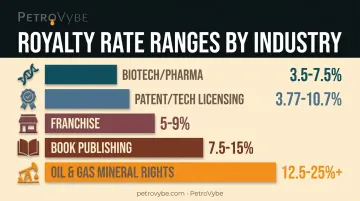
- Hardcover: roughly 10% of retail price for the first tier, rising to 15% after 10,000 copies
- Paperback: typically 7.5-8% of retail
- Ebooks: 25% of publisher net receipts under traditional contracts (Amazon KDP uses a different formula entirely: 35% or 70% of list price)
Patent and technology licensing rates cluster around a 4.75-4.82% median, per the LES survey cited above, but sector matters enormously: multi-IP bundled licenses averaged 6.28%.
Franchise royalties run more predictably. The International Franchise Association reports an average range of 5-9% of gross sales, and Subway's 2023 disclosure document sets its royalty at exactly 8% of gross sales, plus a separate 4.5% advertising fee.
Biotech and pharma royalties depend heavily on development stage. Preclinical deals carry a median of 3.5%, while launched products with proven markets command a median of 7.5%, often layered with upfront and milestone payments worth millions.
Oil, Gas, and Mineral Royalty Ranges
Private mineral owner royalties in the U.S. commonly fall between 12.5% and 25%+ of gross production value, based on regional negotiating norms across Texas and Oklahoma. Federal onshore leases set a regulatory floor: current rules under 43 CFR 3103 require not less than 12.5%, a figure that replaced a previous 16.67% minimum.
A few structural quirks worth knowing:
- Some leases use sliding-scale royalties that increase as production volumes or development costs are recovered
- Texas state leases can't legally dip below one-eighth (12.5%) for covered state lands
- A passive mineral royalty rate reflects revenue share only; it says nothing about the return potential available through direct participation in the development itself
That last point matters more than most royalty owners realize, and we'll come back to it.
Why Ranges Vary So Widely
Never compare royalty percentages across industries without asking what revenue base sits underneath them. A 5% franchise royalty on gross sales and a 5% biotech royalty on net sales after deductions can produce wildly different actual dollars. The percentage is only half the story — the base and the risk profile behind it are the other half.
How Royalty Rates Are Calculated & Validated
Every royalty rate is both a negotiated contract term and a figure that should hold up against market benchmarking. Here's how that actually happens.
Percentage of Revenue vs. Fixed Fee
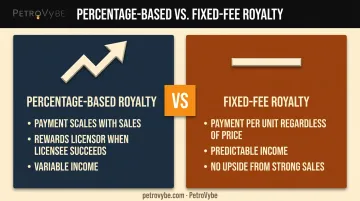
Percentage-of-sales example: A licensee sells $2 million worth of licensed product in a year at a 5% royalty rate. The licensor receives $100,000. Payment scales directly with performance.
Fixed-fee example: A licensee agrees to pay $0.50 per unit sold, regardless of the unit's sale price. Sell 200,000 units, and the licensor receives $100,000 — same result, different mechanism.
The trade-off is straightforward:
- Percentage-based rates align payment with actual performance, rewarding the licensor when the licensee succeeds
- Fixed fees provide payment certainty regardless of how well the product sells
Formal Valuation Approaches
Three methods dominate professional royalty valuation:
| Approach | How it works | Main limitation |
|---|---|---|
| Cost | Recoups the licensor's development expenditure | Doesn't capture actual earning power |
| Market | Benchmarks against comparable arm's-length agreements | True comparables can be hard to find |
| Income | Allocates a negotiated share of projected licensee profit | Requires forecasts and assumptions |
The income approach is the one you'll hear cited most, often alongside the so-called "25% rule of thumb" (the idea that a licensor deserves roughly 25% of the licensee's expected operating profit).
This heuristic has real limits. The Federal Circuit called it "fundamentally flawed" in Uniloc USA, Inc. v. Microsoft Corp. (2011), ruling that it couldn't stand alone as evidence in patent damages cases. Treat it as a historical reference point, not a formula.
Documentation and Verification
Royalty rates get formalized in the license, lease, or contract document itself, specifying:
- Payment basis and reporting frequency
- Deductions allowed against gross revenue
- Audit rights for the licensor or mineral owner
Licensors and mineral owners typically receive periodic statements and retain the right to audit reported production or sales figures. This is standard practice, not an adversarial red flag.
Oil & Gas Royalty Rates: What Investors Should Know
Oil and gas royalties work differently from IP royalties in one critical way: they're tied to mineral rights ownership, not intellectual property. An operator pays a mineral rights owner a percentage of gross production revenue for the right to extract oil or gas from beneath their land.
That's a royalty interest: a passive share of revenue with zero cost exposure. The royalty owner doesn't pay for drilling, doesn't pay for equipment, and doesn't share in operating losses. It's simple, but it's also limited.
A working interest, or direct development participation, works differently. It's an active stake in exploration and production economics, meaning both the upside of a productive well and the cost exposure of dry holes, operating expenses, and development capital.
This is where the distinction becomes practical rather than academic. A royalty check reflects value that's already been created. Development participation puts you at the point where that value gets created in the first place: before the well is drilled, before production is proven, and before the market has priced it in.
PetroVybe's model is built around that second position. Rather than offering accredited investors a passive royalty interest alone, PetroVybe structures its PetroVybe ONE project as direct development participation in South Texas and Gulf Coast Basin natural gas assets, concentrated in Lavaca County, Texas. Investors hold a stake in drilling, completion, and scaling decisions, not just a revenue stream from wells someone else already developed.
Three things separate this from buying a royalty check off the open market:
- Tax treatment. Intangible Drilling Costs (IDCs) make up 60-80% of invested capital and apply against active income, including W-2 earnings and capital gains, unlike passive royalty income. PetroVybe partners saw a 94% tax deduction in 2024 and 91% in 2025.
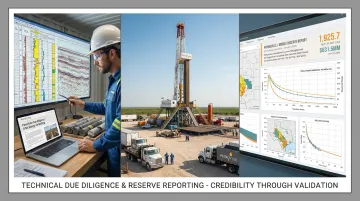
- Technical validation. Chief Geophysicist Michael Stamatedes has a documented 75.2% well success rate across a 48-year career, nearly double the sub-40% industry average, feeding directly into decline curve projections and return forecasts.
- Third-party validation. PetroVybe's proved reserves carry a $48 million PV-10 valuation from a licensed third-party engineering firm, independent confirmation that matters when evaluating a development-stage opportunity versus an already-priced royalty purchase.
Common Misinterpretations of Royalty Rates
A few mistakes show up again and again, across every asset class:
- Treating a published "typical" rate as a guarantee. A 5-9% franchise benchmark is a starting point for negotiation, not a fixed law.
- Ignoring the revenue base. A royalty on gross sales pays very differently than the same percentage on net profit after deductions.
- Assuming higher always means better. A higher rate paired with limited exclusivity or heavy upfront costs can net less than a lower rate with better terms.
- Confusing a royalty interest with equity or a working interest. This is oil and gas's costliest mix-up: expecting development-style returns from what is actually a passive position.
Royalty rates should always be evaluated within the full context of the deal — the base, the exclusivity, the risk-sharing, and what else is on the table. Never in isolation.
Frequently Asked Questions
What is a typical royalty rate?
There's no single typical rate. IP and technology royalties often run from low single digits to the mid-teens, while franchises average 5-9% of gross sales. Oil and gas mineral royalties commonly range from 12.5% to 25%+ of production value.
How are royalty rates calculated?
Licensors and licensees calculate royalty rates using either a percentage of revenue, which aligns pay with performance, or a fixed fee per unit, which provides payment certainty. A license or lease agreement formalizes both methods, specifying the exact payment basis.
What do royalty rates mean?
A royalty rate is the agreed compensation an asset owner receives when another party uses their intellectual property, brand, or natural resource, typically expressed as a percentage of revenue or a fixed per-unit fee.
What's the difference between a royalty interest and a working interest in oil and gas?
A royalty interest is a passive share of production revenue with no cost exposure. A working interest is active participation in development, carrying both profit upside and exposure to drilling and operating costs.
Can royalty rates be negotiated?
Yes, almost always. Asset value, exclusivity, and market comparables shape most rates; law rarely fixes them, except in specific cases like federal mineral leases or statutory copyright licenses.
How is royalty income taxed compared to development participation?
Royalty income generally counts as ordinary income for tax purposes, with standard depletion allowances available. Direct development participation can offer different tax treatment, including Intangible Drilling Cost deductions applied against active income.