

Introduction
A Net Royalty Acre (NRA) standardizes your mineral royalty interest into one comparable number, so an owner earning a 25% royalty and one earning 12.5% can be measured on the same scale. If you own mineral rights, buy royalty interests, or invest in oil and gas, you need this figure before signing anything.
Here's the catch: NRA is not a legal term of art. It has no fixed statutory definition, and different buyers calculate it differently. That ambiguity has landed in court, which is exactly why a clear, consistent calculation matters before you sign anything.
This guide is written for mineral and royalty owners, buyers, and oil and gas investors who need to value or compare royalty interests across different lease terms. We'll cover the definition, the exact formula, worked examples, common mistakes, and how NRA ownership compares to direct working interest investment.
Key Takeaways
- NRA standardizes royalty interests for fair comparisons across lease rates
- Core formula: NRA = Net Mineral Acres x (Lease Royalty Rate / 0.125)
- Higher royalty rates produce more NRA and a higher valuation, even with identical acreage
- No universal legal definition exists, so define NRA explicitly in agreements
- Royalty and working interest ownership differ greatly in risk, control, and tax outcomes
What Is a Net Royalty Acre? (NMA vs. NRA Explained)
Before calculating anything, separate two terms that get confused constantly.
Net Mineral Acre (NMA) is your actual underground ownership tied to surface acreage:
NMA = Gross Acres x Mineral Interest %
A 25% mineral interest in 100 acres equals 25 NMA. This number stays fixed unless you sell or inherit additional interest.
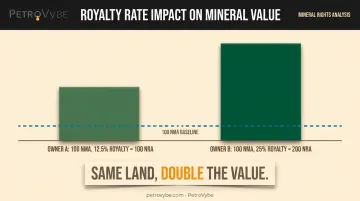
Net Royalty Acre (NRA) is different. It's a standardized unit historically benchmarked against a 1/8th (12.5%) royalty rate, used to compare income potential across leases carrying different royalty rates. Two owners can hold identical NMA and still have very different NRA, purely because their lease terms differ.
Here's a quick comparison:
| Owner | NMA | Lease Royalty | Normalized NRA |
|---|---|---|---|
| Owner A | 100 | 12.5% | 100 |
| Owner B | 100 | 25% | 200 |
Same land, same mineral ownership, double the NRA for Owner B. That gap directly affects purchase offers and valuation.
Why This Gets Contested in Court
Because NRA isn't a term of art, courts have had to interpret it when purchase agreements left it ambiguous. In Foundation Minerals, LLC v. Montgomery, a New Mexico mineral purchase agreement defined NRA using the 1/8th convention. Disputes still arose over title, tender, and how unleased interests factored into the calculation, and the appellate court affirmed in part, reversed in part, and remanded the case.
Even a clearly defined term generates litigation when related concepts, like unleased minerals, aren't addressed with equal precision. Get every definition confirmed in writing, including how unleased acreage factors into your calculation, before you sign.
The industry is also split between the "normalized to 1/8th" convention and a full-lease-royalty method that treats one NRA as the entire lease royalty attributable to one acre. Ask any buyer which convention they're using before you accept a number.
How to Calculate Net Royalty Acres: Step-by-Step
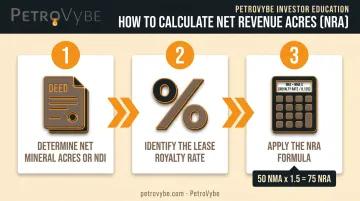
You need three inputs: your Net Mineral Acres (or Net Decimal Interest), the unit or tract size, and the lease royalty rate.
Step 1: Determine Your Net Mineral Acres or Net Decimal Interest (NDI)
Pull your NMA from title or deed records. If you're working from a royalty statement instead, your Net Decimal Interest (NDI) will already be listed as a small decimal figure, typically something like 0.015625.
If your records are incomplete:
- Contact the well operator for a copy of your division order
- Reach out to the state regulatory agency (in Texas, that's the Railroad Commission)
- Request a title opinion if you're preparing for a sale
Step 2: Identify the Lease Royalty Rate
Royalty rates typically fall between 12.5% and 25%, though the number you're working with should come from your actual lease document or division order, not an assumption.
Older leases across Texas and Oklahoma often locked in the historic 1/8th (12.5%) rate, while more recently negotiated leases commonly run higher.
If you can't locate your rate, 12.5% is the standard industry default for a rough estimate — confirm it before finalizing any transaction.
Step 3: Apply the Net Royalty Acre Formula
The standard formula, per NARO's normalized convention, is:
NRA = NMA x (Lease Royalty Rate / 0.125)
Worked example: You own 50 NMA under a lease with an 18.75% royalty rate.
NRA = 50 x (0.1875 / 0.125) = 50 x 1.5 = 75 NRA
If you're working from a royalty statement instead of title documents, use the alternative formula:
NRA = (NDI x Unit Size) / Lease Royalty Rate
Example: Your NDI is 0.0125, the unit size is 640 acres, and the royalty rate is 20%.
NRA = (0.0125 x 640) / 0.20 = 8 / 0.20 = 40 NRA
Why two buyers can quote different numbers for the same interest: the "old" 1/8th-normalized method scales everything against a 12.5% benchmark, while the "modern" full-lease-royalty method treats one NRA as the complete royalty attributable to one acre, with no normalization at all.
Run the same 100 NMA at a 25% royalty through both methods, and you'll get 200 NRA under one convention and a very different figure under the other. Neither is wrong. They're just different rulers.
One caveat worth repeating: only a full title examination confirms true ownership figures. Treat every estimate from division orders or rough records as directional, not final, until title is verified.
Why Net Royalty Acres Matter
Buyers typically price purchase offers in dollars-per-NRA. A 2024 Hart Energy market report cited a $10,000 to $20,000 per NRA range in a Permian Basin transaction snapshot. If you don't know your own NRA, you have no way to judge whether an offer sitting in that range, or well below it, is actually fair.
This matters because NMA and NRA measure fundamentally different things:
| Term | What It Measures |
|---|---|
| NMA | Land ownership: the fraction of underground minerals you hold |
| NRA | Income potential: what buyers and lenders use to price a deal |
An owner who quotes NMA when a buyer is pricing based on NRA is negotiating with the wrong number. Failing to account for the difference in royalty rates between leases can mean unknowingly accepting an offer well under market value, especially if your lease carries a rate above the old 12.5% benchmark.
Common Mistakes and Misconceptions
A few errors show up repeatedly among owners calculating NRA for the first time.
- Assuming NMA and NRA are always equal. They match only when the lease royalty rate is exactly 1/8th (12.5%); any other rate creates a divergence.
- Confusing unleased mineral interests (UMIs) and nonparticipating royalty interests (NPRIs) with standard NRA. Neither has an active lease rate to plug into the formula, so buyers often assume 25% as a negotiated rate, not a legal default.
- Relying on the outdated 12.5% assumption. Modern leases often run 18.75% to 25%, so using the old benchmark can undervalue the interest.
- Treating NRA as legally settled. It isn't—no fixed definition exists, so every purchase or sale agreement should specify exactly how NRA is calculated to avoid future disputes.
Net Royalty Acres vs. Direct Working Interest: Two Different Paths to Oil & Gas Wealth
Royalty ownership, measured in NRA, is a passive share of revenue. You don't pay for drilling costs, you don't control operations, and you don't get upfront tax deductions tied to development expenses. It's simplicity in exchange for limited upside.
Direct working interest ownership works differently. Investors participate directly in development economics and gain access to substantial tax advantages, including intangible drilling cost (IDC) deductions, that royalty owners simply cannot claim.
| Factor | Royalty / NRA Ownership | Direct Working Interest |
|---|---|---|
| Cost participation | None | Bears proportionate development and operating costs |
| Operational control | None | Participates in development decisions |
| Tax treatment | Reported on Schedule E, no IDC eligibility | IDC deductions available against active income |
| Income style | Passive, tied to production only | Active participation in project economics |
This distinction matters because royalty ownership suits owners who inherited or long-held minerals and want simplicity above all. Accredited investors seeking tax-efficient growth and greater upside typically look toward direct participation instead.
PetroVybe structures its natural gas development projects in South Texas and the Gulf Coast Basin around this exact difference. Partners hold a direct position at the entry point where value gets created, not a passive royalty stream on production someone else already developed.
In 2024, PetroVybe partners achieved a **94% tax deduction against active income**, including W-2 earnings and capital gains, through IDC deductions tied to their working interest structure, something a standard royalty or NRA position cannot offer. Investors receive K-1 partnership reporting rather than 1099 royalty statements, reflecting the structural difference between the two models.

If passive royalty income alone isn't meeting your wealth-building goals, compare direct working interest positions against royalty acres on MOIC and IRR potential before deciding where to allocate capital.
Frequently Asked Questions
How do I calculate a net royalty acre?
Multiply your Net Mineral Acres by the lease royalty rate divided by the standard 1/8th (0.125) rate. See the step-by-step formula section above for worked examples.
What is the difference between net and gross royalties?
Gross royalty is the full royalty share the lease states, before applying any fractional ownership. NRA reflects net royalty, which accounts for your actual fractional mineral interest.
What is the difference between net mineral acres and net royalty acres?
NMA measures your physical land ownership. NRA measures standardized income potential based on your lease's royalty rate.
What is a net decimal interest (NDI)?
NDI is the small decimal figure on your royalty statement showing your exact share of a well's production. It's a common starting point for NRA calculations when title records aren't handy.
Do unleased minerals have net royalty acres?
Appraisers typically value unleased minerals using an assumed market-standard royalty rate, often 25%, since no actual lease rate exists yet. This is a negotiated assumption, not a fixed rule.
Can I estimate my net royalty acres without knowing my exact royalty rate?
Yes, use the industry-standard 12.5% assumption for a rough estimate. Verify your true lease rate before finalizing any sale or valuation.