

This scenario plays out across Texas constantly. Mineral and royalty interests get inherited alongside houses, trucks, and bank accounts, but they don't work like ordinary property. Texas law treats mineral rights as a separate real property estate, distinct from the surface, which means inheriting them triggers its own legal and administrative process most families have never dealt with.
This guide walks through what heirs actually own, how the transfer process works, what the interest might be worth, the tax rules that apply, and how to decide whether to keep, lease, or sell.
Key Takeaways
- Texas mineral rights are real property, transferred via probate, small estate affidavit, or affidavit of heirship.
- Operators suspend royalty payments at death until heirship documentation is filed and approved.
- Value depends on production status, basin location, and commodity prices, not a fixed acreage rate.
- Heirs receive a stepped-up tax basis at death, plus a possible depletion deduction on royalty income.
Understanding What You Actually Inherited
Texas recognizes a legal concept called the severed estate. Mineral ownership underground can be completely split from surface ownership above it. A family might have sold their farmland three generations ago while a great-grandparent reserved the mineral rights in the deed. That reservation can still carry weight today.
According to research from Texas A&M AgriLife, the mineral estate remains dominant whether it's held together with the surface or severed from it. Severance can date back decades before anyone in the current generation was born. Tracing mineral ownership means reading the actual deeds, reservations, and lease history, not relying on family stories about "the old place."
The exact type of interest you hold determines what you're entitled to and how much control you have.
Types of Mineral Interests Heirs May Hold
- **Full mineral estate with executive rights**: the right to negotiate and sign leases, plus receive bonus payments and royalties.
- Royalty interest or non-participating royalty interest (NPRI): pays income but carries no leasing authority.
- Fractional undivided interest: shared with siblings, cousins, or other heirs, common when a mineral estate passes to multiple descendants.
- Overriding royalty interest (ORRI): carved out of an existing lease, tied to that lease's life span rather than the underlying minerals.

Confusing these categories is one of the most common mistakes heirs make. An NPRI owner, for instance, can't sign a new lease even if the current one expires. Read the creating instrument before assuming you have leasing power.
How Mineral Rights Pass Down Under Texas Law
If your relative left a will, mineral rights pass according to its terms, just like any other asset. Without a will, Texas intestate succession rules under Texas Estates Code Chapter 201 dictate exactly which relatives inherit and in what shares.
The formulas differ depending on whether the property was separate or community, and family complexity can shift the math:
- Half-blood siblings inherit half the share of a whole-blood sibling of the same degree.
- Adopted children inherit as full children of the adoptive parent, while also retaining certain rights from natural parents.
- Multiple marriages can split ownership between a surviving spouse and children from a prior relationship.
These default rules apply automatically, even if the family never intended that outcome.
Here's the part that surprises most heirs: an operator will not resume royalty payments without documentation proving the chain of ownership. This holds true no matter how straightforward the family situation seems. That's why probate — or a legally sufficient alternative — matters even for a "simple" estate with no disputes.
How to Transfer Inherited Mineral Rights in Texas: Step-by-Step
Before filing anything, gather the paperwork that establishes what was owned and where:
- Certified death certificate
- Original will, if one exists
- Existing mineral deeds and lease agreements
- Recent royalty statements or check stubs
These documents anchor everything that follows.
Choose the Right Probate Pathway
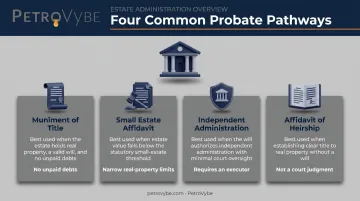
Texas offers several routes, and the correct one depends on the estate's facts:
- Muniment of title: for a valid will with no unpaid debts other than those secured by real estate.
- Small estate affidavit: for smaller intestate estates, though this option has narrow real-property limitations and generally doesn't cover severed mineral interests outside a homestead.
- Independent administration: the standard route for typical estates requiring an executor to collect and distribute assets.
- Affidavit of heirship: nonjudicial evidence of heirship, useful when no probate was ever opened, though it's not a court judgment.
Dollar thresholds and requirements change periodically, so confirm current numbers with a probate attorney before choosing a path.
Record Your Documents, Then Notify the Operator
Texas has 254 counties, each with an independent recording system. If your family's minerals span three counties, you'll research and record ownership documents separately in each one. Skipping a county leaves a gap in the public record that will surface later.
Once recorded, submit your documentation to the operator's division order department. This releases funds held "in suspense" and redirects future royalty payments. Processing times vary by operator and how complete your paperwork is, so double-check every document before submitting to avoid restarting the review.
Common Title Issues That Delay Heir Transfers
Even a clean filing doesn't guarantee a smooth transfer. Three problems show up again and again:
- Unprobated ancestor estates: a break in the chain of title from a prior generation nobody ever formally closed out.
- Ambiguous legal descriptions: decades-old deeds referencing landmarks, fence lines, or markers that no longer exist.
- Fractional share disputes: multiple heirs disagreeing over percentages or next steps, which can stall an otherwise clean transfer for months.
What Are Inherited Mineral Rights Worth in Texas?
There's no single published rate per acre for Texas minerals, no matter what a cold-call buyer tells you. Value hinges on:
- Whether the interest is currently producing
- Location relative to active basins like the Eagle Ford, Permian, or Gulf Coast
- Current oil and natural gas prices
- Where the well sits on its production decline curve
A nonproducing interest near active permitting can carry real value even with zero current cash flow. A producing interest late in its decline curve might be worth less than the family assumes.
Get a professional appraisal or test offers from multiple buyers before accepting anything. First offers usually come from buyers who've already reviewed the title and production data — that number is rarely their best one.
There's also a tax angle here.
Tax tip: Establishing value as of the date of inheritance, often through a retrospective appraisal, is separate from negotiating a future sale price. Getting that starting number right materially affects your tax bill down the road.
Tax Implications Heirs Should Understand
Inherited mineral rights come with a genuine tax advantage: the stepped-up basis rule. Under IRS Publication 559, inherited property is generally valued at fair market value on the date of death. That new basis can reduce capital gains tax if you later sell, since gain is measured against the stepped-up value, not what your relative originally paid decades ago.
That covers the sale side. Ongoing royalty income carries its own tax considerations:
- Ongoing royalty income is subject to federal income tax (Texas has no state income tax), but it may qualify for a percentage or cost depletion deduction that offsets taxable royalty income.
- Depletion percentages and eligibility rules are specific to the type of interest, so don't assume every dollar of royalty income gets the same treatment.
- The holding period and basis determination affect whether sale proceeds land as capital gains or something else entirely.
Talk to a CPA familiar with oil and gas assets before you sell anything. This isn't a generic real estate transaction, and the tax rules reflect that.
Should You Keep, Lease, or Sell Inherited Mineral Rights?
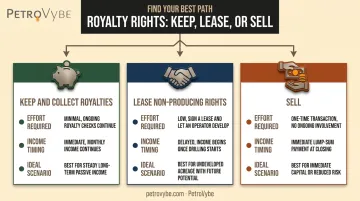
Once ownership is documented and value is understood, heirs generally face three paths.
Keep and collect royalties. This works well for actively producing, well-documented interests. It requires ongoing attention to division orders, check stubs, and production volumes, but no upfront capital or major decisions.
Lease non-producing rights. If minerals are undeveloped but sit near active drilling, leasing to an operator can generate an upfront bonus payment plus future royalty potential, without giving up ownership.
Sell. This makes sense when the management burden outweighs the income, when multiple heirs can't agree on next steps, or when converting an illiquid, fractional asset into usable capital serves the family better than holding it.
For heirs who sell and face a lump-sum capital gain, or who already carry a heavy W-2 tax burden, reinvesting proceeds into a private Texas natural gas development program is one option worth understanding. PetroVybe, for example, operates development projects across roughly 58,000 acres in the South Texas and Gulf Coast Basin, including Lavaca County, combining legacy production with new drilling.
The company's structure passes through Intangible Drilling Cost (IDC) deductions (historically 60-80% of invested capital, with some partner cohorts reporting deductions in the 90%+ range) against active income, including W-2 earnings and capital gains.
A few realities to weigh before going this route:
- Minimum investment is $100,000, and accredited investor status is required.
- The hold period before a first distribution typically runs 2-3 years, unlike a lease bonus that can arrive within weeks.
- Returns are forward-looking projections, not guarantees, and depend on commodity prices and drilling outcomes.
This approach redeploys inherited mineral wealth into a comparable asset class, tangible energy production, with a different tax profile. It's not a fit for every heir, particularly those needing near-term income or lacking the liquidity threshold.
Whichever path a family chooses, coordination among heirs often determines how smoothly it plays out. For families with multiple heirs sharing a fractional interest, forming an LLC or family trust can simplify decision-making and preserve negotiating leverage with operators or buyers, rather than each heir fielding separate offers.
Frequently Asked Questions
How are mineral rights inherited in Texas?
Mineral rights pass via a valid will or Texas intestate succession law when no will exists. Either path requires probate or an affidavit of heirship to legally document the transfer to heirs.
How do you transfer inherited mineral rights in Texas?
Gather the death certificate, will, and existing deeds, then complete the appropriate probate pathway. Record the transfer with the county clerk in each relevant county and notify the operator to update division orders.
Who owns the mineral rights to my property in Texas?
Surface and mineral ownership can be severed, so owning the surface doesn't guarantee mineral ownership. A title search or deed review is the only reliable way to confirm who holds the minerals.
How much are inherited mineral rights in Texas worth?
Value depends on production status, location, commodity prices, and decline stage. Skip generic per-acre estimates and get a professional appraisal instead.
Do I have to pay taxes on inherited mineral rights in Texas?
Inherited minerals receive a stepped-up basis at death. Ongoing royalty income is subject to federal tax but may qualify for a depletion deduction. Consult a CPA familiar with oil and gas assets for specifics.
What happens if a previous owner's estate was never probated?
An unprobated ancestor's estate creates a gap in the title chain. This gap must be cleared, often through an affidavit of heirship or delayed probate, before operators will release payments.