
But a royalty check that shows up in the mailbox looks simpler than it actually is. The real economics behind mineral rights depend on ownership type, lease language, commodity prices, and tax rules that behave nothing like a stock dividend or a rental property check. This guide breaks down what mineral rights are, how the income actually gets built, the benefits and risks worth weighing, and how direct development participation offers accredited investors a different structure entirely.
Key Takeaways
- Mineral rights are real property, separate from the surface, granting a perpetual claim to subsurface resources.
- Income comes from lease bonuses and royalties, calculated by your ownership decimal, not a flat payout.
- Value hinges on basin quality, lease terms, and title clarity, not last quarter's check size.
- Royalty income often qualifies for percentage depletion but stays classified as portfolio income for taxes.
- Direct participation in gas development can offer deeper tax deductions against active income for the right investors.
What Are Mineral Rights?
Mineral rights are ownership of the subsurface estate, meaning the oil, gas, natural gas liquids (NGLs), and other minerals beneath a piece of land. In the United States, this ownership can be entirely separate from who owns the surface, a legal arrangement known as a split estate.
One party can farm the land while another owns everything underneath it. The mineral owner (or their lessee) generally has the right to reasonable surface access to extract those resources, according to Montana State University Extension.
Owning the mineral estate hands you a bundle of rights. Owners can:
- Explore and develop the resource
- Lease minerals to an operator
- Collect bonus and royalty payments
- Sell or convey the interest to another party
Unlike a lease, which expires, mineral ownership is perpetual by default. That distinction matters enormously during a purchase. Buyers need to confirm through title research whether they're acquiring true perpetual ownership or a time-limited interest dressed up to look similar.
Types of Mineral and Royalty Interests
Not all subsurface interests function the same way. Mixing them up is one of the most common (and costly) mistakes new investors make.
| Interest Type | What It Includes | Cost Exposure | Duration |
|---|---|---|---|
| Mineral Interest (MI) | Full subsurface ownership plus the executive right to sign leases | None | Perpetual |
| Royalty Interest (RI) | Share of production revenue only | None | Ends when the lease ends, unless minerals are also owned |
| Overriding Royalty Interest (ORRI) | Revenue share carved from a working interest | None | Tied to the specific lease that created it |
| Working Interest (WI) | Share of revenue and drilling/operating costs | Full cost exposure | Follows the operating agreement |
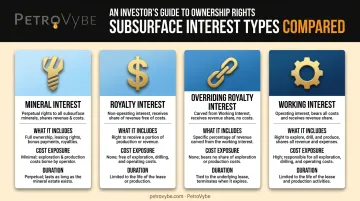
A mineral interest owner can negotiate leases and collect payments indefinitely. A royalty interest owner just collects a revenue share, with zero say in operations, per legal guidance from Cornell Law School's Legal Information Institute.
Working interest owners take on the most risk and the most potential reward, since they're on the hook for drilling and operating costs alongside the revenue.
How Mineral Rights Generate Passive Income
Mineral owners typically see money from three sources:
- Lease bonus payments: an upfront, one-time payment for signing a lease with an operator
- Production royalties: an ongoing share of revenue once a well produces, based on your lease terms
- Delay rentals: smaller payments made to hold an undrilled lease before production begins
Royalty rates vary more than most people assume. According to Texas A&M AgriLife research on Texas and Oklahoma leasing, 18.75% has become fairly common, while 12.5%–16.67% still shows up for marginal or exploratory wells.
Rates above 20% are possible when leasing demand runs high. There's no single "standard" rate. It's negotiated, and it depends on basin quality and bargaining leverage.
The Royalty Math
A simplified formula shows how a check gets built:
Gross Revenue × Royalty Rate × Ownership Decimal = Gross Royalty (before deductions)
That "before deductions" part matters. Many leases allow operators to subtract post-production costs, such as gathering, transportation, and processing, before the check reaches you. Two owners with identical royalty rates on similar acreage can receive very different net amounts depending on how that clause was written.
Why Early Checks Are Misleading
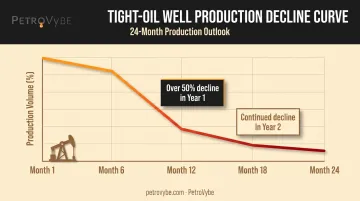
New owners often assume their first royalty check represents a steady, ongoing baseline. It usually doesn't. Unconventional horizontal wells decline fast.
Research published by the Society of Petroleum Engineers found that prolific U.S. tight-oil wells commonly decline more than 50% in their first year of production, with another notable drop in year two. A big first check is not a forecast.
Tax treatment adds another layer. Royalty income can qualify for a percentage depletion deduction, generally set at 15% of qualifying gross income for independent producers and royalty owners under IRC Section 613A.
However, that deduction only reduces the royalty income itself. The IRS classifies royalty income as portfolio income, meaning it cannot offset your W-2 wages or capital gains elsewhere.
Benefits and Risks: Is Investing in Mineral Rights a Good Idea?
Mineral rights sit in an odd middle ground between real estate and commodities exposure. The upside is real, but so are the trade-offs.
Potential Benefits
- Tangible diversification: mineral value doesn't move in lockstep with stock or bond cycles
- Genuine passivity: once a well produces, owners bear no drilling costs or operating liability
- Long-term upside: additional wells, new formations, or stronger commodity prices can all increase value without any added investment
Key Risks to Weigh
Royalty income is directly exposed to commodity price swings, and those swings can be dramatic. The EIA reported that the 2024 Henry Hub natural gas annual average price fell 68% versus 2022, the largest two-year drop since 2001, before prices rebounded 56% in 2025. That kind of volatility flows straight into a royalty check.
Other risks worth flagging:
- Operator dependence: owners can't force a company to drill, maintain, or keep producing a well
- Title complexity: mineral chains of title often span generations of heirship and conveyances, which can delay payment for months
- Illiquidity: mineral rights aren't publicly traded; selling can take time and may require a discounted price to attract a buyer
- Deduction risk: unfavorable post-production cost clauses can shrink net checks compared with a stronger lease on similar acreage
None of these risks are dealbreakers on their own. But together, they explain why mineral rights reward careful due diligence far more than they reward optimism.
Mineral Rights vs. Direct Development Participation
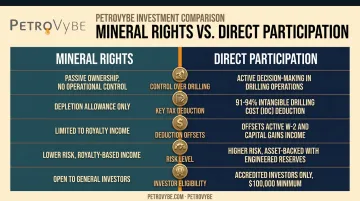
Mineral and royalty ownership is inherently passive. You collect what the lease allows, but you have zero say in whether or when an operator drills. Direct participation in a development project works differently. Instead of just owning the resource, investors take a stake in the actual drilling and production economics of a project.
The tax mechanics diverge sharply, too. Percentage depletion, the deduction available to royalty owners, only offsets the royalty income itself and stays classified as portfolio income.
Intangible Drilling Cost (IDC) deductions, available to working-interest participants, work differently. The IRS allows qualifying IDCs, covering labor, fuel, and supplies incident to drilling, to be expensed against active income, including W-2 earnings and capital gains, according to IRS Publication 925 guidance on working interests.
| Factor | Mineral Rights | Direct Participation |
|---|---|---|
| Control over drilling | None | Direct stake in project decisions |
| Key tax deduction | Percentage depletion | Intangible Drilling Costs (IDC) |
| Deduction offsets | Royalty income only | Active income, including W-2 and capital gains |
| Risk level | Passive, low operational risk | Higher, tied to drilling and production outcomes |
| Investor eligibility | Open to most investors | Accredited investors only |
This is the structure PetroVybe operates in. The Texas-based natural gas development company gives accredited investors direct positions in early-stage projects across South Texas and the Gulf Coast Basin.
Its flagship PetroVybe ONE project spans roughly 58,000 acres in Lavaca County, with around 400 acquired wells and more than 57 planned new wells. The company's leadership blends operational, geological, and financial backgrounds:
- Peter A. Snell (CEO) led a 5x year-over-year EBITDAX increase during a prior oil and gas turnaround
- Blaine Yeary (COO) scaled a $5 billion asset from zero to 35,000 BOEPD over eight years
- Clayton Riddle (CFO) grew EBITDA 900% at a previous company as both a petroleum engineer and financial strategist
- Michael Stamatedes (Chief Geophysicist) brings a 48-year track record with a 75.2% well-location success rate, against an industry average below 40%
PetroVybe's structure is built around IDC deductions, with partners in its 2024 and 2025 program years receiving 94% and 91% tax deductions, respectively, against active income. The company targets a 10-year MOIC of roughly 2.2x to 5.8x, alongside a projected 26% IRR, backed by a $48 million third-party PV-09 reserves valuation and a clean 2025 independent audit.
This isn't a replacement for mineral rights ownership. It's a different risk and tax profile entirely. Mineral rights offer perpetual, hands-off ownership with modest tax leverage.
Direct participation offers greater tax leverage and production upside, along with the added risk of drilling and operating exposure. It's also limited to accredited investors with a minimum liquidity commitment, typically $100,000 at PetroVybe. Which one fits depends on your goals, your tax situation, and how much complexity you're willing to take on.
How to Start Investing in Mineral Rights: Due Diligence Essentials
Before writing a check, get clear on structure. Mineral rights ownership follows two main paths:
- Direct ownership, sourced through auctions, brokers, or private sellers
- Pooled funds or partnerships, which often restrict access to accredited investors
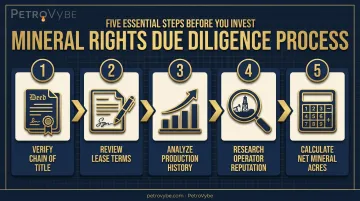
Whichever path you choose, build a due diligence checklist:
- Verify the chain of title to confirm clean, undisputed ownership
- Review lease terms closely, especially post-production deduction language
- Analyze production history and decline curves for the specific well or basin
- Research operator reputation and track record on nearby wells
- Calculate net mineral or royalty acres to understand your true ownership decimal
Don't go it alone. A landman or mineral title attorney should verify ownership before you close, and a CPA can walk through whether percentage depletion or an IDC-based structure better fits your tax situation. The upfront cost of professional support is small compared with the cost of buying into a clouded title or an unfavorable lease.
Frequently Asked Questions
How can I invest in mineral rights?
Investors typically buy direct-title interests through auctions, brokers, or private sellers, or gain exposure through a fund or partnership structure. Larger deals often require accredited investor status.
How much money can you make from mineral rights?
Returns depend on royalty rate, ownership decimal, production volume, and commodity prices. Income typically declines as wells age, so investors shouldn't count on a fixed return.
Is investing in mineral rights a good idea?
It can suit investors seeking passive, tangible-asset diversification. Commodity swings, title complexity, and illiquidity mean it isn't the right fit for every investor or every dollar.
What is the difference between mineral rights and a royalty interest?
Mineral rights are perpetual ownership, including the right to lease. A royalty interest is a revenue-sharing right created by that lease, and it ends when the lease ends.
Are mineral rights and royalty payments taxable?
Yes, royalty income is generally taxable, and you report it on Schedule E. Percentage depletion deductions may apply, subject to IRS limits, so consult a tax professional for your situation.
Is there an alternative to buying mineral rights for investors who want bigger tax deductions?
Yes. Direct participation in natural gas development projects, such as those offered by PetroVybe, can provide IDC deductions against active income in addition to passive royalty-style economics.