
Here's the good news: yes, you can defer capital gains tax, and in some cases reduce it substantially, through several IRS-sanctioned strategies. This guide walks through reinvestment-based deferrals, timing strategies, and a lesser-known option: direct investment in oil and gas development, which offers deductions against active income rather than just delayed tax.
Key Takeaways
- IRS-sanctioned tools—1031 exchanges, Opportunity Zone funds, and installment sales—can legally defer capital gains tax
- Deferred tax is usually still due later, unless assets receive a step-up in basis at death
- Real estate-only strategies differ from options that work across stocks, businesses, and other assets
- Holding periods, eligibility rules, and timing windows differ by strategy—and mistakes can void the deferral
- High-income earners often stack compatible strategies to improve after-tax results
Can You Defer Capital Gains Tax? Understanding the Basics
Selling an appreciated asset can trigger a steep tax bill—often 15–20% federal, plus state tax on the full gain.
Capital gains tax applies when you sell for more than your basis (what you paid, adjusted for improvements or depreciation). Rates hinge on two things: how long you held the asset and your income level.
For 2025, long-term federal capital gains rates (assets held over one year) break down like this:
| Filing Status | 0% Rate | 15% Rate | 20% Rate |
|---|---|---|---|
| Single | Up to $48,350 | $48,351–$533,400 | Above $533,400 |
| Married Filing Jointly | Up to $96,700 | $96,701–$600,050 | Above $600,050 |

On top of that, the 3.8% Net Investment Income Tax applies once income crosses $250,000 for married joint filers or $200,000 for single filers. Short-term gains (held under a year) are taxed as ordinary income, which can push rates even higher.
Three terms get confused constantly:
- Avoiding tax means the transaction is structured so gain never gets recognized.
- Deferring tax means the gain is recognized later, not eliminated.
- Eliminating tax generally only happens through a step-up in basis at death.
State taxes compound the problem. California taxes capital gains as ordinary income (up to 12.3%, plus a 1% surcharge above $1 million), while Texas has no state income tax at all. A $1 million gain could face a dramatically different total bill depending purely on zip code.
How Can I Defer the Payment of Capital Gains Tax?
At a glance, the primary deferral strategies include:
- 1031 exchange: swap investment real estate for like-kind property
- Opportunity Zone Fund: reinvest gains from any asset into designated development zones
- Installment sale: spread payments (and tax) over multiple years
- Deferred Sales Trust: a private variation on the installment method
- Retirement account rollovers: applicable in specific qualified-plan contexts
Each option has different eligibility rules, timelines, and trade-offs. The sections below break down how they work and when they fit.
Top Strategies to Defer Capital Gains Tax on Real Estate
The 1031 Exchange
A 1031 exchange lets you sell investment property and reinvest proceeds into "like-kind" property, deferring both the capital gains hit and depreciation recapture. The catch is timing:
- Identify replacement property within 45 days of closing on the sale
- Close on the new property within 180 days — these clocks run concurrently and cannot be extended for any reason

Miss either deadline and the entire gain becomes taxable immediately.
Passive Alternatives: DSTs and 721 UPREITs
Tired of managing tenants? Two structures let you stay inside a 1031 exchange without direct property management:
- Delaware Statutory Trust (DST): A trust vehicle where you own a fractional interest in institutional-grade property, qualifying as replacement property under IRS Revenue Procedure 2002-22
- 721 UPREIT Exchange: You contribute property to a REIT's operating partnership in exchange for units, deferring gain while gaining REIT-style liquidity down the road
Opportunity Zone Funds
Unlike 1031 exchanges, Opportunity Zone Funds work with capital gains from any asset type — stocks, business sales, crypto, not just real estate. You reinvest the gain into a Qualified Opportunity Fund that develops designated low-income areas.
Under the One Big Beautiful Bill Act, the program is becoming permanent starting in 2027, shifting to a rolling 5-year deferral with a 10% basis step-up (30% for Qualified Rural Opportunity Funds).
Installment Sales and Deferred Sales Trusts
An installment sale spreads the sale price and the tax liability across multiple years instead of one lump sum. A Deferred Sales Trust is a private structure built on that same IRS installment method. The IRS has scrutinized aggressive versions where the seller never truly transfers ownership risk.
Step-Up in Basis at Death
When heirs inherit appreciated assets, basis resets to fair market value at death. Gains built up during your lifetime are eliminated for income-tax purposes, which is why many long-term holders treat step-up as their final deferral outcome.
Can I Defer Capital Gains Tax If I Reinvest the Money?
Not automatically. Reinvesting proceeds into a taxable brokerage account does nothing to defer your tax bill. Reinvesting proceeds into a taxable brokerage account does nothing to defer your tax bill. The IRS requires a specific qualifying structure.
What actually defers tax:
- 1031 exchange (real estate only)
- Opportunity Zone Fund investment (any asset type)
- Section 351 exchange (concentrated stock diversification)
For stock-heavy investors, a Section 351 exchange lets you contribute appreciated shares to a corporation or exchange fund alongside other investors. You receive diversified holdings without triggering gain. Treasury has flagged concerns about certain ETF-style versions of this strategy in recent years.
A Lesser-Known Strategy: Deferring Gains Through Oil & Gas Development Investment
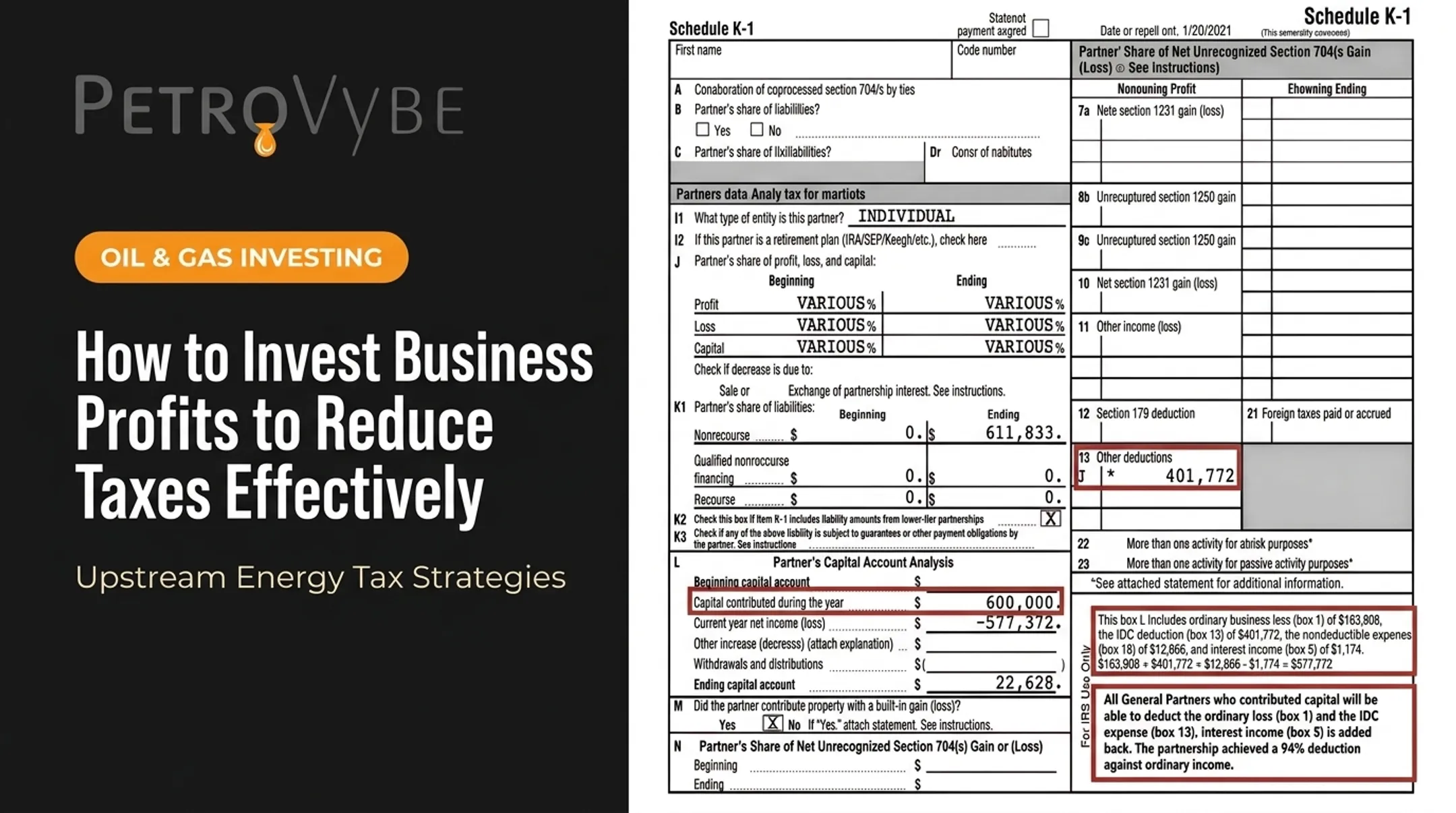
Most deferral strategies only push your tax bill down the road. Direct participation in oil and gas drilling can do more: a large first-year deduction that offsets a gain in the same year.
How the deduction works
Intangible Drilling Costs (IDCs)—labor, site prep, drilling fluids, and other costs with no salvage value—are deductible under IRC Section 263(c).
Working interests held directly are also exempt from the passive activity rules under Section 469(c)(3)(A). That means IDC deductions can offset active income, including W-2 wages and capital gains, not only passive rental-style income like most real estate write-offs.
Industry literature typically pegs IDC deductions at 60–80% of invested capital in a new drilling program.
A real-world structure
PetroVybe is a private natural gas development company operating roughly 400 wells across 58,000 acres in Lavaca County within the Gulf Coast Basin. It offers accredited investors direct participation structured around these rules.
Partners received a 91% deduction in 2024 and 94% in 2025 against active income. Those results are backed by a $48 million third-party engineered reserve valuation (PV-09) and a clean 2025 independent audit.

This route is built for a narrow investor profile:
- Accredited investors (verified net worth over $1 million, or income thresholds met)
- Investors with $100,000+ in liquidity
- Those diversifying beyond stocks, bonds, and real estate
Speak with a qualified tax professional before pursuing this path. Deduction percentages vary by project, deductions may be spread over five years instead of taken upfront, and oil and gas investments carry real operational and market risk.
How Long Can You Delay Capital Gains Tax?
How long you can push capital gains tax depends on the strategy:
- 1031 exchanges ("swap till you drop"): Continuous exchanges can defer tax indefinitely. Each new property resets the clock. Only a cash sale or death (with a basis step-up) ends the chain.
- Opportunity Zone Funds: Under the OBBBA tax changes, investments made from 2027 onward get a rolling 5-year deferral, not a fixed calendar end date.

What Is the 6-Year Rule for Capital Gains Tax?
Search results sometimes mention a "6-year rule," but that label is not a U.S. federal deferral clock. It most often points to Australia's main-residence exemption, which can keep a former home exempt from capital gains tax for up to six years after you move out if it is rented.
The closest U.S. concept is Section 121's two-out-of-five-year ownership-and-use test for primary residence exclusions. If someone cites a "6-year rule," confirm which country's tax code they mean before treating it as advice that applies to you.
Working with a Tax Professional Before You Sell
The right deferral strategy depends on your asset type, timeline, and goals. Before finalizing any sale, work through these questions with a CPA or tax strategist:
- Do you want to remain a real estate owner (favoring 1031) or exit property management (favoring DST/UPREIT)?
- Is your gain tied to real estate specifically, or could it come from stock, a business sale, or another asset (opening the door to Opportunity Zone Funds or IDC deductions)?
- Do you want deferral, or a current-year deduction against active income?
If you're weighing natural gas development as a diversification and tax-planning tool, timing matters. Aligning an IDC-driven deduction with the tax year of your capital gains event can offset a meaningful share of the liability. PetroVybe helps accredited investors evaluate that timing against their sale, but always run the numbers with your own tax advisor first.
Frequently Asked Questions
How can I defer the payment of capital gains tax?
The main IRS-sanctioned vehicles include 1031 exchanges (real estate), Opportunity Zone Funds (any asset), installment sales, and Deferred Sales Trusts. The right choice depends on your asset type and goals.
Can I defer capital gains tax if I reinvest the money?
Not automatically. Reinvesting into a regular brokerage account doesn't defer anything — you need a qualifying structure like a 1031 exchange, Opportunity Zone Fund, or Section 351 exchange.
How long can you delay capital gains tax?
With repeated 1031 exchanges, deferral can continue indefinitely until you sell for cash outright or pass the assets to heirs, who receive a stepped-up basis.
What is the 6-year rule for capital gains tax?
This is generally an Australian tax concept related to former primary residences, not a U.S. federal rule. Confirm with a tax advisor before assuming it applies to your situation.
Is it better to defer or just pay capital gains tax now?
It depends on your tax bracket, cash flow needs, and long-term plans. Paying now is sometimes simpler and avoids the complexity and constraints that come with deferral structures.
Can capital losses offset capital gains to reduce my tax bill?
Yes, through tax-loss harvesting. Losses offset gains dollar-for-dollar, and up to $3,000 of excess loss can offset ordinary income annually, with the rest carried forward indefinitely.