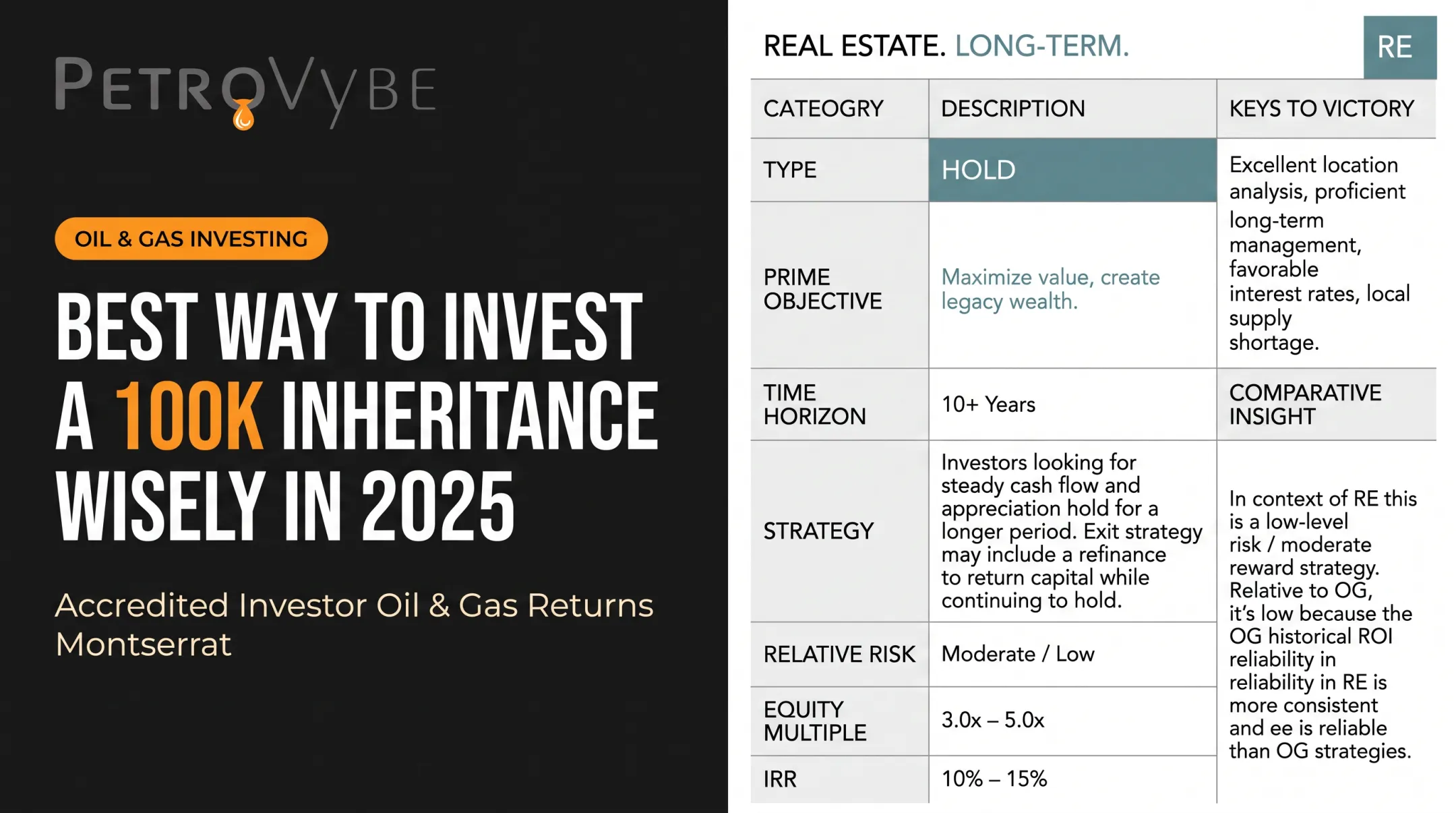
Many investors struggle with a simple question: where does $100k actually go the farthest right now? The answer isn't one asset. It's a plan that spans public markets, tax-advantaged accounts, and increasingly, private alternatives that most portfolios never touch.
This guide walks through the top vehicles for deploying $100k in 2026, the questions you need to answer before you invest a dollar, and why tax-advantaged alternatives like natural gas development are drawing serious attention from high-income earners.
Key Takeaways
- Your ideal $100k strategy hinges on time horizon, risk tolerance, and tax bracket
- Diversify across stocks, real estate, cash, and alternatives to limit downside without capping growth
- High earners with $100k+ liquidity can use tax-advantaged energy investments for deductions against active income
- Emergency savings and high-interest debt come before any investment decision
Questions to Ask Before Investing $100k
Before you deploy a single dollar, run through these checkpoints:
- Is your emergency fund funded? Keep three to six months of expenses in a high-yield savings account, not a checking account earning nothing.
- Do you carry high-interest debt? Paying off a credit card near 20% APY is a guaranteed return that beats almost any market return.
- What's your time horizon? Retirement 25 years out calls for a different mix than a home purchase in three years.
- What's your tax situation? W2 earners and business owners with significant income often need investments that create deductions against active earnings—not only passive income.
Clear answers here keep your $100k allocated to growth instead of plugging avoidable cash-flow or tax gaps later.
Best Ways to Invest $100,000 in 2026
Stocks, Index Funds & ETFs
Low-cost index funds remain the backbone of long-term growth. Fidelity reports the S&P 500 has averaged roughly 10.6% annually since its 1957 launch, with an 11.5% average over the 40 years through December 2025.
Fees matter more than most investors realize. Morningstar's fee study found broad index funds averaging 0.09%, compared to 1.00% for the average active equity fund. On a $100,000 investment compounding at 10% over 30 years, that fee gap translates to roughly $419,000 in lost growth. Run your own numbers through a fee calculator before choosing a fund.

Tax-Advantaged Retirement Accounts
Maxing out a Roth IRA or 401(k) lets your money compound without an annual tax drag. For 2026, the IRA contribution limit rises to $7,500, and the 401(k) elective deferral limit climbs to $24,500.
High earners above the Roth IRA income phaseout ($242,000–$252,000 for married couples filing jointly) can still get in through a backdoor Roth conversion. The math on tax-advantaged compounding is compelling: $100,000 growing at 8% in a tax-sheltered account versus a comparable taxable account with a 1% annual tax drag reaches roughly $1,006,266 versus $761,226 after 30 years.

Real Estate & REITs
Publicly traded REITs offer real estate exposure without the headaches of being a landlord. Equity REITs currently yield around 3.7%–4.0% in dividend income, according to Nareit data—useful income ballast between stocks and bonds.
For a $100k long-term plan, REITs usually work best as a diversifier, not the core growth engine.
High-Yield Savings, CDs & Bonds
This is the ballast of your portfolio: money you need liquid and protected, not growing aggressively. Current benchmarks:
- High-yield savings: top rates around 4.2%–5.8%, national average closer to 0.4%
- CDs: roughly 4.2%–4.9% depending on term length
- I Bonds: 4.26% composite rate through October 2026
- Treasury yields: 3.9%–5.2% across the curve
Keep this sleeve sized to near-term cash needs and reserves. It will not drive long-term growth, but it protects capital and funding flexibility.
Private Alternative Assets (Natural Gas Development)
Accredited investors are increasingly carving out a slice of $100k+ portfolios for private alternatives: private credit, private equity, and direct energy development. KKR's 2025 RIA survey found the share of advisors planning to increase private-equity allocations jumped from 45% to 74% in a single year.
One reason is power demand. AI infrastructure needs electricity, and natural gas is filling much of the gap. The IEA projects data center electricity demand growing from 460 TWh in 2024 to over 1,000 TWh by 2030, with natural gas already supplying over 40% of U.S. data center electricity.
For accredited investors who want direct energy exposure, PetroVybe offers early-stage natural gas development in Texas' Gulf Coast Basin, backed by:
- ~400 acquired wells plus 57+ planned new wells across 58,000 acres in Lavaca County
- A $48 million PV-09 reserve valuation from an independent engineering firm
- A clean 2025 audit performed by Weaver
- Targeted 2.2x–5.8x MOIC and roughly 26% IRR over a 10-year hold

Tax treatment is a major differentiator versus most real estate. Intangible drilling cost (IDC) deductions can offset a large share of active income, including W-2 wages and capital gains—not only passive income. PetroVybe partners saw 91% deductions in 2024 and 94% in 2025 against active income.
Why Tax Efficiency Changes the Math on $100k
Here's a concrete example. Say a high earner invests $100,000 and receives an approximate 70% first-year deduction against active income.
If that investor is in a combined 37% federal and state bracket, a $70,000 deduction reduces their tax bill by roughly $25,900 in year one alone. That's cash back in the investor's pocket before the underlying asset has even produced a barrel.
Compare this to real estate depreciation. Under IRS Section 469 rules, depreciation typically only offsets passive income (with a limited $25,000 special allowance for active participants). Most W-2 earners can't apply that depreciation against their salary.
IDC deductions work differently. IRS Publication 535 confirms drilling costs tied to a working interest are treated as nonpassive, so they can offset active earnings directly.
That said, private, illiquid investments like natural gas development come with real risk:
- Capital is locked up for a multi-year hold period (often a decade)
- Projections like MOIC and IRR are forecasts, not guarantees
- Only accredited investors qualify under SEC rules
- These should represent a portion of a diversified $100k plan, not the whole thing
Building Your Diversified $100k Allocation
There's no universal formula, but a moderate-risk framework for a $100k portfolio might look like this:
| Category | Allocation | Purpose |
|---|---|---|
| Index funds/ETFs | 40% | Core long-term growth |
| Retirement accounts | 25% | Tax-advantaged compounding |
| Cash/CDs/bonds | 15% | Liquidity and stability |
| REITs | 10% | Income and diversification |
| Private alternatives | 10% | Tax efficiency, uncorrelated growth |

No single category should dominate. Revisit this mix annually. If natural gas allocations outperform and swell to 20% of the portfolio, rebalance back toward your target. Markets and goals change, and your allocation should change with them.
Frequently Asked Questions
Where should I put $100k in 2026?
Spread it across index funds, tax-advantaged retirement accounts, a cash reserve for stability, and select alternative assets. The right mix depends on your risk tolerance and tax situation.
How much interest can $100k earn per year?
Returns vary by vehicle: about 4% in high-yield savings and a historical 8–10%+ average in stocks. Private alternatives like energy development can offer higher potential with higher risk.
Is $100k enough to qualify as an accredited investor?
Accredited investor status depends on income or net worth thresholds, not investment size. Individuals typically need over $1 million net worth (excluding primary residence) or $200,000+ in annual income. $100k is a common minimum check size for many private placements.
How can I reduce taxes while investing $100k?
Roth accounts and HSAs shelter growth from future taxes. For high earners, IDC deductions through natural gas development can offset active income directly—rare among passive investments.
What is the safest way to invest $100k?
High-yield savings accounts, CDs, and government bonds or I Bonds carry the lowest risk, but also the lowest growth potential compared to stocks or alternatives.
How long does it take to turn $100k into $1 million?
It depends on your rate of return and any additional contributions. At a 10% average annual return with no added contributions, $100k alone would take roughly 24-25 years to reach $1 million.