
This article is general education, not investment, tax, or legal advice. Leasehold costs are the price of admission in oil and gas investing. They're the expenses tied to acquiring and holding the legal right to drill on a piece of acreage, and they shape everything from your upfront capital outlay to how much of your investment you can deduct against ordinary income. This treatment requires the investor to elect general partner status in the Subscription Agreement and may be limited in a given year by the excess business loss limitation under IRC §461(l).
These costs aren't uniform. A lease in a proven Permian tract can run wildly different numbers than one in an emerging Gulf Coast basin, depending on acreage location, bonus payments, lease terms, and how messy the title work turns out to be.
This article breaks down typical leasehold cost ranges, the factors that drive them, how cost depletion and percentage depletion actually work, and what investors should check before committing capital.
Key Takeaways
- Leasehold costs bundle bonus payments, legal/title fees, broker commissions, and G&G costs into one acquisition package.
- Per-acre bonuses can swing more than 100-fold in the same county, so basin-wide averages are nearly meaningless.
- IRS rules allow cost depletion or percentage depletion—pick the method that fits each production stage.
- Dry holes can unlock immediate IDC write-offs; that treatment does not extend to the full leasehold.
How Much Do Leasehold Costs Run? (Pricing Overview)
There's no fixed sticker price for a leasehold. Costs swing based on lease negotiation, acreage desirability, and regional bonus rates that can vary dramatically even within a single county.
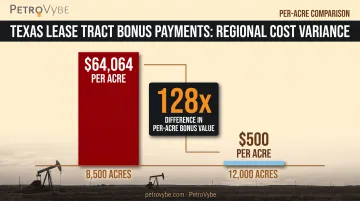
Consider this: a 2024 Texas General Land Office tabulation showed one 40-acre Reeves County tract drawing a high bid of $64,064 per acre, while a 17.4-acre Webb County tract in the same document drew just $500 per acre. That's roughly a 128-fold difference within the same tabulation of bids.
What goes wrong when investors misjudge leasehold costs:
- Underestimating legal and title verification expenses
- Ignoring the amortization schedule on G&G costs
- Missing eligibility rules for percentage depletion entirely
Typical Cost Range
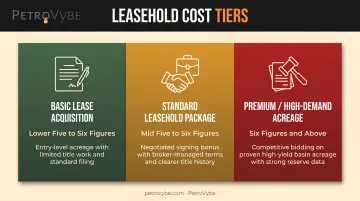
Broad tiers investors tend to encounter:
- Basic lease acquisition (lower five to six figures per lease): Modest bonus and minimal title work. Fits smaller working-interest positions or early-stage exploratory acreage where the formation isn't proven yet.
- Standard leasehold package (mid five to six figures): Negotiated bonus, full title verification, and broker commission. Common in established areas like East Texas or the Gulf Coast, where production history justifies fuller diligence.
- Premium / high-demand acreage (six figures and up): Competitive bonuses, extensive G&G, and complex legal work. Aimed at proven, high-yield reserves where multiple operators bid on the same tract.
These figures typically cover the bonus payment, legal fees, and broker commissions. They exclude drilling, completion, and ongoing operating costs, which come later and separately.
Matching the tier to your risk tolerance and the acreage's production history keeps leasehold spend from quietly eroding returns before the first well is drilled.
Key Factors That Affect Leasehold Costs
Leasehold pricing hinges on land value, regulatory environment, and production potential. Six factors drive most of the spread between cheap acreage and premium tracts.
Cost drivers at a glance:
- Basin quality and county-level competition
- Primary term length and renewal language
- Title clarity and ownership fragmentation
- Geological and geophysical (G&G) spend
- Broker and negotiation fees
- Producing vs. dry-hole outcome
Location and Basin Quality
Proven basins with strong production history command higher bonus payments than unproven acreage. But "proven basin" doesn't mean uniform pricing.
North Dakota Trust Lands February 2025 auction results show how wide county-level spreads can run inside one core area:
| County | Bonus range (per acre) |
|---|---|
| Williams | $1,112 – $30,098 |
| Dunn | $224 – $351 |
| Burke | $22 – $66 |
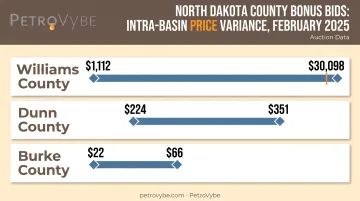
Basin labels explain only part of the pricing story. Tract size, mineral interest conveyed, and bid competition matter just as much.
Lease Terms and Duration
Primary term length and renewal clauses directly affect upfront and long-term costs. A shorter primary term with weak renewal language can cut the bonus, but it also raises the risk of losing the lease before drilling begins.
Title and Legal Complexity
Disputed ownership, fragmented mineral rights, or unclear title history all drive up legal fees. Transfers involving deceased mineral owners, for example, often need a death certificate, proof of transfer, and a completed W-9 before the lease can close cleanly.
Geological and Geophysical (G&G) Costs
Seismic surveys and core sampling add real dollars to the leasehold total. Under IRC 167(h), domestic G&G expenditures are generally deducted ratably over a 24-month period beginning when the costs are paid or incurred. Even if the property is abandoned during that window, the remaining deduction doesn't accelerate—it stays on schedule.
Broker and Negotiation Fees
Commissions paid to professionals who secure favorable lease terms factor into the total leasehold price tag. These fees are one-time costs baked into the acquisition, not recurring charges.
Well Productivity Outcome
Whether a well produces or comes up dry changes both the tax treatment and the effective cost of the leasehold. A producing well lets you recover costs through depletion over years. A dry hole can open faster deduction paths—though not automatically for the entire lease basis.
Cost Breakdown of Leasehold Investments
Total leasehold cost extends well beyond the initial bonus check. Several one-time and amortized items build your full basis before a well produces.
| Cost Component | Timing | Description |
|---|---|---|
| Bonus payment to landowner | One-time | Upfront payment to secure exclusive drilling rights |
| Legal and title verification fees | One-time | Confirms clear ownership and resolves disputes before drilling |
| Broker commissions | One-time | Fees paid to professionals negotiating lease terms |
| G&G (geological and geophysical) costs | Amortized over 24 months | Pre-drilling seismic and core sampling expenses |
How those items typically land:
- Bonus, legal, and broker fees usually capitalize into leasehold basis
- G&G costs often amortize over 24 months instead of expensing up front
- Depletion later recovers basis against income once production starts
Each line item behaves differently at tax time. Lumping them into one “leasehold cost” figure can mislead you on real basis and when deductions actually show up.
Cost Depletion vs Percentage Depletion — What's the Difference?
The IRS recognizes two methods for recovering leasehold costs against income, and they work in different ways.
| Factor | Cost Depletion | Percentage Depletion |
|---|---|---|
| Calculation | Allocates leasehold cost proportionally to reserves extracted each year | Deducts a fixed 15% of gross income from the well |
| Best Use Case | Early production years when extraction exceeds 15% of gross income | Later years or when income-based deductions exceed remaining basis |
| Eligibility | Available to most working-interest owners regardless of size | Subject to production limits and IRC 613A income caps; excludes large integrated companies |
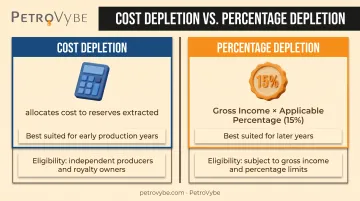
Important nuance: percentage depletion isn't automatic. Qualifying independent producers and royalty owners can generally deduct 15% of gross income from the property.
Under IRC 613A, that deduction is capped at 100% of taxable income from the property and 65% of the taxpayer's overall taxable income. Disallowed amounts carry forward.
Switching methods across a well's life can change total deductions. Early on, when production is high relative to remaining basis, cost depletion often wins. Later, as basis shrinks, percentage depletion usually produces the larger write-off.
PetroVybe supports accurate reporting with third-party engineering validation, including a $48 million PV-09 reserve valuation from a licensed firm—giving partners a defensible basis for depletion calculations. Prepared by Lee Keeling & Associates, Tulsa, March 2026.
What Most Investors Miss About Leasehold Costs
A few blind spots show up again and again among investors evaluating leasehold structures:
- Overlooking dry-hole write-offs. Certain intangible drilling costs on a nonproductive well may qualify for immediate deduction against ordinary income—only with a specific election, not as an automatic write-off of the full leasehold basis.
- Underestimating amortized G&G costs. These get spread over 24 months, so they don't hit your basis all at once. Skip this detail and your investment basis projection will be off.
- Ignoring depletion strategy alignment. Cost vs. percentage depletion should match your broader tax plan, not default to the sponsor’s choice.
- Not demanding itemized reporting. If a sponsor won’t break out bonus payments, legal fees, broker commissions, and G&G costs, you can’t verify basis or deduction eligibility. This treatment requires the investor to elect general partner status in the Subscription Agreement and may be limited in a given year by the excess business loss limitation under IRC §461(l).
Conclusion
Leasehold costs vary enormously by basin, lease terms, and eventual production outcome. A single per-acre number rarely tells the whole story, since county-level bids alone can differ by more than 100-fold.
What matters next is how those costs are recovered and whether the acreage can support real production:
- Cost depletion spreads basis against produced volumes over the life of the well
- Percentage depletion can allow a statutory share of gross income when you qualify
- Dry-hole treatment is narrow—most failed-well spend does not get special write-off treatment beyond normal capitalization rules
Judge any leasehold package on bonus plus terms, the depletion path you can actually use, and engineered recovery potential—not the headline per-acre figure alone.
Frequently Asked Questions
Can I deduct leasehold costs on my taxes?
Yes—leasehold costs are generally recovered over time through depletion, not as an immediate write-off. Related legal, title, and geological/geophysical (G&G) expenses may follow separate amortization schedules. Confirm treatment for your structure with a tax professional.
Who typically pays for leasehold costs?
In oil and gas leases, the investor or operating partner typically bears bonus payments, legal fees, and G&G costs. These get factored into the overall project's capital structure from the outset.
What is included in oil and gas leasehold costs?
Leasehold costs typically include bonus payments to landowners, legal and title verification fees, broker commissions, and geological/geophysical costs tied to securing drilling rights.
How does percentage depletion differ from cost depletion?
Cost depletion allocates leasehold basis proportionally to reserves extracted each year. Percentage depletion deducts roughly 15% of gross income from the property, subject to income-based caps and eligibility rules.
What happens to leasehold costs if a well turns out to be a dry hole?
Certain intangible drilling costs on a nonproductive well may be deducted as an ordinary loss under a specific election. This doesn't automatically apply to the full leasehold basis or G&G costs.
Are leasehold costs tax deductible for accredited investors?
Leasehold-related costs feed into depletion deductions, and combined with intangible drilling cost deductions, can offset a significant portion of active income for qualifying investors. PetroVybe partners, for example, saw deductions of 94% against active income in recent years. Prior result; not a promise of any future deduction. This treatment requires the investor to elect general partner status in the Subscription Agreement and may be limited in a given year by the excess business loss limitation under IRC §461(l).
Informational requests only. PetroVybe projects are offered solely to verified accredited investors. Submitting this form does not create an investment or advisory relationship.